
Don't Get Stuck at Captiva Beaches, Find Mobi‑Mat and Wheelchair Rentals

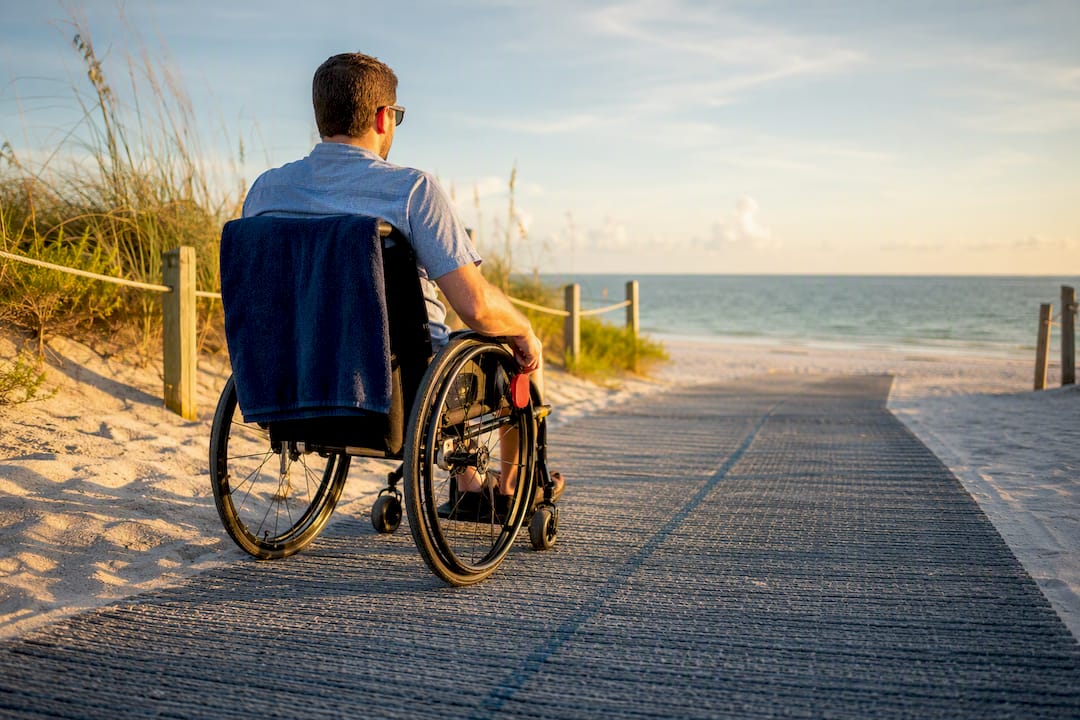
Alison Hagerup Beach Park, Turner Beach, and Andy Rosse Lane Park are Captiva’s three most accessible public beach access points, each with distinct strengths. Alison Hagerup offers a Mobi‑Mat and a portable ADA toilet, Turner Beach has ADA parking and accessible restrooms, and Andy Rosse gives you the shortest walk from the village, though parking there is limited. Arrive early, since lots fill by mid-morning, and plan ahead if you need a beach wheelchair, since most rentals come from vendors on neighboring Sanibel.
TL;DR:
Alison Hagerup Beach Park provides a Mobi‑Mat to the shoreline and portable ADA toilet, but its unpaved lot can complicate transfers from a manual wheelchair.
Turner Beach has ADA parking and accessible restrooms, yet the parking lot fills quickly, especially on weekends, and requires a meter or annual sticker.
Public beach equipment rentals are limited on Captiva, so most visitors must reserve and transport beach wheelchairs from vendors on Sanibel ahead of time.
During stormy weather or high tide, beach access features like Mobi‑Mats can become buried, twisted, or temporarily removed without real-time updates.
Booking a beachfront rental with private access minimizes parking and mobility issues but requires checking surface types, stairs, and nearby facilities before booking.
Table of Contents
Shortlist: Accessible Beaches on Captiva and What Each Provides
Detailed Accessibility Features and Known Limitations at Each Access Point
Mobility Equipment and Rentals: Getting a Beach Wheelchair to Captiva
How to Plan a Visit: Timing, Parking, Safety, and What to Pack
Official Park Pages and Accessibility Resources to Check Before You Go
Shortlist: Accessible Beaches on Captiva and What Each Provides
Every beach on this island sits on a barrier strip of sand that shifts with the tide, so “accessible” here means something a little different than it does on a mainland beach with a paved boardwalk. Still, three spots stand out for mobility support, and a fourth category, private resort beaches, deserves a mention even though it’s off-limits to the general public.
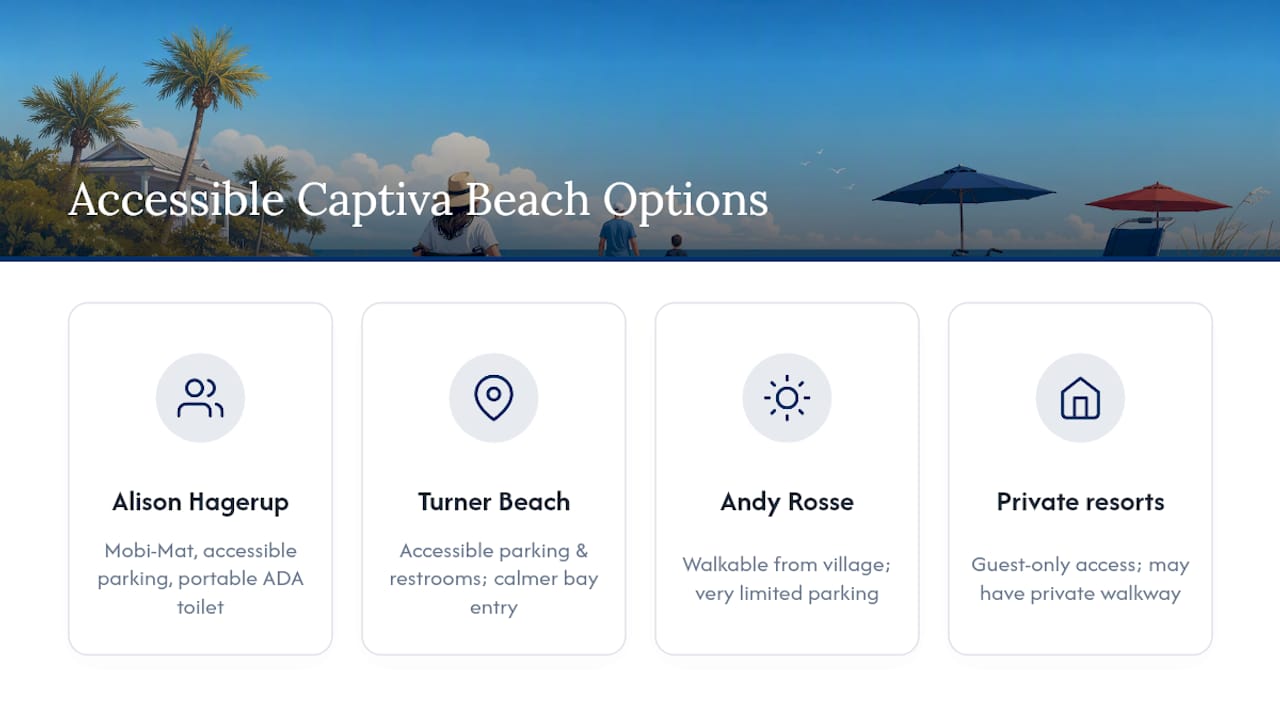
Alison Hagerup Beach Park is the most consistently equipped option for wheelchair users and anyone who struggles with loose sand. The park has a Mobi‑Mat that runs from the parking area to the shoreline, handicap-accessible parking spaces, and a portable ADA toilet on site. It’s a strong pick if you want the most direct path from car to sand without wrestling through soft dunes.
Turner Beach, at the northern tip near Blind Pass, pairs ADA-accessible parking with accessible restrooms, and the water here tends to be calmer on the bay side, which makes for an easier entry if you’re moving slowly or using a companion for support. It’s also one of the better spots for watching boats pass through the pass itself, if that’s part of the appeal for your group.
Andy Rosse Lane Park and the adjacent Captiva Beach public access point sit right at the edge of the village, so if you’re staying near the shops and restaurants, you can walk to sand in minutes. The tradeoff is parking. There’s very little of it, and what exists disappears fast on weekends. Andy Rosse works well for a sunset walk or a short visit, less well as a home base for a full beach day if you’re relying on a vehicle.
Private resort beaches exist up and down the island, but they’re reserved for guests of specific properties and aren’t part of the public shoreline network. If you’re renting a home with direct beach frontage, you may have a private walkway that bypasses the public access points entirely, which is worth factoring into your planning if mobility is a concern.
Detailed Accessibility Features and Known Limitations at Each Access Point
The difference between a beach that’s technically ADA-compliant and one that’s actually easy to use often comes down to details the brochures don’t emphasize. Here’s what to expect at each site once you’re standing in the parking lot.
At Alison Hagerup, the handicap-accessible parking spaces exist, but the lot itself is not paved. That matters if you’re transferring from a vehicle to a manual wheelchair, since loose gravel or packed sand handles differently than asphalt. Parking is metered, with short-stay and full-day pricing tiers, so decide before you arrive whether you’re popping in for an hour or settling in for the afternoon. The Mobi‑Mat gets you across the toughest stretch of sand, but it ends well before the waterline on most days, meaning the final few yards to the water are still soft sand.
Turner Beach runs about. Parking at Turner Beach is metered, with an hourly fee for parking, and the lot accepts annual beach parking stickers if you already have one from a longer stay on Sanibel or Lee County. The restrooms listed as accessible on the county page are a genuine asset here, since Andy Rosse and some smaller access points don’t offer permanent facilities. Local park information also flags something worth taking seriously: this lot fills quickly, and arriving after mid-morning on a weekend often means circling for a spot or giving up entirely.
Andy Rosse Lane Park and Captiva Beach offer limited paved parking, and during peak season the handful of spots go within the first hour or two of daylight. Some access points along this stretch have a portable toilet rather than a permanent restroom building, so don’t count on running water or a full facility if nature calls mid-visit.
Pro Tip: Call the park directly before you leave your rental. Mats get pulled after storms, tides shift the usable sand width by the hour, and a facility that was in place last month might be temporarily removed for maintenance.
Here’s a quick side-by-side of what you’re actually working with:
Alison Hagerup Beach Park: Mobi‑Mat to shoreline, unpaved handicap parking, portable ADA toilet, paid parking with tiered pricing.
Turner Beach: ADA parking, accessible restrooms, roughly $5/hour parking, annual sticker accepted.
Andy Rosse Lane Park: Limited paved parking, no permanent restroom at some points, closest walk to the village.
Shifting sand and storm-driven erosion are the two biggest wild cards. A Mobi‑Mat that worked perfectly during your last visit can end up buried, twisted, or simply removed after a strong tide event, and there’s no public tracker that updates in real time. That’s why a phone call the morning of your visit beats relying on a website screenshot from three months ago.
Mobility Equipment and Rentals: Getting a Beach Wheelchair to Captiva
Captiva doesn’t have a dependable on-island rental network for beach wheelchairs. Most travelers end up sourcing equipment from vendors on Sanibel, the neighboring island connected by a short causeway, and then transporting the chair over themselves.
Billy’s Rentals is one of the more established Sanibel-based options for beach wheelchair rentals, and the general workflow looks like this:
Reserve ahead of time. Beach wheelchairs are a limited inventory item, especially during winter high season, so book before you arrive on the island rather than hoping to walk in.
Confirm delivery versus pickup. Some vendors offer drop-off service; others require you to collect the chair yourself and load it into your own vehicle for the drive to Captiva.
Measure your vehicle and your traveler. Beach wheelchairs have wide, balloon-style tires that don’t fold as compactly as a standard wheelchair, so check trunk or SUV cargo space before rental day.
If a dedicated beach wheelchair isn’t practical for your trip, a few alternatives can still get you comfortably onto the sand. A companion-push manual chair with all-terrain wheels handles some of the softer stretches reasonably well. Portable transfer boards help with the move from car seat to beach chair without a full lift. And booking a ground-floor, beachfront rental sidesteps a good chunk of the transfer problem altogether, since you’re not hauling equipment from a public lot in the first place.
How to Plan a Visit: Timing, Parking, Safety, and What to Pack
A little scheduling discipline goes a long way on an island where parking spots are the scarcest resource of the day.
Arrive early, especially on weekends and holidays. Lots at Turner Beach and Alison Hagerup routinely fill by mid-morning once the sun’s fully up.
Check tide charts and park pages before you leave. A high tide or recent storm can shrink usable beach width or temporarily pull a Mobi‑Mat out of service.
Pack for the specifics of a barrier island beach day. Bring your own shade (natural cover is sparse), a wide-leg beach chair that won’t sink into soft sand, water shoes for shell-strewn shallows, and strong sun protection.
Have a transfer plan for water entry. If a companion is helping you into the surf, decide ahead of time where the mat or paved area ends and the soft sand begins, so you’re not improvising that transition in the moment.
Call ahead when conditions feel uncertain. Park phone numbers exist for exactly this reason. A two-minute call beats a wasted drive.
Why a Beachfront Rental Can Simplify the Whole Equation
Renting a home with direct beach access, or a very short walk to the sand, removes several of the unknowns that come with public beach parking. You’re not competing for a handicap spot, you’re not relying on a Mobi‑Mat staying in place through your whole stay, and you likely have a private walkway with a more predictable surface than a public lot.
Before booking, ask the host or property manager a few pointed questions:
How many steps or stairs stand between the house and the beach path?
What’s the beach path surface, boardwalk, sand, or paved walkway?
Is on-site parking paved, and is it close to the door?
How far is the nearest restroom or outdoor shower?
Can the host point you toward local beach gear or wheelchair rental contacts?
Browsing beachfront rentals on Captiva lets you filter for exactly this kind of proximity before you ever pack a bag.
A Local Planner’s Perspective on Realistic Accessibility
Captiva isn’t a place with unlimited paved lots and permanent ramps at every access point, and pretending otherwise sets visitors up for a frustrating morning. The honest approach is planning around the island’s real constraints: limited parking, sand that behaves differently after every storm, and equipment that has to travel over from Sanibel. Call the park ahead, coordinate with your rental host on the beach path, and build your schedule around the early hours. That combination solves more problems than any single feature on a beach ever will.
— Josh
Book a Rental With the Beach Access You Actually Need
Public beach parking on Captiva is limited, and equipment rentals mean an extra trip to Sanibel, so the fastest way to cut out both headaches is booking a home that already sits close to the sand. Vacation rental platforms list beachfront and near-beach homes you can filter by proximity, offering private walkways and predictable parking instead of a gamble on a public lot filling up early.
When you’re comparing listings, look for ground-floor units, a short and level beach walk, and on-site parking with a paved or hard-packed surface, all details that cut down on transfers and guesswork once you’re actually on the island. Browse the full beachfront home collection or check current rental availability to find a property that matches your group’s mobility needs before your travel dates fill up.
Official Park Pages and Accessibility Resources to Check Before You Go
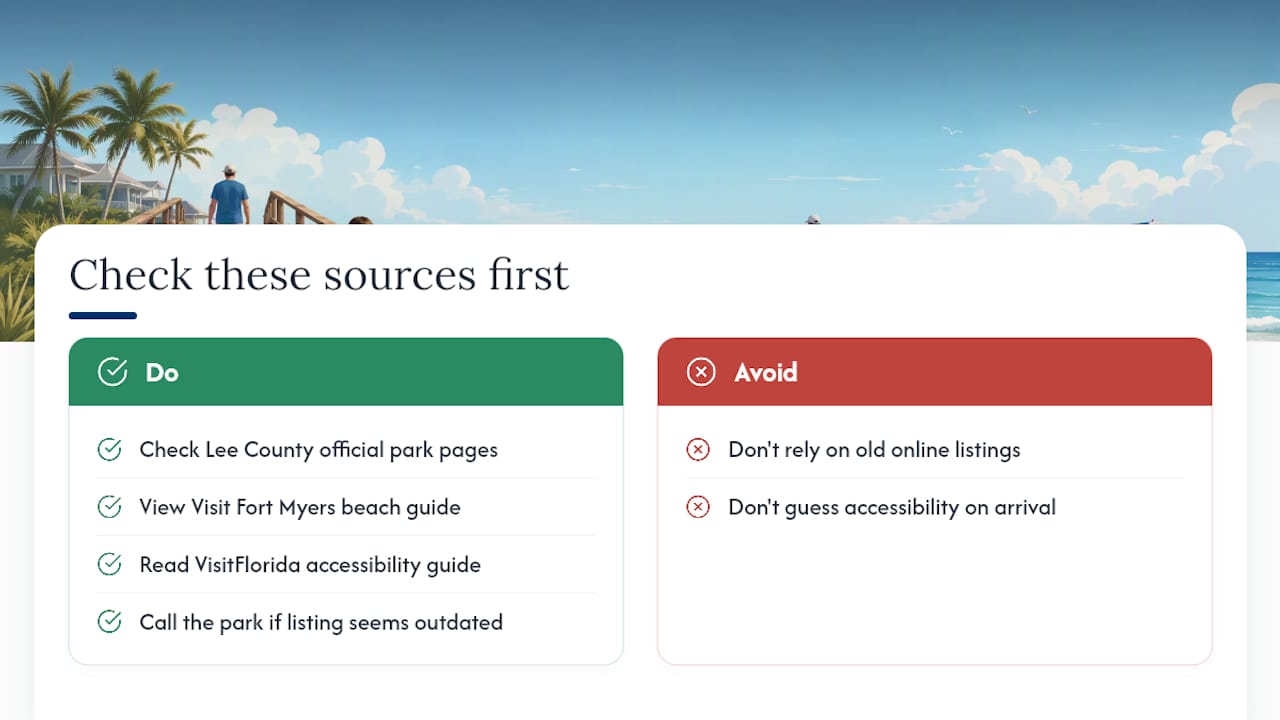
Facility details change, so confirm current conditions directly with these sources before your visit. Lee County maintains official pages for both Alison Hagerup Beach Park and Turner Beach, including contact numbers and amenity notes. Visit Fort Myers covers both parks in its regional beach guide, and the VisitFlorida accessibility guide explains statewide terminology around Mobi‑Mats, beach wheelchairs, and access ramps if you’re new to these features. When a listing seems outdated, a phone call to the park beats guessing.
Sources
FAQ
What are the best accessible beaches on Captiva Island?
Alison Hagerup Beach Park, Turner Beach, and Andy Rosse Lane Park are the top choices, with Alison Hagerup offering a Mobi‑Mat and ADA toilet, and Turner Beach providing ADA parking and accessible restrooms.
Which Captiva beaches are wheelchair accessible?
Alison Hagerup Beach Park has a Mobi‑Mat leading to the shoreline plus handicap parking, while Turner Beach offers ADA parking and accessible restrooms, making both stronger options than Andy Rosse Lane Park, which has minimal paved parking.
Is Captiva or Sanibel better for accessibility?
Sanibel has a broader rental network for equipment like beach wheelchairs, since most rentals for the area come from Sanibel-based vendors, but Captiva’s Alison Hagerup and Turner Beach both offer dedicated ADA features that hold up well for a day visit.
Do I need to bring my own beach wheelchair to Captiva?
Yes, in most cases. Captiva doesn’t have a consistent on-island rental supply, so reserving a beach wheelchair from a Sanibel vendor and transporting it over the causeway is the standard approach.
What should I pack for an accessible beach day on Captiva?
Bring your own shade, a wide-leg beach chair for soft sand, water shoes, and sun protection, and confirm parking and mat conditions by phone before you leave your rental.
Recommended
Comments