
High-End Beach Rental vs. Resort: What Luxury Travelers Need to Know

For most groups of four or more planning a week-long stay, a high-end private beach rental delivers more space, more privacy, and a lower total cost than a comparable luxury resort. The practical decision rule: if your group has five or more people, your stay is seven nights or longer, or privacy and a self-contained environment matter to you, a private rental almost always wins. If your stay is a short duration with full-service needs, a staffed resort generally earns its premium.
Rentals tend to win when you need:
More usable space per dollar (full homes versus hotel suites)
A private pool, full kitchen, and outdoor living areas
Lower cost-per-person for groups, with a noticeable savings for a family of four over seven nights compared to an all-inclusive resort stay
A quiet, curated atmosphere with no shared amenities or lobby crowds
Resorts tend to win when you need:
Daily housekeeping, on-site dining, and concierge without any planning on your part
Supervised kids’ clubs or childcare programs
A short stay where flat cleaning fees would inflate the per-night rental cost
American Realty of Captiva has spent over 30 years matching travelers to the right Captiva Island property, and every listing comes with transparent fee breakdowns, documented cleaning protocols, and local on-island support.
Key Takeaways
For most groups of four or more on stays of seven nights, a private luxury beach rental delivers more space, more privacy, and a lower total cost than a comparable resort stay.
Point | Details |
Rentals win for groups and long stays | A family of four saves roughly $1,000–$1,500 over seven nights in a rental versus an all-inclusive resort. |
Resort fees inflate the true nightly cost | Mandatory resort fees of $45–$65 per night can add substantially to a seven-night resort stay before extras. |
Breakeven falls at 4–5 nights | Cleaning fees ($100–$300) and platform fees (10–16%) make rentals cost-competitive only from around four nights onward. |
Resorts suit short stays and full-service needs | Two-to-three-night stays, couples wanting spa access, and parents needing supervised childcare favor a staffed resort. |
Captiva-island offers direct-booking rentals | American Realty of Captiva lists beachfront and pool homes with transparent fees and 30+ years of local expertise. |
Table of Contents
How does a high-end beach rental compare to a luxury resort?
The difference between a beach house and a beach resort is not just a matter of amenities. It is a fundamentally different way of experiencing a destination.
Couple, 3-night stay: A resort makes sense here. The flat cleaning fee on a rental ($100–$300) hits harder over just three nights, and two people rarely need four bedrooms. A resort suite with room service and a spa feels appropriate for the trip.
Family or group, 7-night stay: The rental wins on nearly every axis. The per-person cost drops as the group grows, the kitchen saves money on meals, and a private pool means no waiting for a chair.
The single biggest decision hinge for a short couple’s trip is convenience. For a week-long family trip, it is total cost and space.
What does a luxury beach vacation actually cost, all in?
Headline nightly rates tell you almost nothing. The real comparison happens when you add every mandatory line item.
That cost gap for a family of four grows meaningfully for larger groups, because the rental rate stays flat while resort per-person charges keep climbing.
Resort sticker prices routinely omit mandatory fees. In Maui, for example, resort fees at Wailea properties run $45–$65 per night, turning a quoted $400/night into $600–$700 before a single meal or activity. That pattern repeats at premium properties across Florida, Hawaii, and the Caribbean.
On the rental side, cleaning fees ($100–$300 per stay) and platform service fees of roughly 10–16% are the most commonly missed costs. The math on cleaning fees is straightforward: spread a $250 cleaning fee across seven nights and it adds about $36 per night. Spread it across two nights and it adds $125. That is why the breakeven point between a rental and a resort typically falls around four to five nights.
Groceries shift the arithmetic further in the rental’s favor on longer stays. USDA analysis confirms that food prepared at home costs meaningfully less than away-from-home dining, and a fully equipped kitchen in a private rental lets a family of four eat well for a fraction of what seven days of resort restaurant meals would cost.
Pro Tip: Ask the property manager for a complete fee schedule before you book, including pool heating charges, parking, and any per-person surcharges. Then divide every flat fee by your number of nights to get the true nightly rate.
What service does each option actually deliver?
Resorts and high-end rentals offer genuinely different service models, and neither is objectively better. The right one depends on how much you want to plan.
A luxury resort typically provides daily housekeeping, multiple on-site restaurants, a concierge desk, an activity coordinator, a kids’ club with supervised programming, and 24/7 front-desk access. You arrive, hand over your bags, and the property handles nearly everything. That convenience has real value, especially for travelers who want a complete break from logistics.

A high-end private rental asks more of you in exchange for more control. Housekeeping is usually available on request or on a scheduled mid-stay basis rather than daily. Groceries, transportation, and activity planning fall to you or to a local concierge you arrange separately. The tradeoff is that every detail can be shaped around your group’s preferences rather than a property-wide schedule.
What you can arrange for a premium rental:
A private chef for select dinners, sourcing local seafood and cooking in your kitchen
Pre-stocked groceries waiting when you arrive (many local concierge services offer this)
Boat or yacht charters through local operators for a day on the water
A mid-stay cleaning and linen refresh scheduled at your convenience
The self-catering approach works best when you plan ahead. Booking a private chef or grocery pre-stock before arrival eliminates the main friction point of the rental model and keeps the experience feeling effortless.
How do privacy and space shape the experience?
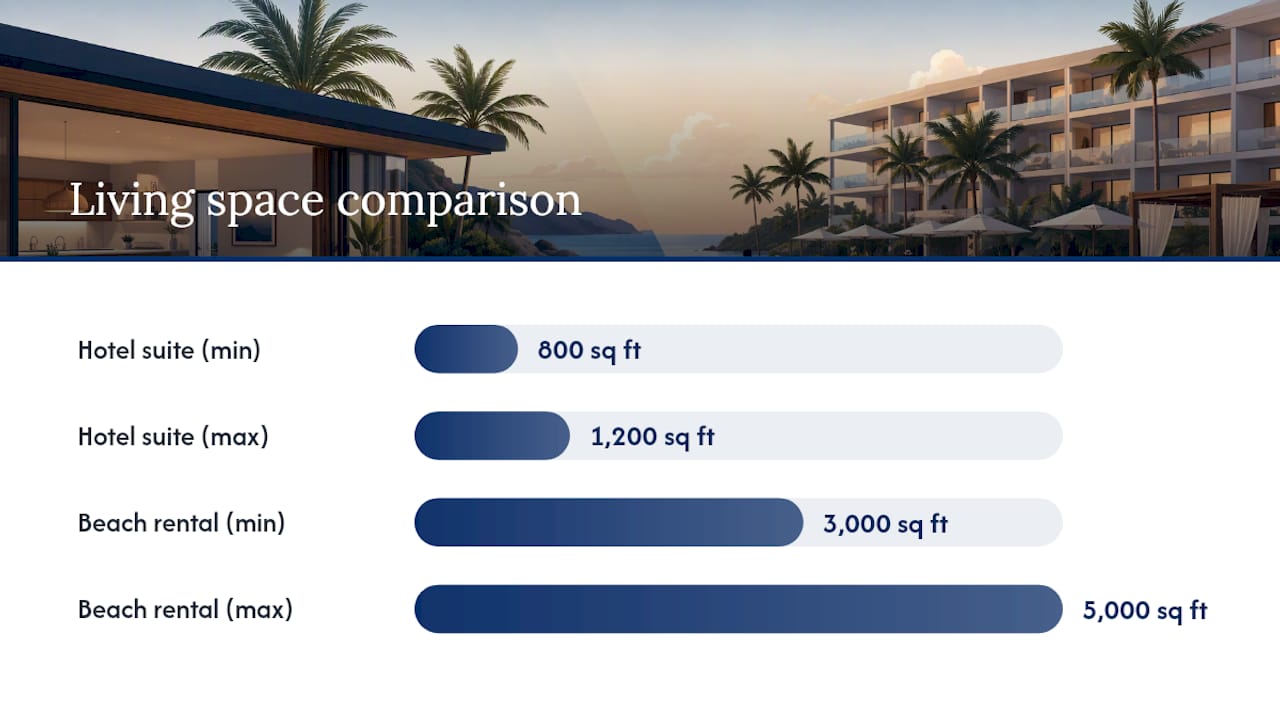
Space is where private rentals pull away from even the best resort suites. A luxury hotel suite might offer 800–1,200 square feet. A premium beach rental on Captiva Island can offer 3,000–5,000 square feet of living space, multiple bedrooms with en-suite baths, a screened lanai, a private pool, and direct beach access. The difference is not incremental.
What premium rentals typically offer that resorts cannot:
A private pool you never share with other guests
A full kitchen where breakfast happens on your schedule, not the restaurant’s
Multiple living rooms and outdoor decks where different members of your group can spread out
Gear storage for kayaks, paddleboards, and beach equipment
The quiet of a residential setting rather than a hotel corridor
What resorts offer that rentals rarely match:
Multi-pool complexes with dedicated adult and family sections
On-site spa with a full treatment menu
Supervised kids’ programs that give parents genuine downtime
Nightly entertainment and curated social programming
The atmosphere question is worth sitting with. A resort is designed to be social. Pools are shared, restaurants are communal, and the energy of other guests is part of the experience. A private beach rental is the opposite: the property is yours, the pool is yours, and the only schedule that matters is the one your group sets. For a multi-generational family trip or a milestone celebration, that seclusion tends to be exactly what people are looking for. For a solo traveler or a couple who enjoys the buzz of a well-run property, the resort’s social energy is a feature rather than a drawback.
You can read more about what defines a luxury vacation rental and how the standards have shifted for affluent travelers.
What questions should you ask before choosing?
Work through these in order before you commit to either option.
How long is your stay? Fewer than four nights, and a resort’s all-in pricing often beats a rental’s flat fees. Four nights or more, and the rental math starts to favor you.
How many people are traveling? Five or more guests, and a private rental almost always costs less per person and offers more space.
How much time will you spend at the property? If your group plans to be out exploring most of the day, a resort’s amenities may go largely unused. If you want a home base to relax in, a private rental earns its value.
Do you need childcare or supervised kids’ programming? Resorts with dedicated kids’ clubs offer something a rental cannot replicate without hiring private staff.
What is your proximity to medical services? Ask both the property manager and the resort about the nearest urgent care or hospital, and confirm that local management is reachable around the clock.
Questions to ask a rental host or property manager:
What is the total all-in cost, including cleaning, pool heating, and any utility caps?
What is the cancellation policy, and is travel insurance recommended?
Who is the on-island contact if something goes wrong?
What is the cleaning protocol between guests?
Red flags to watch for:
No itemized fee breakdown before booking
Reviews that are sparse, undated, or vague about the property’s condition
Slow or evasive responses to direct questions about fees or policies
Ambiguous language about “beach access” that may mean a public path rather than private frontage
No documented cleaning protocol or local management contact
Local management, transparent cleaning policies, and detailed guest reviews are the strongest trust signals in any private rental listing. Prioritize them over photography.
What you need to know about booking timelines and cancellation risk
Peak-season beach rentals on desirable islands book out months in advance. On Captiva Island, the most sought-after beachfront homes for spring and winter holidays are often reserved six to twelve months ahead. Resorts generally hold inventory longer and offer last-minute flexible rates, though those rates rarely include the best rooms.
Planning timeline:
Book a premium beach rental 6–12 months ahead for peak season (December through April on Captiva)
Resorts can often be booked 2–4 months out for comparable dates, with more last-minute availability
Last-minute rental deals exist but carry real risk: the best properties go first, and you may end up with a less desirable location or layout
Pro Tip: Purchase trip cancellation and interruption insurance for any rental booking over $2,000 total. Rental cancellation policies vary widely, and a non-refundable deposit on a $5,000 week is a meaningful exposure. Many credit cards offer travel protection, but read the terms carefully — coverage limits and covered reasons differ significantly.
Cleaning and health protocols are worth confirming directly. Ask whether the property is deep-cleaned between every stay, whether pool water is tested and treated on a regular schedule, and whether HVAC filters are maintained seasonally. A property manager who can answer those questions without hesitation is one worth trusting.
For security, private rentals in gated communities or managed complexes offer a level of access control comparable to a resort. Confirm that the property has working exterior lighting, secure locks, and a local management contact available after hours.
When does a luxury resort make more sense?
There are specific trip profiles where a resort is clearly the better fit, and it is worth being honest about them.
Short romantic getaways (2–3 nights): The flat cleaning fee and platform charges on a rental make a two-night stay comparatively expensive. A resort suite with room service, a spa, and a curated atmosphere is proportionate to the trip and often the more pleasurable choice.
Travelers who want to be fully looked after: If the idea of planning groceries, arranging transport, or coordinating a private chef sounds like work rather than pleasure, a resort’s bundled services are worth the premium.
Parents who need supervised childcare: A well-run resort kids’ club gives parents genuine, uninterrupted downtime. That is difficult to replicate in a private rental without hiring dedicated staff.
Weather-disrupted trips: Resorts often offer more flexible rebooking and on-site entertainment that keeps a trip enjoyable even when the beach is not cooperating. A private rental in a storm means you are managing the situation yourself.
One honest caveat: resort amenities that look inclusive on paper often carry hidden charges. Premium restaurant reservations, cabana rentals, and spa treatments are typically priced separately and can add hundreds of dollars per day to a stay that felt all-in at booking. Getting a complete fee breakdown before you commit applies to resorts just as much as rentals.
What you get booking a luxury beach rental with American Realty of Captiva
American Realty of Captiva has been placing guests in Captiva Island’s finest beachfront and bayfront homes for over 30 years. The inventory spans private-pool homes, true beachfront properties with direct Gulf access, and spacious multi-bedroom homes suited to families and groups. Every listing is managed locally, which means a real person on the island handles questions, coordinates cleaning, and responds when something needs attention.
What the booking experience includes:
Transparent, itemized fee breakdowns before you commit
Documented cleaning protocols between every stay
Direct-booking access with no third-party platform markups
Personalized guidance from a team with deep local knowledge of Captiva Island
Properties with private pools, fully equipped kitchens, and outdoor living spaces designed for the way families and groups actually vacation
Explore the full range of luxury rentals available on Captiva Island, including beachfront homes with private Gulf access and properties with private pools for guests who want that seclusion without sharing a pool deck with strangers.
The case for knowing your own priorities first
The high-end beach rental vs. resort comparison rarely has a universal answer, and articles that pretend otherwise are usually selling something. What I have seen, working with travelers who come to Captiva Island, is that the guests who are happiest with their choice are the ones who were honest about how they actually vacation, not how they imagine they will.
A family that books a resort because it sounds luxurious, then spends most of the week in their room or at the beach, has paid for amenities they never used. A couple that books a private rental for a long weekend, then finds the grocery run and the quiet evenings feel more like a chore than a retreat, would have been better served by a well-run boutique resort. The decision rule in this guide holds up in practice: groups and longer stays favor rentals; short stays and full-service preferences favor resorts. American Realty of Captiva offers the kinds of properties that make the rental choice feel effortless, and the team’s local expertise means you are not navigating Captiva Island blind.
Captiva-island: private luxury on the Gulf, without the resort markup
Private beachfront living on Captiva Island is the alternative to paying resort rates for a fraction of the space. Captiva-island, powered by American Realty of Captiva, offers direct access to Gulf-front homes, bayfront retreats, and pool-equipped properties where the entire home is yours from arrival to departure.
With over 30 years of local expertise, the team handles the details that matter: transparent pricing, on-island support, and properties that are genuinely ready when you arrive. No resort fees. No shared amenities. No surprises on the final bill. Browse available dates and view all Captiva Island rentals to find the property that fits your group, your dates, and the kind of vacation you actually want.
Sources
Recommended
Comments