
Property Caretaker on Captiva: What One Does and How to Choose

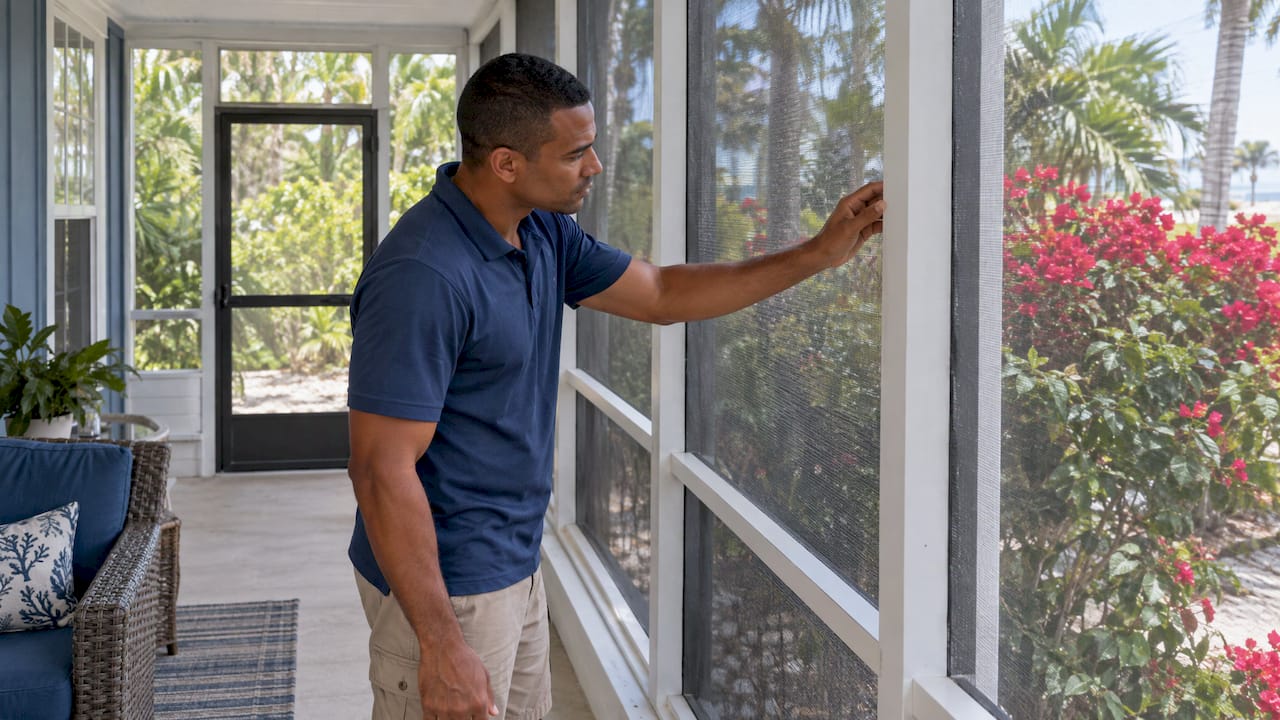
A property caretaker on Captiva is the person who looks after a house when you are not in it: walking the rooms, checking the air conditioning, catching a slow leak, and calling you when something needs attention. If you own a home here and only use it part of the year, you need that eyes-on routine. If the home is also a rental, you need more than a walk-through: you need a local team that handles guests, upkeep and storms together. That is the work we do at American Realty of Captiva, and it is why most owners who plan to rent are better served by a property manager than by a caretaker alone.
TL;DR
A caretaker inspects a vacant Captiva home on a schedule, reports problems and coordinates repairs. Salt air, humidity and storms make regular visits essential on the island.
Visit frequency matters more than almost anything else. Check your homeowner’s insurance policy first, because some policies set a visit interval for vacant homes.
Before hiring, ask what each visit covers, what happens before and after a named storm, who steps in when the usual person is away, and who can approve emergency repairs.
If your home earns rental income, a manager who handles guests and the house together replaces a separate caretaker. We manage a curated collection of 40+ Captiva homes with 30+ years of local experience.
Visiting Captiva rather than owning? The best caretaking you can ask for is a professionally managed home. Browse our Captiva vacation homes.
Table of Contents
What a property caretaker actually does on Captiva
The word covers a range of jobs, from a neighbor who checks the mail to a full home-management team. On a barrier island like Captiva, the core of the work is the same. Someone with a key visits on a set schedule, walks the interior and exterior, and tells the owner what they found.
Inside, that usually means confirming the air conditioning is running and the humidity is under control, looking at ceilings and walls for stains, running faucets and flushing toilets so the drain traps stay full, checking the water heater and breaker panel, and making sure doors and windows are locked. Outside, it means looking at the screened lanai, the pool and its equipment, the landscaping, the dock or seawall if there is one, and any sign of forced entry. Mail and flyers are collected so the house does not look empty.
Good caretakers also document what they see. A dated photo of a dry ceiling is useful today, and it is useful again if you ever need to show an insurer what condition the house was in.
What a caretaker does not do is just as important to understand. A pure caretaker watches and reports. Fixing the leak, replacing the screen, or cleaning the home for the next guest is a separate job that needs a vendor, and someone to schedule and supervise that vendor. That gap is where a lot of absent owners get frustrated.
Why Captiva homes need more attention than most
Captiva is a narrow barrier island, and the things that make it beautiful are the things that wear on a house. Salt air works on metal, screens and fixtures. Humidity settles into closed-up rooms. Sun and rain are hard on decks and exterior paint. A bayfront or beachfront home adds docks, seawalls, boat lifts and pool equipment to the list.
Humidity is the quiet one. When a home sits closed with the air conditioning off or set too warm, mold has what it needs. The EPA’s guidance on cleaning up clean water damage within 24 to 48 hours shows how narrow the window is: wet materials that dry quickly stay free of mold, and wet materials left alone do not. A visit every week or two is how a small drip gets found inside that window instead of after a month of closed doors.
Then there is the storm season. The Atlantic hurricane season runs from June 1 to November 30, which means roughly half the year carries some risk for a home that nobody is watching. Before a storm, someone needs to secure loose outdoor furniture and close up the house. Afterward, someone needs to get to the property as soon as it is safe, check for damage and photograph it. If you live in Ohio or Toronto, that someone has to be on the island. We write about the season in more detail in our guide to Captiva’s hurricane season.
How often a caretaker should visit
There is no single right answer, but the pattern across Florida is consistent. The more weather, water and equipment a home has, the more often it should be seen.
Monthly visits are a weak safeguard for a vacant home. A lot can change in thirty days of summer heat and humidity, and a leak found after three weeks does far more damage than one found after one. Every two weeks is a common middle ground for a house with modern systems and no obvious trouble spots. Weekly visits make sense for homes with pools, older plumbing, a history of repairs, or anything exposed to the water, and especially during hurricane season. After any named storm or power outage, an extra visit is the norm no matter what the regular schedule says.
Before you settle on a number, read your homeowner’s insurance policy. Some policies include a vacancy clause that limits or changes coverage if a home sits unoccupied beyond a set number of days, and some set a required interval for visits. The right wording is in your policy and your carrier is the one who can interpret it, so ask your insurance agent in writing what they require for a home that is empty part of the year. Build the caretaker’s schedule around the answer, not the other way around.
Questions to ask before you hire anyone
The caretaking field is not licensed in the way electricians or contractors are, so the quality of the person matters. Here is what to settle before handing over a key.
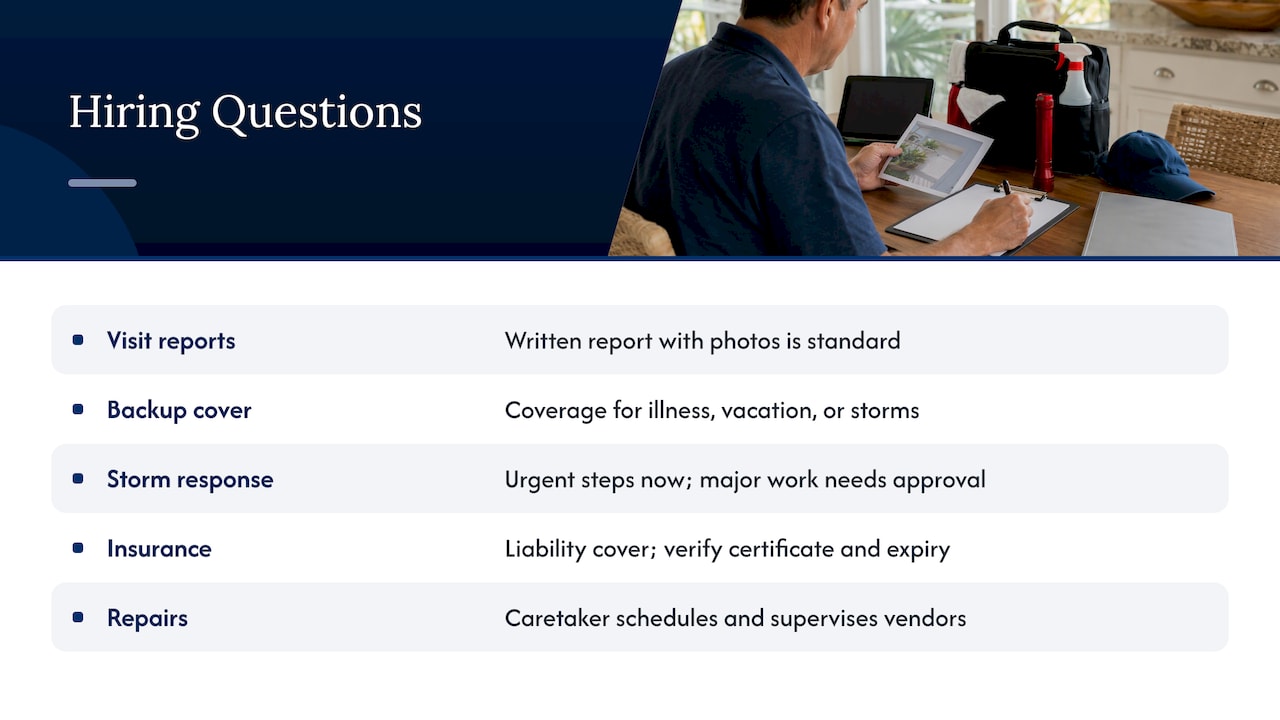
Start with the visits themselves. Ask how often they happen, what each one covers, and what you receive afterward. A written report with photos is the standard worth expecting. Ask who covers when the usual person is sick, on vacation or dealing with a storm at their own house, because on an island that last scenario is the one that tests the arrangement.
Ask about storms next. You want to know what happens before a named storm, whether shutters can be closed or arranged, how outdoor items are secured, and how soon after the storm the home will be checked. Ask what the caretaker will do on their own and what requires your approval. A sensible arrangement is that urgent steps, such as shutting off water to stop a leak, happen immediately, and anything bigger, such as tarping a roof, waits for your yes.
Ask about insurance. A caretaker with a key to your house should carry liability coverage, and the usual way to verify it is to ask for a certificate of insurance showing the business name, the coverage amounts and the expiration date. Ask for a fresh one when it expires.
Finally, ask who does the repairs. If the answer is “call a contractor yourself,” you have bought eyes but not hands. If the answer is a vendor network the caretaker schedules and supervises, you have bought something closer to management. Owners who go through due diligence after a property purchase often find that ongoing obligations, upkeep included, are the part they underestimated, and this question is where that shows up.
Caretaker, home watch or property manager
These terms overlap, and it helps to know which you are shopping for.
Type | What it covers | Best for |
Informal caretaker | One local person who checks on the house, often paid informally | A home you use yourself and visit often |
Home watch | Scheduled inspections and a report, with repairs handled separately | A seasonal home that is never rented |
Property manager | Inspections, maintenance, vendor coordination, guest stays and storm readiness in one relationship | A home that earns rental income |
If you never rent your home, a home-watch routine on a weekly or biweekly schedule can do the job. The moment the home is rented, the picture changes. Guests arrive and leave, the house needs turning over between stays, supplies need restocking, and every stay is a chance for something to break or leak. A separate caretaker who only inspects does not cover any of that. A manager does, and the same person who knows how your house behaves is the one handling the people in it.
There is also the cost angle. Owners who pay a home-watch fee in the off-season and a separate rental manager in the high season are paying two parties to learn the same house. A single local relationship is simpler to run and easier to hold accountable. To see what the role looks like from a guest’s side, read what a vacation rental manager does and our overview of guest management on Captiva.
What it costs, and why the number varies
Published home-watch pricing in southwest Florida is typically a monthly fee tied to visit frequency, and it rises with the size of the home, the number of visits and the extras. Weekly visits cost more than biweekly ones. Add-ons such as mail handling, package receipts, vendor coordination and storm preparation are usually priced separately. A pool, a dock and a large lot all add time to each visit, which adds to the fee.
Instead of comparing quotes line by line, compare what is in them: the visits per month, whether you get photos, whether storm preparation is included or extra, whether vendors are scheduled for you, and who answers the phone when something goes wrong. A low monthly number that leaves you arranging every repair yourself is often more expensive in time than a higher number that includes coordination.
For rental homes, management is generally paid as a share of booking revenue rather than a flat monthly fee, which means the cost of looking after the house moves with the income it earns. Ask for the fee structure in writing, including any reservation or card-processing charges, so you can compare like with like.
If you are visiting rather than owning
Most people who search for a caretaker are owners, but if you are planning a Captiva getaway, this matters to you too. A house that has been regularly inspected, kept dry and cool, and attended to by people who know it is a house where the air conditioning works, the lanai screens are intact and the pool is clear when you walk in. Families notice the difference in the first ten minutes, and so do couples who came for quiet.
When you choose a rental, ask who looks after the home and how quickly someone can reach it if something stops working. On an island with one road, a local team that can be at the door quickly is worth more than a call center on another coast. Our Captiva vacation planning guide walks through the rest of the trip.
Our perspective
We have spent more than 30 years on Captiva, and the pattern is always the same. A house is happiest when someone who knows it is paying attention. Sunrise over the bay feels different when the home around you is cool, dry and quiet, and that comfort is built in the weeks when nobody is there to enjoy it. That is why we see caretaking and rental management as one job. The person who walks the house, the team that readies it for arriving guests and the people who prepare it before a storm should know the same home and the same owner. It means fewer handoffs, fewer surprises and one number to call. Our collection of 40+ luxury beachfront, bayfront and pool homes is managed by a local team, and direct bookings carry 0% platform fees. For an owner, that means a home that earns while it is looked after. For a guest, it means a home that has been cared for by people who answer the phone. If you own on Captiva, or are thinking about it, talk with us about how we would look after your home. If you are visiting, we would love to find you the one that feels like yours. Josh
See the homes we look after
Our collection includes beachfront homes, bayfront homes and homes with private pools, each on Captiva and each handled by our local team. You can search by map or by preference, and book directly with 0% platform fees, online or by phone.

If you are an owner who wants to talk about management for your own Captiva home, or a traveler who wants a house that is looked after the way it should be, start at American Realty of Captiva and let us know what you need.
FAQ
Do I need a property caretaker if my Captiva home is only empty a few months a year?
Yes, in most cases. Humidity, heat and storms do not wait for you to return, and a leak or air conditioning failure can do real damage in a few weeks. A scheduled inspection, ideally weekly or every two weeks, puts a set of eyes on the house and a record of its condition.
How often should someone check on a vacant Captiva home?
Weekly is the safest schedule for homes with pools, older plumbing or exposure to the water, and every two weeks can work for newer, well-maintained homes. Add a visit after any named storm or power outage. Check your homeowner’s insurance policy first, since some set their own visit requirement.
What is the difference between a caretaker and a property manager?
A caretaker inspects and reports, and sometimes arranges repairs. A property manager does that and also runs the rental side: guests, turnovers, supplies and vendors. If your home is rented at all, a manager covers the caretaking as part of the same relationship.
What should a caretaker do before and after a hurricane?
Before a named storm, they secure loose outdoor items and close up the house, and arrange shutters where that is part of the service. Afterward, they check the home as soon as it is safe to travel, photograph any damage and call you. Agree in advance which urgent steps they can take without your approval.
Sources
Recommended
Comments