
Short-Term Rental Regulations Florida: 2026 Guide

Short-term rental regulations in Florida define any property rented for fewer than 30 days more than three times per year as a vacation rental requiring a state license. Florida Statute 509.241 mandates that all such properties hold a valid license issued by the Florida Department of Business and Professional Regulation (DBPR). Beyond state licensing, owners must collect and remit a 6% state sales tax on transient rental income, plus county Tourist Development Taxes ranging from 2% to 6%. Local governments operate under a state preemption framework that limits their ability to ban rentals outright, though private HOA and condominium restrictions remain fully enforceable. Understanding each layer of this system is the difference between a profitable rental and a costly compliance failure.
What are the short-term rental regulations in Florida?
Florida’s vacation rental rules operate on three distinct levels: state licensing, tax compliance, and local or private restrictions. Each layer carries its own requirements and penalties. Missing any one of them puts your rental income and investment at risk.
The state defines a short-term rental as any residential unit rented for periods of fewer than 30 days more than three times annually. That threshold is lower than most owners expect. A beach house rented four times a year for a week each time triggers full licensing and tax obligations under Florida law.
The Florida STR preemption framework prevents cities and counties from banning vacation rentals or restricting how often or how long guests may stay, unless the local ordinance was adopted on or before june 1, 2011. This means most Florida municipalities cannot simply prohibit short-term rentals in residential neighborhoods. What they can do is regulate noise, parking, trash, occupancy safety, and registration requirements within their jurisdiction.
Private restrictions from HOAs and condominium associations sit entirely outside this preemption framework. HOA bylaws can restrict or ban short-term rentals regardless of what the city or county allows. This is the layer most investors overlook, and it is the one most likely to derail a rental business after purchase.
How to obtain and maintain a Florida vacation rental license
A Florida DBPR vacation rental license is not optional. Fines for operating without one can reach $1,000 per day under Florida Statute 509.261. The licensing process is straightforward when you follow it in order.
Step 1: Confirm you need a license. Any property rented for fewer than 30 days more than three times per year requires a license. Single-family homes, condominiums, and townhomes all qualify if they meet that threshold.
Step 2: Apply through the DBPR. Submit your application through the Florida Department of Business and Professional Regulation’s online portal. You will need proof of ownership, a property address, and payment of the applicable license fee.
Step 3: Pass the required inspection. The DBPR requires that vacation rental properties meet minimum safety and habitability standards before a license is issued. This includes working smoke detectors, proper egress, and compliance with Florida building codes.
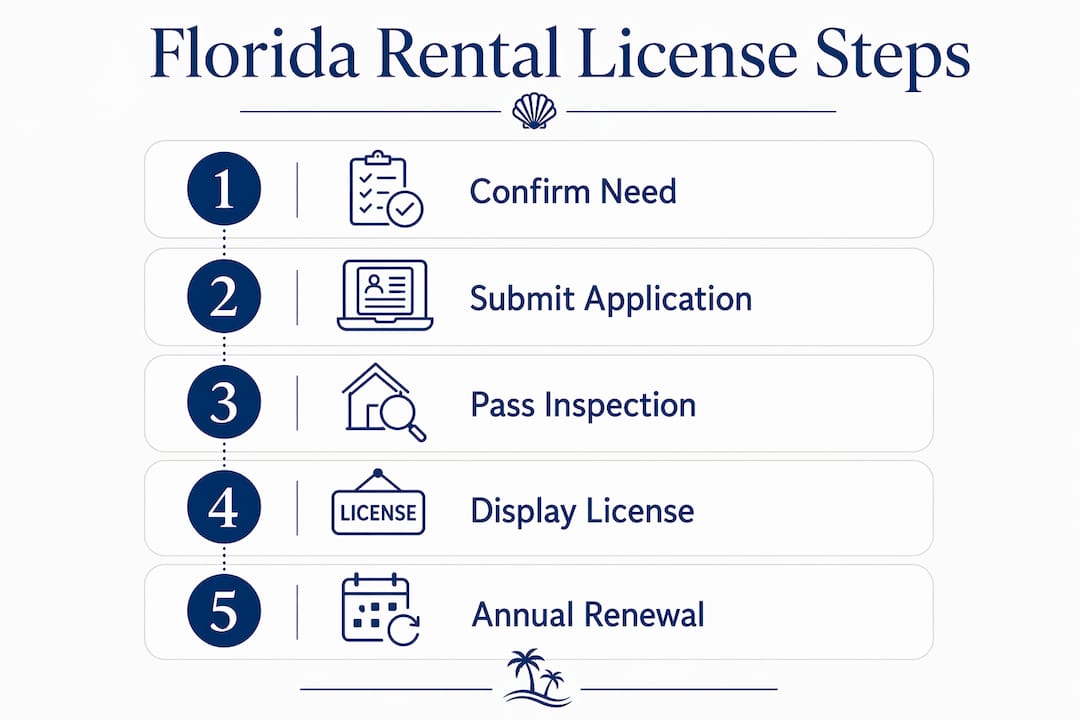
Step 4: Display your license number. Once issued, your DBPR license number must appear on all rental listings, including those on Airbnb and Vrbo. Platforms now verify these numbers and will suppress or remove listings that lack valid credentials.
Step 5: Renew annually. Florida vacation rental licenses require annual renewal. Missing the renewal deadline does not give you a grace period. Your listing can be delisted from booking platforms the moment your license lapses.
City-specific permits add another layer. Wellington and Boynton Beach both require separate local registration in addition to the state DBPR license. Always check with your city or county planning department to confirm whether a local permit is also required.
Pro Tip: Set a calendar reminder 60 days before your DBPR license renewal date. This gives you time to resolve any inspection issues or documentation gaps before the deadline.
What taxes apply to Florida short-term rentals?
Florida imposes a 6% state sales tax on all transient rental income for stays under six months. That tax applies to the total rental amount, including any cleaning fees charged to guests. Owners must register with the Florida Department of Revenue using Form DR-1 before collecting any rental income.
County Tourist Development Taxes add to that base rate. Depending on the county, these taxes range from 2% to 6% on top of the state rate. Lee County, which includes Captiva Island and Fort Myers Beach, charges a Tourist Development Tax that brings the combined rate well above the state minimum.
Tax Type | Rate | Authority |
Florida state sales tax | 6% | Florida Department of Revenue |
County Tourist Development Tax | 2%–6% | County tax collector |
Combined effective rate | 8%–12% | State + county combined |
Penalties for failing to collect or remit these taxes are significant. The Florida Department of Revenue can assess back taxes, interest, and penalties that quickly exceed the original tax owed. Platforms like Airbnb collect and remit state sales tax on behalf of hosts in some cases, but owners remain responsible for confirming that all applicable county taxes are also covered.
Pro Tip: Open a dedicated bank account for tax collections from day one. Mixing rental tax funds with operating income is the fastest way to underpay and face a penalty audit.
Registering with the Florida Department of Revenue is a separate process from obtaining your DBPR license. Both registrations must be active before you accept your first booking. Treating them as one step is a common and expensive mistake.
What can local governments regulate under Florida’s preemption law?
Florida Statute 509.032(7)(b) is the core law governing what cities and counties can and cannot do with short-term rental rules. The statute prevents local governments from banning vacation rentals or placing restrictions on how often or how long guests may stay. This protection applies statewide, with one critical exception.
Local ordinances adopted on or before june 1, 2011 are grandfathered and remain fully enforceable. Cities like Miami Beach aggressively enforce bans on short-term rentals under 30 days in residential zones under exactly this kind of pre-2011 ordinance. Violators in Miami Beach face fines and delisting orders. Before purchasing a property for short-term rental use, confirm the adoption date of any local vacation rental ordinance.
What local governments can regulate, even under preemption, includes the following:
Registration requirements: Cities may require owners to register locally and pay a registration fee.
Noise ordinances: Quiet hours and decibel limits are enforceable at the local level.
Parking rules: Cities can limit the number of vehicles associated with a rental property.
Occupancy limits: Safety-based occupancy caps tied to square footage or bedroom count are permitted.
Trash management: Local rules on waste disposal schedules and container placement apply to rentals.
Fort Lauderdale, for example, enforces strict noise and parking rules for vacation rentals while stopping short of outright bans. The 2026 regulatory landscape reflects a clear trend: local governments are shifting focus from banning rentals to controlling their operational impact on neighborhoods. Owners who stay ahead of these nuisance-focused rules avoid the complaints that trigger enforcement actions.
How do HOA and condo rules affect your rental?
HOA and condominium associations hold independent legal authority to restrict or ban short-term rentals, and state preemption does not apply to them. This is the most misunderstood aspect of Florida vacation rental law. A city may allow short-term rentals in your neighborhood, but if your HOA declaration prohibits them, the HOA rule wins.
Common restrictions found in Florida HOA and condo declarations include minimum lease terms of 30 or 90 days, caps on the total number of rentals per year, mandatory guest screening and approval processes, and fines or suspension of amenity access for violations. Owners who overlook HOA declarations before purchasing face unexpected penalties or complete bans on rental activity after closing.
The enforcement tools available to associations are real. Boards can levy daily fines, restrict access to pools and common areas, and pursue legal action to stop unauthorized rentals. Some associations in popular Florida markets have successfully forced owners to terminate active rental agreements mid-season.
Pro Tip: Request a full copy of the HOA or condo declaration, bylaws, and any amendments before making an offer on a property. Have a real estate attorney review the rental restriction language specifically. This single step prevents the most costly mistake in Florida STR investing.
Reviewing the types of vacation rental investment properties available in Florida helps you identify which property structures carry the lowest association restriction risk from the start.
How to keep your listings active on Airbnb and Vrbo
Booking platforms require a verified DBPR license number on every Florida vacation rental listing. Airbnb and Vrbo both cooperate with municipal regulators and will suppress or automatically delist listings that display expired, invalid, or missing license numbers. The financial impact of delisting is immediate and severe.
Follow these steps to maintain platform compliance:
Display your DBPR license number on every listing, in the description and wherever the platform provides a dedicated license field.
Keep your tax registrations current with both the Florida Department of Revenue and your county tax collector.
Update your license number immediately after each annual renewal to avoid any gap in platform verification.
Respond to platform compliance requests promptly. Airbnb and Vrbo send compliance notices before taking action. Ignoring them accelerates delisting.
Consider a professional management company for ongoing compliance monitoring. A qualified manager tracks renewal dates, tax remittance deadlines, and local registration requirements on your behalf.
Screening a vacation rental management company carefully before hiring ensures they have documented compliance protocols, not just booking expertise. The best managers treat license and tax maintenance as a core service, not an afterthought.
Pro Tip: Take a screenshot of your active DBPR license and save it with your property documents. When a platform requests verification, having it ready cuts response time from days to minutes.
Key Takeaways
Florida short-term rental compliance requires a valid DBPR license, accurate tax registration, and a thorough review of both local ordinances and private association restrictions before you list or invest.
Point | Details |
State license is mandatory | Any property rented under 30 days more than three times yearly needs a DBPR license. |
Tax obligations are layered | Owners owe 6% state sales tax plus 2%–6% county Tourist Development Tax on all rental income. |
Local bans are mostly preempted | Cities cannot ban rentals or restrict frequency unless their ordinance predates june 1, 2011. |
HOA rules override local permissions | Association bylaws can prohibit rentals entirely, independent of what the city allows. |
Platform compliance protects revenue | Airbnb and Vrbo delist listings with expired or missing DBPR license numbers automatically. |
What I’ve learned watching owners get this wrong
After years of watching property owners navigate Florida’s rental rules, the pattern is consistent. Owners who treat licensing and taxes as a one-time setup task are the ones who end up with fines, delisted listings, and back tax bills. The owners who stay profitable treat compliance as an ongoing operating cost, not a checkbox.
The HOA issue surprises people every single time. I have seen investors purchase properties in desirable Florida coastal communities, list them on Airbnb within weeks, and then receive a cease-and-desist letter from their condo association before the first guest checks out. The city allowed the rental. The state license was valid. The association declaration did not, and the association won. Thorough due diligence on private restrictions is not optional. It is the first thing you do before making an offer.
The Florida vacation rental market remains one of the strongest in the country. That strength attracts both serious investors and people who underestimate the compliance requirements. The regulatory environment in 2026 is more structured than it was five years ago, and that is actually good news for owners who do it right. Compliant properties face less competition from unlicensed operators, and platforms actively reward listings with verified credentials. Get the license, register for taxes, check the HOA documents, and then focus on delivering a great guest experience. That is the entire formula.
— Josh
Vacation rentals on Captiva Island, managed the right way
Captiva Island sits in Lee County, where vacation rental rules are clear and the market for premium properties is consistently strong. American Realty of Captiva has managed short-term rentals on the island for over 30 years, with full attention to state licensing, tax compliance, and local registration requirements built into every property we manage.
Whether you are an investor evaluating your first Florida rental property or an owner looking for professional management support, Captiva-island makes the process straightforward. Browse our full collection of available Captiva rentals to see what a fully compliant, professionally managed vacation rental looks like in practice. For personalized guidance on the island’s rental market, our team is ready to help you make a confident decision.
FAQ
What is a short-term rental in Florida?
Florida defines a short-term rental as any residential property rented for fewer than 30 days more than three times per year. Properties meeting this threshold require a DBPR vacation rental license under Florida Statute 509.241.
Do I need a license to rent my Florida home on Airbnb?
Yes. Any Florida property rented short-term more than three times annually requires a valid DBPR vacation rental license, and Airbnb requires that license number to be displayed on your listing. Operating without one risks fines of up to $1,000 per day and automatic delisting.
Can my city ban short-term rentals in Florida?
Cities generally cannot ban vacation rentals or restrict stay duration under Florida Statute 509.032(7)(b), unless their ordinance was adopted on or before june 1, 2011. Miami Beach is a notable exception, enforcing a pre-2011 ban on short-term rentals in residential zones.
Can an HOA stop me from renting my Florida property short-term?
Yes. HOA and condominium association bylaws can prohibit or restrict short-term rentals regardless of what the city or state allows. Always review the full declaration and bylaws before purchasing a property you intend to rent.
What taxes do Florida short-term rental owners owe?
Florida owners owe a 6% state sales tax on all transient rental income plus a county Tourist Development Tax ranging from 2% to 6%, depending on the county. Both must be registered and remitted separately through the Florida Department of Revenue and the county tax collector.
Recommended
Comments