
How to Spot Legitimate Vacation Rental Promotions


A genuine vacation rental promotion holds up under scrutiny: the price compares reasonably to local market rates, payment stays on the booking platform, and the property has a verifiable address and real reviews. The single most reliable rule is this — if a host asks you to pay outside the platform or via wire transfer, gift card, or crypto, stop. The Federal Trade Commission is direct about it: those payment methods are effectively irreversible, and you likely cannot get your money back. Platforms like Airbnb and Vrbo build fraud protections into their payment systems for exactly this reason. Fifteen minutes of verification before you pay is all it takes to tell a real deal from bait.
Table of Contents
What red flags tell you a “promotion” is probably a scam?
Scammers design fake promotions to feel urgent and irresistible. Knowing their playbook lets you screen offers in under a minute.
The most consistent warning signs cluster around three areas: price, payment, and pressure.
Off-platform payment pressure. The most common scam tactic is a listing that looks legitimate on a platform, then a “host” who asks to move conversation and payment off-platform. Once you leave the platform, you lose its protections entirely.
Wire transfers, gift cards, or crypto — Any request for these payment methods is disqualifying. The FTC is unambiguous: money sent this way is gone.
No single flag proves fraud, but two or three converging signals — off-platform payment request, untraceable payment method, and photos that fail a reverse-image search — strongly indicate you are looking at a scam.
How do you verify a promotional listing and host before paying?
Run this routine before you hand over any payment. It takes roughly 15 minutes and catches most fakes.
Reverse-image search the photos. Right-click any listing photo and open it in Google Images or Google Lens. If the same image appears on unrelated properties or stock photo sites, the listing is likely fabricated. Search at least three photos, not just one.
Confirm the street address on Google Maps Street View. Paste the listed address into Google Maps and switch to Street View. The exterior should match the listing photos. If the address does not exist or shows a completely different building, walk away.
Search the address on a county property appraiser site. Most Florida counties publish free public records. A quick search confirms the property owner’s name and whether the listing matches the real parcel.
Check the host’s review history. Read the lowest-rated reviews first. Look for patterns: complaints about bait-and-switch pricing, unresponsive hosts, or properties that did not match photos. A host with no reviews or only recent five-star ratings from new accounts deserves extra scrutiny.
Cross-reference on third-party review sites. Search the property address or management company name on Google, TripAdvisor, or Yelp. A real property managed by a real company will have a footprint beyond a single listing.
Verify the domain if you clicked a link. Type the booking URL manually rather than clicking email or social media links. Scammers build lookalike sites with nearly identical domain names. An SSL padlock alone does not confirm legitimacy.
Request a live video walkthrough. A legitimate host can show you the property on a short video call. A scammer cannot. This step alone eliminates most fakes.
Insist on a written rental agreement. It should show the full property address, check-in and check-out procedures, and clear cancellation and refund terms. No written agreement means no booking.
For personalized vacation rental experiences, reputable property managers welcome these requests as a normal part of the booking process, not an inconvenience.
Is a promotional price actually a real deal?

A headline rate that looks stunning often tells a different story at the final checkout. The discipline here is simple: compare the all-in price, not the advertised number.
Start by searching the same property or comparable properties on two or three established booking channels for identical dates. Price-history checks and flexible-date comparisons are among the strongest signals that a rate is genuinely lower rather than a marketing illusion. If a property’s calendar shows $250 per night for most of the season and a “promotion” offers less than $150, that gap (a 40% or greater discount) warrants a hard look.
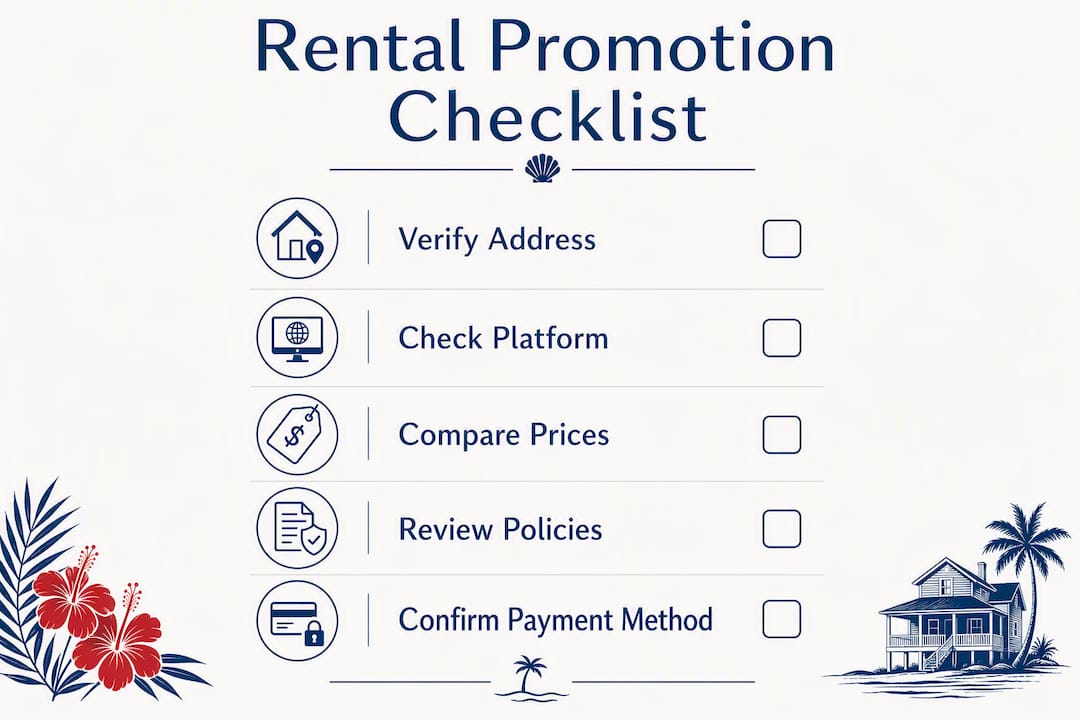
Then click through to final checkout before trusting any number. Hidden fees — resort charges, cleaning fees, mandatory service fees — routinely explain why a headline rate looks unrealistically low. A $100/night rate that adds $400 in fees for a four-night stay is not a discount.
Price Gap vs. Market | What It Suggests |
<20% below market | Plausible seasonal or early-booking discount |
20–40% below market | Worth verifying carefully; ask for written terms |
>40% below market | Strong red-flag threshold; verify every detail before proceeding |
Pro Tip: Before you celebrate a low headline rate, check the cancellation and refund policy. A non-refundable “promotional” rate with no written terms is a risk regardless of the price.
For context on what genuine early-booking savings look like, the early-booking discount guide on Captiva-island walks through how real seasonal pricing works versus marketing copy.
Which payment methods are safe, and which should you avoid?
The payment method you choose determines whether you have any recourse if something goes wrong. Credit card payments processed through the booking platform give you chargeback rights under the Fair Credit Billing Act. Every other method on the list below offers progressively less protection.
Payment Method | Risk Level | Why |
Credit card via platform | Safest | Chargeback rights under Fair Credit Billing Act; platform fraud team as backup |
Debit card via platform | Acceptable | Some dispute rights, but weaker than credit card protections |
PayPal (Goods & Services) | Acceptable | Buyer protection applies when used correctly; confirm the setting |
Zelle, Venmo, Cash App (peer transfer) | Dangerous | No inherent fraud protection; treated like cash |
Wire transfer | Disqualifying | Irreversible; FTC warns funds are unrecoverable |
Gift cards or crypto | Disqualifying | No consumer protection; a universal scam signal |
Beyond the payment method itself, keep all communication on the booking platform or in documented email. If a host insists on texting a personal number or using WhatsApp to finalize terms, that is a warning sign. A paper trail matters if you ever need to dispute a charge or file a report.
Pay by credit card through the platform whenever possible.
Never send money before receiving a written rental agreement with the full address.
Save all confirmation emails, receipts, and screenshots of the listing at the time of booking.
What should you do if a promotion looks suspicious or you’ve been scammed?
Stop any further payments immediately and preserve every piece of evidence you have. Acting quickly gives you the best chance of recovering funds or preventing additional loss.
Capture everything now. Screenshot the listing, the host’s profile, all messages, payment confirmations, and the property photos. Save the URL. If the listing disappears, your screenshots are your evidence.
Contact your credit card issuer. Request a chargeback dispute. Credit card companies have defined dispute processes, and the sooner you call, the better your odds. Debit card disputes are possible but have tighter timelines.
Report to the booking platform. Airbnb, Vrbo, and similar platforms have fraud reporting tools. Flag the listing and the host so the platform can investigate and protect other travelers.
File a report with the FTC at ReportFraud.ftc.gov. The FTC uses these reports to track patterns and build cases. It takes five minutes and directly supports consumer protection efforts.
Contact local law enforcement. If you have lost money, file a police report. Your card issuer and the FTC may ask for a case number.
Report to the FBI’s Internet Crime Complaint Center (IC3) at ic3.gov if the fraud involved significant financial loss or crossed state lines.
The evidence to collect: confirmation numbers, screenshots of the listing and all communications, payment receipts showing the amount and method, host contact details, and saved photos or URLs of the property.
Your one-minute checklist before paying for any rental promotion
Print this or screenshot it before your next booking. Each check takes under two minutes.
Did you compare the total checkout price (including all fees) against at least two comparable local listings for the same dates?
Did you run a reverse-image search on at least three property photos?
Did you confirm the street address exists and matches the photos using Google Maps Street View?
Did you verify the host or property manager has a working phone number and third-party reviews?
Did you read the lowest-rated reviews for patterns of complaints?
Is payment processed through the platform or by credit card with a written receipt?
Did you receive a written rental agreement showing the full address and cancellation terms?
Did you type the booking URL manually rather than clicking a link from email or social media?
Pro Tip: Save this checklist as a PDF or phone screenshot before your trip research begins. If a listing fails two or more of these checks, treat it as suspicious and document everything before proceeding.
If a listing raises concerns, save all evidence before the listing potentially disappears. Scam listings are often pulled quickly once a victim reports them.
What does a legitimate promotional listing actually look like?
A real promotional offer from a verified property manager passes every item on the checklist above without friction. Here is what that looks like in practice.

Captiva-island, operated by American Realty of Captiva, lists seasonal promotions for beachfront and bayfront homes on Captiva Island, Florida. Each listing shows a verified street address you can confirm on Google Maps. Payment is processed through the platform by credit card, which preserves your chargeback rights. Written rental agreements with cancellation and refund terms are provided before any payment is finalized. The company has operated for over 30 years, and its properties appear in third-party review searches with a consistent history.
Mapping that to the checklist:
Photos: Property images are tied to real, named addresses. A reverse-image search returns the actual property, not a stock photo or a different listing.
Address: Every listing shows a specific Captiva Island address, verifiable on Street View.
Payment: Credit card via the platform, with written confirmation sent immediately.
Reviews: The company’s history is searchable on Google and through direct guest feedback, not just platform-internal ratings.
Written terms: Cancellation and refund policies are stated clearly before booking is complete.
Captiva-island publishes this guide as a resource for all travelers, not only those booking with us. The example above uses our own platform because it is the one we can speak to with direct knowledge. Readers should apply the same checklist to any rental they consider, regardless of the platform.
Luxury rental vetting practices at the professional level follow exactly this pattern — transparency at every step, from listing to checkout.
Key Takeaways
Legitimate vacation rental promotions survive verification: they have real addresses, platform-hosted payments, third-party reviews, and written cancellation terms — and their prices hold up against local market comparisons.
Point | Details |
Pay by credit card on-platform | Credit card payments through the platform give you chargeback rights under the Fair Credit Billing Act. |
Compare all-in price to market | Offers far below comparable local rates are a strong red flag; always check the final checkout total. |
Run the 15-minute verification | Reverse-image search, Street View address check, and a video walkthrough request catch most fake listings. |
Report scams to the FTC | File at ReportFraud.ftc.gov and contact your card issuer immediately if you suspect fraud. |
Captiva-island as a verified example | American Realty of Captiva lists promotions with verified addresses, credit card payments, and written terms. |
The value of local knowledge when evaluating promotions
Most scam-prevention guides treat vacation rental fraud as an abstract problem. Having spent years working with properties on Captiva Island, my perspective is a little more specific: the travelers most vulnerable to fake promotions are often the ones most excited about a destination. That excitement is exactly what scammers exploit with urgency tactics and prices that feel like a once-in-a-season opportunity.
The practical correction is not cynicism. It is a 15-minute habit. The verification routine in this guide is not burdensome — it is the same due diligence a careful traveler applies to any significant purchase. A property that cannot survive a reverse-image search and a Street View check was never worth booking.
One thing I think gets underestimated: flexibility in travel dates is often more effective at finding genuine savings than chasing a suspicious “limited time” promotion. Real seasonal discounts on Captiva Island follow predictable patterns tied to shoulder seasons and last-minute availability. Understanding when to book Captiva vacation homes gives you a realistic baseline for what a legitimate discount actually looks like — which makes a fraudulent offer much easier to recognize on sight.
Verified Captiva Island rentals with transparent promotions
Captiva-island lists luxury beachfront and bayfront vacation homes with every safeguard this guide describes built into the booking process: verified addresses, credit card payment through the platform, written rental agreements, and cancellation terms stated before you commit. American Realty of Captiva has managed properties on the island for over 30 years, and that local depth shows in the pricing transparency — seasonal promotions are tied to real market conditions, not manufactured urgency.
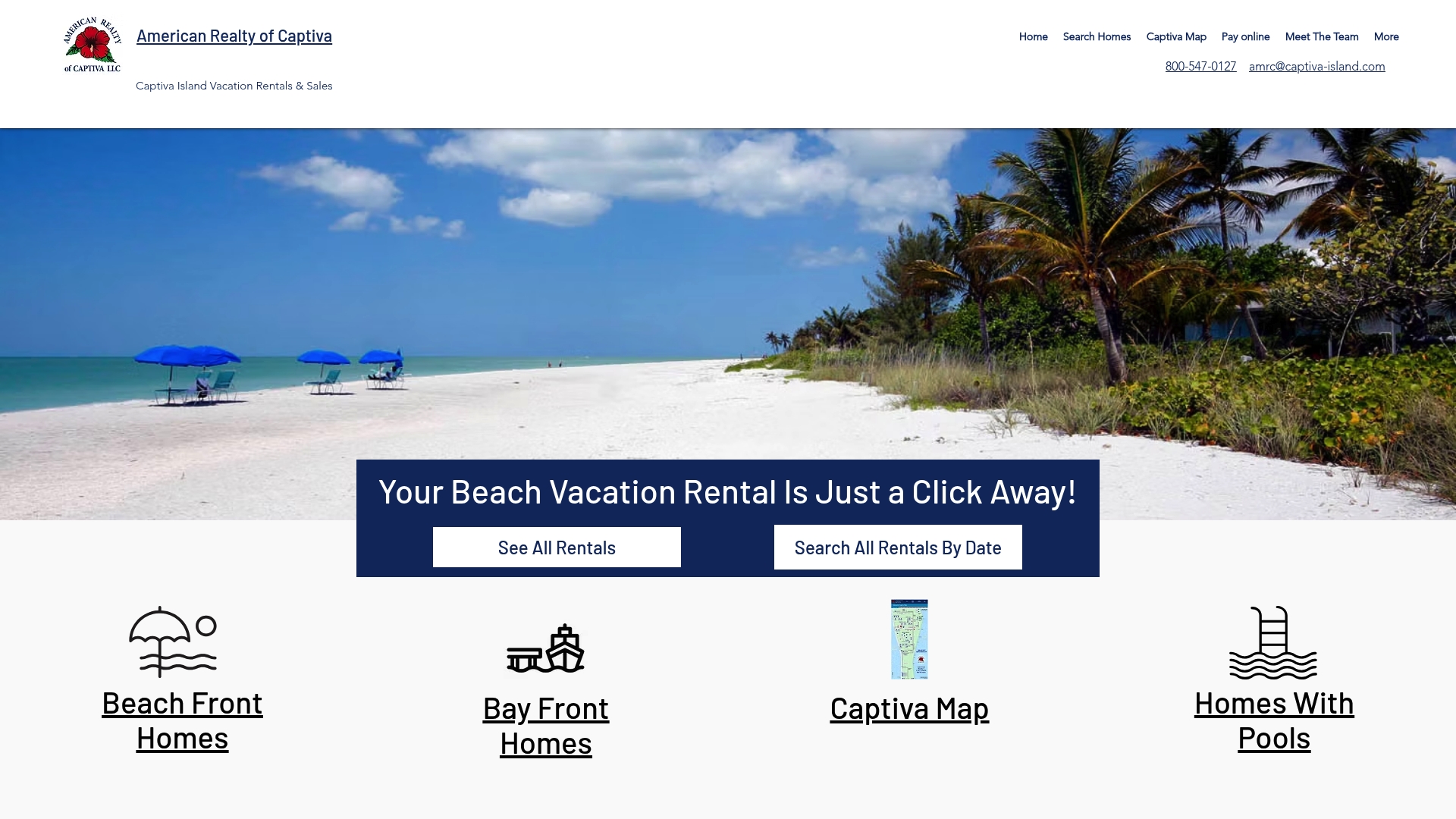
If you are ready to see what a verified Captiva Island promotion looks like, browse current availability and seasonal offers at American Realty of Captiva rentals. Every listing on the platform meets the checklist in this guide.
Useful sources and reporting links
Keep these links saved for quick reference when evaluating a rental promotion or reporting suspected fraud.
FTC Rental Listing Scams — Consumer Advice: The FTC’s primary guidance on vacation rental fraud, including payment warnings and reporting steps.
ReportFraud.ftc.gov: File a fraud report with the FTC directly. Takes five minutes and contributes to national consumer protection efforts.
FTC Data Spotlight — Rental Scams: FTC data on reported rental scam losses, useful for understanding the scale of the problem.
Navy Federal — How to Spot a Vacation Rental Scam: Practical consumer guidance from a financial institution, covering payment safety and red flags.
IC3.gov — FBI Internet Crime Complaint Center: For reporting significant financial fraud involving internet-based rental scams.
Recommended
Comments