
Vacation Home Exit Strategy: Maximize Your Returns


A vacation home exit strategy is the deliberate plan property owners use to sell or transition their vacation property while maximizing financial returns and managing tax, operational, and timing factors. Most owners think about selling only when life forces the decision. That reactive approach costs money. The owners who walk away with the strongest returns plan their exit 12–24 months in advance, choose the right sale structure, and time the market with intention. Whether you own a beachfront cottage in Florida or a mountain cabin in Colorado, the principles of a sound exit plan are the same.
What is a vacation home exit strategy and why does it matter?
A vacation home exit strategy is defined as a structured plan for transitioning ownership of a vacation property in a way that protects your equity and meets your financial goals. The industry term most real estate professionals use is “disposition strategy,” though “exit strategy” has become the standard shorthand among short-term rental investors. Both terms describe the same process: deciding when to sell, how to sell, and what tax and operational steps to take before closing.
The stakes are real. Vacation properties carry capital gains exposure, active booking obligations, and market timing risks that primary residences do not. Owners who skip the planning phase often cancel bookings at a penalty, miss peak listing windows, or pay avoidable taxes. A clear exit plan for vacation properties addresses all three risks before they become problems.

Successful exit planning is a 12–24 month process that involves maintaining multiple plans and reviewing them annually to avoid forced sales in unfavorable markets. That timeline gives you room to renovate, document financials, and choose the right moment to list.
What are the main types of vacation home exit strategies?
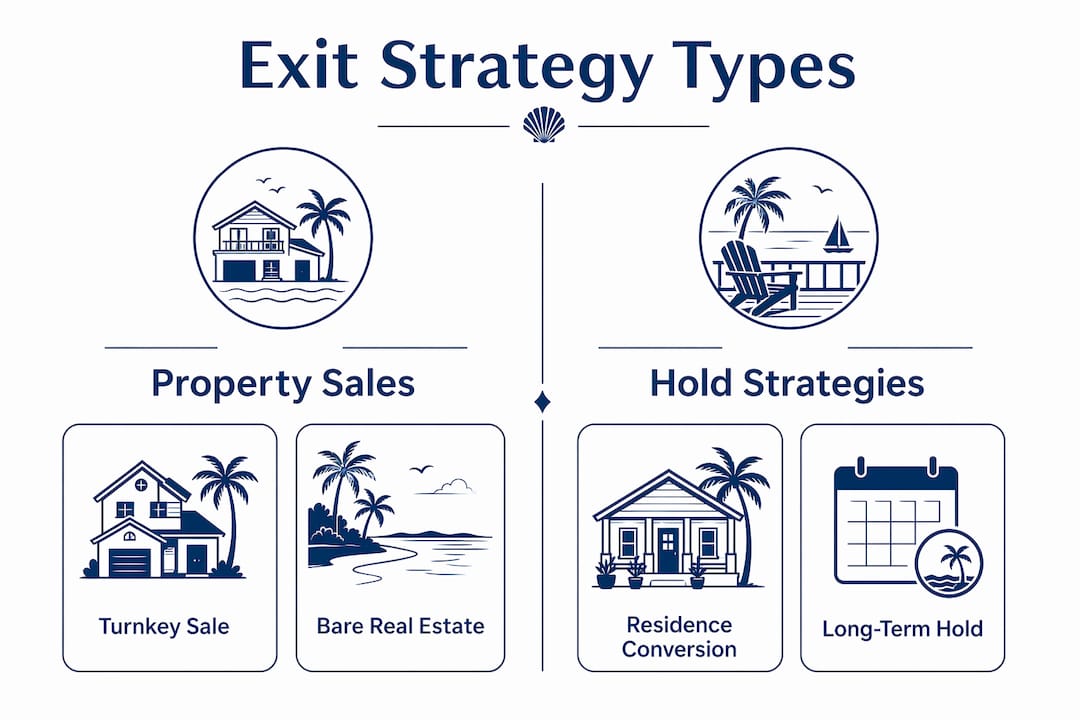
The four core exit options for vacation property owners are the turnkey business sale, the bare real estate sale, the principal residence conversion, and the long-term hold. Each serves a different financial goal, and the right choice depends on your property’s income history, your tax situation, and your timeline.
Turnkey business sale
A turnkey sale packages the property with its operating business. You transfer the booking calendar, vendor relationships, cleaning protocols, and financial records alongside the deed. Selling as a turnkey business can command a 15–25% price premium over a bare real estate sale when supported by at least two years of documented operational data. That premium reflects the buyer’s ability to generate income from day one. To qualify for that premium, you need audited financials, a full booking history, and documented vendor contacts. Buyers pay for certainty, not potential.
Pro Tip: Start compiling your operational documentation at least 18 months before your target sale date. Buyers scrutinize two full years of records, so gaps in your data will reduce your negotiating position.
Bare real estate sale
A bare real estate sale treats the property purely as an asset. You sell the structure and land, wind down bookings, and transfer nothing operational. This approach works well when the property’s rental income is modest, when local short-term rental regulations have tightened, or when the buyer pool is primarily primary residence purchasers. The types of vacation rental investment properties you own often determine which sale structure attracts the strongest buyer pool.
Principal residence conversion and long-term hold
Converting your vacation home to a principal residence for at least two years makes you eligible for the federal home sale gain exclusion, which can shelter a significant portion of your profit from capital gains tax. Holding the property until death triggers the step-up in basis rule, which resets the tax basis to fair market value at the owner’s death, effectively eliminating capital gains accrued during the owner’s lifetime. Sophisticated investors also use Delaware Statutory Trusts (DSTs) to diversify equity and defer taxable events rather than selling outright.
How to manage active bookings when selling a short-term rental
Selling an active short-term rental is operationally complex in a way that selling a vacant property is not. You have guests with confirmed reservations, platform reviews that affect your listing’s visibility, and income you do not want to forfeit. Handling this well protects both your reputation and your revenue through closing.
The two most practical approaches are a post-close management agreement and a co-host transition. Under a post-close management agreement, you continue managing the property after the deed transfers, honoring existing bookings and retaining that revenue. Under a co-host arrangement, you add the buyer as a co-host on your platform account 30–45 days before closing so they can shadow operations and build familiarity before taking over.
One operational detail most sellers miss: Airbnb prohibits account transfers, and Superhost status does not transfer to the buyer. The buyer must build their own listing and reviews from scratch. The co-host method is the primary workaround, giving the buyer operational exposure while you retain account control through the transition period.
Canceling confirmed bookings is the option to avoid. Platform penalties include financial fees, suppressed search rankings, and negative reviews that follow the listing. Plan your transition so that no guest reservation requires cancellation.
Pro Tip: Draft a written transition manual covering your cleaning vendors, maintenance contacts, pricing strategy, and seasonal booking patterns. Buyers who receive this document close faster and pay closer to asking price.
What tax strategies should owners consider before selling?
Capital gains tax is the largest financial variable in most vacation home sales. The right tax strategy can mean the difference between keeping a large portion of your profit and handing a significant share to the IRS. The three most commonly used strategies are principal residence conversion, the Section 1031 exchange, and the long-term hold.
Converting your vacation home to a primary residence requires at least two years of residency to qualify for the federal gain exclusion. This strategy works best when you are approaching retirement or already spending significant time at the property.
A Section 1031 exchange defers capital gains tax by swapping a rental or business property for another like-kind property. It applies only to properties used for business or rental purposes, not primary residences. The exchange has strict identification and closing timelines, so you need a qualified intermediary in place before you close the sale. The home sale exclusion rules interact with 1031 exchange eligibility in ways that can surprise sellers, making early professional advice critical.
The step-up in basis rule rewards the long-term hold strategy. When a property transfers at death, the heir’s tax basis resets to the current fair market value, erasing all capital gains accumulated during the original owner’s lifetime. This strategy suits owners who no longer need the liquidity and want to pass the asset to heirs with minimal tax burden.
Consult a CPA who specializes in real estate before you commit to any of these paths. The wrong sequence of events, such as moving into the property after a failed 1031 exchange attempt, can disqualify you from both strategies.
How does timing affect the success of your exit plan?
Timing a vacation home sale is not guesswork. The market has clear patterns, and listing at the right moment adds measurable value. For Florida vacation homes, the optimal listing window runs from late winter through early summer, when buyer demand peaks alongside tourism season. Listing after renovations during high-demand seasons significantly improves sale appeal and can increase the final price.
The risks of poor timing are just as concrete. Waiting too long can mean selling during a regulatory shift that restricts short-term rentals, a market correction that compresses prices, or a personal financial pressure that forces a quick sale at a discount. Investors who establish exit strategies before buying their first vacation rental maintain the flexibility to pivot between short-term rental, long-term rental, and outright sale depending on market conditions.
Presentation matters as much as timing. Professional photography, accurate income documentation, and a clean property condition report all reduce buyer hesitation. Summer beach rentals book fast for a reason: demand is visible, and buyers can see the income potential in real time. List when that energy is working in your favor.
Key Takeaways
A vacation home exit strategy succeeds when you plan early, choose the right sale structure, manage the operational transition carefully, and time the market with clear data.
Point | Details |
Plan 12–24 months ahead | Early planning gives you time to document financials, renovate, and choose your listing window. |
Turnkey sales command a premium | Two years of audited records can support a 15–25% price premium over a bare real estate sale. |
Manage bookings before closing | Use a co-host arrangement or post-close agreement to protect income and avoid platform penalties. |
Tax strategy shapes your net return | Principal residence conversion, 1031 exchanges, and step-up in basis each serve different financial goals. |
Timing the market adds real value | Listing in late winter through early summer in Florida aligns with peak buyer demand and tourism activity. |
What I’ve learned about exit planning that most guides skip
I’ve watched owners treat their vacation home sale as a single transaction rather than a process. That framing is the root of most costly mistakes.
The owners who do this well treat the exit as a project with a start date, not a reaction to a life event. They begin building their operational documentation two years out, not two weeks before listing. They maintain three parallel plans: sell as turnkey, convert to long-term rental, or refinance and hold. When the market shifts, they have options. When it doesn’t, they execute the primary plan from a position of strength.
The detail most sellers underestimate is operational independence. A property that runs without the owner’s daily involvement is worth more than one that requires constant attention. Buyers pay a premium for a business that does not need them to be present. If your vacation rental depends on your personal relationships with cleaners, your memory of the Wi-Fi password, and your informal understanding with the pool service, you have not built a transferable business. You have built a job.
The tax piece deserves more attention than most sellers give it. A conversation with a real estate CPA 18 months before your target sale date costs a fraction of what a poorly timed conversion or a missed 1031 deadline will cost you. The remote property management habits you build now directly affect the premium a buyer will pay later.
Start earlier than feels necessary. The owners who feel calm at closing are the ones who started planning when the sale still felt far away.
— Josh
Vacation home investment insights from Captiva-island
Captiva Island’s vacation rental market gives property owners a clear view of what buyers actually want in a premium beachfront investment. American Realty of Captiva has spent over 30 years matching buyers, sellers, and renters with the right properties on one of Florida’s most sought-after barrier islands.
Whether you are building a rental portfolio, planning your exit, or looking for a property that performs from the first season, the full rental collection at Captiva-island offers a range of beachfront and bayfront homes with documented rental histories and strong seasonal demand. For owners focused on the premium end of the market, the beachfront properties on Captiva represent exactly the kind of asset that supports a turnkey sale at a meaningful premium. The local expertise at American Realty of Captiva translates directly into better-informed decisions at every stage of ownership.
FAQ
What is a vacation home exit strategy?
A vacation home exit strategy is a deliberate plan for selling or transitioning a vacation property to maximize financial returns while managing tax obligations and operational responsibilities. It typically involves choosing between a turnkey sale, a bare real estate sale, or a tax-advantaged conversion.
How early should I start planning my vacation home exit?
Exit planning works best when started 12–24 months before your target sale date. That window gives you time to compile two years of financial records, complete renovations, and choose the right listing moment.
What is a 1031 exchange and does it apply to vacation homes?
A Section 1031 exchange defers capital gains tax by swapping one rental or business property for another like-kind property. It applies to vacation homes used as rentals but not to primary residences, and it requires a qualified intermediary and strict timelines.
Can I transfer my Airbnb account to the buyer?
Airbnb prohibits the transfer of host accounts and Superhost status. The standard workaround is adding the buyer as a co-host 30–45 days before closing so they can learn operations before building their own listing.
When is the best time to list a Florida vacation home for sale?
The optimal listing window for Florida vacation homes runs from late winter through early summer, when tourism demand peaks and buyer activity is highest. Listing immediately after renovations during this window produces the strongest results.
Recommended
A well-planned exit strategy is just as important as the initial investment. Understanding market timing, property value, guaranteed rent scheme and buyer demand can help vacation homeowners maximize returns while making smarter real estate decisions. Great advice!
Great insights on planning a vacation home exit strategy and maximizing long-term returns. I especially liked the focus on timing, market conditions, and having a clear investment plan before selling. Property owners can also benefit from professional rental management services to improve occupancy, maintain the property, and increase its value before an exit. Combining smart management with a well-planned selling strategy can make a big difference.