
Vacation Rental Minimum Stay: What Every Traveler Should Know


A vacation rental minimum stay is the smallest number of consecutive nights a guest must book to reserve a property. Property managers set this requirement to protect their revenue, control operational costs, and reduce the wear that comes with frequent guest turnover. Understanding what is vacation rental minimum stay policy means before you search saves you real frustration. The right knowledge helps you find the perfect home, avoid invisible listings, and plan a trip that actually fits your schedule.
What is vacation rental minimum stay, and how does it vary?
A minimum stay requirement is the contractual floor on how many nights you must book. It is not a suggestion. If a property requires three nights and you search for two, that listing simply will not appear in your results.
The baseline varies significantly by property type and location. Urban apartments typically require just 1–2 nights, since city travelers often book for business or weekend trips. Beach houses, lake homes, and leisure destination properties generally require 3–7 nights. Monthly rentals, common in retirement or snowbird markets, often mandate 28–30 nights.

Property type | Typical minimum stay | Key driver |
Urban apartment | 1–2 nights | High demand, low turnover cost |
Beach or vacation home | 3–7 nights | Higher turnover cost, leisure travel patterns |
Luxury estate | 3–5 nights (year-round) | Fixed costs exceed one night’s rate |
Large home (4+ bedrooms) | 7 nights during peak season | Revenue protection, Florida markets |
Monthly rental | 28–30 nights | Snowbird or extended-stay market |
Location adds another layer. In Florida, for example, 4+ bedroom homes often mandate 7-night minimums during summer and holidays, with final payment deadlines 60 days out. That structure protects owners from last-minute cancellations on high-value weeks. A luxury beach rental operates on a fundamentally different cost model than a downtown studio, and the minimum stay reflects that difference directly.
Local regulations also shape these rules. Some cities and counties restrict short-term rentals to a minimum of 30 nights to limit neighborhood disruption. Florida’s statewide framework, for instance, defines short-term rentals as those rented more than three times per year for periods under 30 days, which influences how owners structure their policies.
Why do property managers set minimum stay requirements?
Turnover cost is the primary reason. Every time a guest checks out, the property requires cleaning, laundry, restocking, and a full inspection. Turnover costs range from $75 to $350+ per booking, depending on property size. That figure means a single-night booking at a large beach house can actually lose money once labor and supplies are counted.
Property managers calculate a break-even point. If the cost of one turnover exceeds the revenue from one night’s rate, a longer minimum stay becomes the only financially sound choice. High fixed turnover costs are the main justification for minimum stays across the industry. This is not about inconveniencing travelers. It is about keeping the property financially viable so it stays available for future guests.
Operational workload matters too. Coordinating check-ins, check-outs, key exchanges, and guest communications for a two-night booking takes nearly the same effort as managing a seven-night stay. Fewer turnovers mean the property manager can give each guest more attention, respond faster to maintenance issues, and maintain the quality that earns strong reviews.
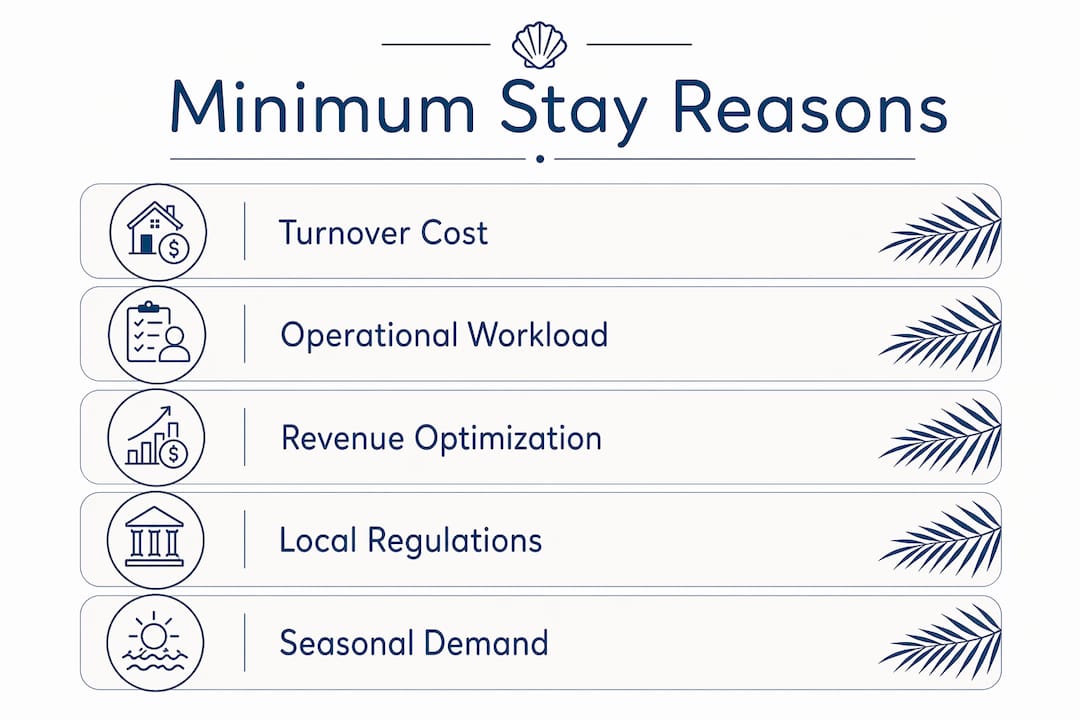
Revenue optimization plays a role as well. A property booked for three nights at a premium rate generates more total income than three separate one-night bookings, even at the same nightly price, once turnover costs are subtracted. Longer stays also reduce the risk of calendar gaps, those awkward one or two-night holes between bookings that are hard to fill.
Pro Tip: If you are comparing two similar properties and one has a longer minimum stay, ask the host directly about their off-peak flexibility. Many managers quietly reduce minimums for shoulder-season weeks to fill gaps.
How do seasonal and dynamic minimum stay policies affect booking options?
Minimum stay requirements are not static. Most property managers adjust them throughout the year based on demand, day of week, and calendar position. Dynamic minimum stay settings can shift a peak-season 5-night requirement down to 2 nights on a slow midweek stretch. That flexibility helps owners fill gaps without permanently lowering their standards.
Here is how the seasonal pattern typically works:
Peak season (summer, major holidays): Minimums rise to 5–7 nights. Demand is high, so owners have no reason to accept short stays that create gaps around prime weeks.
Shoulder season (spring, early fall): Minimums often drop to 3–4 nights. Owners want occupancy but still protect against high-cost single-night turnovers.
Off-peak (winter weekdays, slow months): Minimums may fall to 1–2 nights. Filling any night is better than leaving the property empty.
Holiday gaps: Some owners raise minimums specifically around Thanksgiving or Christmas to prevent travelers from booking only the cheap nights surrounding a holiday week.
Understanding this rhythm helps you plan smarter. Booking during off-season periods often means shorter minimum stays, lower nightly rates, and more calendar flexibility. The property that requires 7 nights in july may welcome a 3-night stay in october.
Pro Tip: Search with flexible dates when you can. Many booking platforms let you browse by “flexible” arrival windows, which surfaces properties whose dynamic minimums align with your travel window even when exact-date searches come up empty.
Knowing when to book also affects which minimum stay tiers you encounter. Early bookers during peak season face the strictest minimums. Late bookers in slow periods often find owners willing to negotiate shorter stays to avoid empty nights.
What should travelers know when searching and booking vacation rentals?
Search invisibility is the most common frustration travelers face. Guests searching for dates shorter than a property’s minimum stay will not see that listing in results at all. The property exists and may even be available. You just cannot find it through standard filters.
A few practical strategies help you work around this:
Adjust your search window. Adding one extra night to your search often unlocks properties that were invisible at your original length. You can always ask the host if the extra night is truly required or if it is a soft minimum.
Contact hosts directly about gap nights. A “gap night” is a single open night between two bookings. Hosts sometimes accept shorter stays to fill these gaps, even when their listed minimum is higher. Direct host communication is the most reliable way to unlock otherwise blocked availability.
Check age requirements. Many vacation rental policies require the primary guest to be 25 or older. Violations of age, occupancy, or minimum stay rules can result in instant booking cancellations without a refund. Read the full policy before you book.
Review the full rental agreement. Minimum stay is one clause among many. Payment deadlines, cancellation terms, and noise policies all connect to the same framework. Understanding the complete picture protects your deposit.
Learning short-term rental regulations in Florida also helps you understand why certain minimums exist in specific markets. State and local rules shape what owners can legally offer, and knowing the regulatory context makes the policies feel less arbitrary.
For travelers who want the most flexibility, booking a weekend stay with a clear understanding of minimum stay terms leads to better outcomes than searching blindly and hitting walls. Preparation is the simplest tool you have.
Key Takeaways
Vacation rental minimum stay requirements exist to protect owner revenue and control turnover costs, and understanding them before you search makes finding the right property significantly easier.
Point | Details |
Minimum stay is contractual | It is the required number of consecutive nights; properties below this threshold are invisible in search results. |
Costs drive the policy | Turnover costs of $75–$350+ per booking make short stays financially unworkable for many properties. |
Minimums shift by season | Peak periods carry 5–7 night minimums; off-peak periods often drop to 1–2 nights with more flexibility. |
Direct contact unlocks options | Contacting hosts about gap nights can reveal availability that standard search filters hide entirely. |
Age and policy compliance matter | Most properties require guests to be 25 or older; violations can trigger cancellation without a refund. |
Why minimum stay policies deserve more respect from travelers
I have watched travelers get frustrated by minimum stay rules for years, and the frustration almost always comes from the same place: they see the policy as an obstacle rather than a signal. When a property requires 5 nights during peak season, that is not the owner being difficult. That is the owner telling you exactly how the economics of that home work.
The properties with the most generous minimum stay flexibility tend to be the ones with the most attentive management. Owners who think carefully about their minimums also think carefully about their cleaning standards, their communication, and their pricing. The two habits travel together. When I see a property with a thoughtfully structured minimum stay policy that adjusts by season, I take that as a sign the owner is running a professional operation.
The trend I find most interesting right now is the move toward dynamic minimums tied to real-time demand data. Owners who adjust their minimums weekly, rather than setting a flat rule for the whole year, consistently report better occupancy and fewer calendar gaps. That is good for travelers too, because it means more availability at shorter durations during slow periods. The rigid “7 nights always” approach is quietly giving way to something more responsive, and that benefits everyone.
— Josh
Vacation rentals on Captiva Island with stays that fit your plans
Captiva Island is the kind of place where the right number of nights feels obvious once you arrive. Three days is enough to exhale. A full week lets the island settle into you properly.

Captiva-island, through American Realty of Captiva, offers vacation rental properties ranging from private beachfront homes to tranquil bayfront retreats, with stay options designed to fit real travel schedules. Whether you are planning a long weekend or a full week by the Gulf, the team brings over 30 years of local expertise to help you find the right fit. Browse beachfront homes on Captiva and check current availability to see which properties match your preferred stay length and travel dates.
FAQ
What is a vacation rental minimum stay?
A vacation rental minimum stay is the required number of consecutive nights a guest must book to reserve a property. Property managers set this floor to cover turnover costs and protect revenue.
Why can’t I find certain rentals in my search results?
Properties with minimum stay requirements longer than your selected dates are hidden from search results entirely. Try extending your search by one or two nights, or contact the host directly about availability.
Do minimum stay requirements change by season?
Yes. Dynamic minimum stay policies adjust by season, day of week, and demand. Peak periods typically require 5–7 nights, while off-peak periods may drop to 1–2 nights.
What happens if I violate a minimum stay policy?
Violating rental policies, including minimum stay rules, can result in immediate booking cancellation without a refund. Always read the full rental agreement before confirming your reservation.
How do I find short-stay vacation rentals?
Search with flexible dates, look for properties during shoulder or off-peak seasons, and contact hosts directly about gap nights. Understanding digital reservation terms before booking also helps you navigate policies with confidence.
Recommended
Comments