
What Defines a Luxury Vacation Rental in 2026


Most travelers picture a luxury vacation rental as a large home with a pool and a good view. That image is not wrong, but it is incomplete. What defines luxury vacation rental experiences in 2026 has shifted considerably, moving past square footage and marble countertops toward something more personal and, honestly, harder to fake. Bookings for luxury rentals priced at $1,000 or more per night have increased by 73% since 2019. That surge tells you something real is driving demand, and it is not just bigger hot tubs.
Table of Contents
Key Takeaways
Point | Details |
Privacy outranks amenities | Modern luxury travelers prioritize silence, exclusivity, and control over shared or elaborate facilities. |
Service ecosystems matter | True luxury rentals offer curated concierge, private chefs, and wellness access, not just well-furnished rooms. |
Design and location shape value | Architectural quality and proximity to premium surroundings directly determine a property’s luxury classification. |
Experience over ostentation | Meaningful local immersion and restorative stays define luxury more than visible status symbols in 2026. |
Hotels and rentals serve different needs | Luxury vacation homes deliver private estates and customized living that hotel rooms structurally cannot replicate. |
What defines a luxury vacation rental today
The answer starts with the physical space but does not end there. A genuinely luxurious rental offers private outdoor living areas designed for use, not just photographs. Think screened lanais that open to a quiet bay, covered terraces with an outdoor kitchen, or a pool deck where you are the only one who decides who gets in.
Smart home technology is now an expected feature rather than a bonus. Climate control you manage from your phone, integrated sound systems, automated lighting, and keyless entry all remove friction from the stay. These details matter because luxury is partly the absence of small annoyances.
The characteristics of luxury rentals also include a standard of maintenance and cleanliness that goes beyond a clean bathroom. Linens are hotel grade, kitchen equipment actually works, and the property looks exactly like its listing photographs. Discrepancy between what you see online and what you find at check-in is the fastest way to disqualify a property from the luxury category.
Then there is exclusivity. Ultra-luxury buyers prioritize low-density residences and curated environments that protect their privacy over time. In rental terms, this means properties that are not packed into a resort corridor, where the closest neighbor is far enough away that you forget they exist.
Service is where many rentals claim luxury status and few actually deliver it. Top-tier properties offer full-service ecosystems with specialized concierge support, private chefs who can accommodate specific dietary needs, and on-site wellness offerings. This is not a front desk that answers the phone. It is a team oriented around your specific trip.
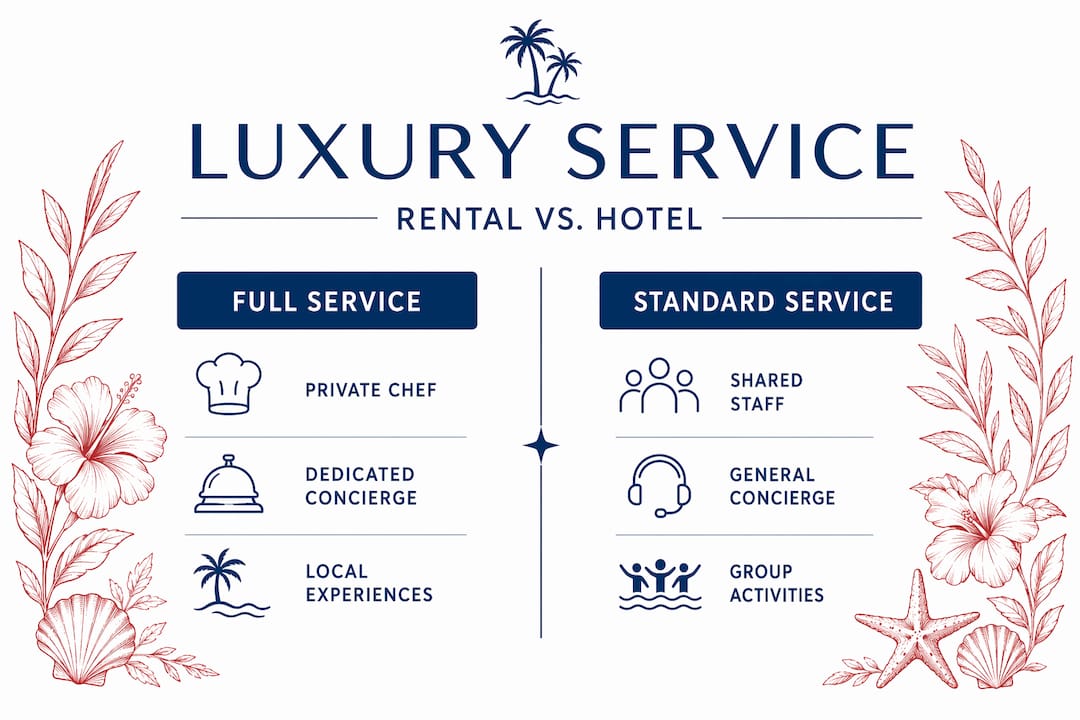
Pro Tip: When evaluating high-end rentals, ask directly whether the concierge is dedicated to your property or shared across dozens of listings. The answer tells you immediately what kind of service to expect.
Location ties it all together. Proximity to the water, a private forest, a cultural district, or a protected natural area is not a backdrop. It is part of what you are paying for. The best features of high-end rentals always include a setting that could not be recreated somewhere cheaper.
The experience side of luxury stays
The most significant shift in defining luxury vacation rentals is the move away from performing luxury toward actually feeling it. 2026 travelers seek meaningful, restorative experiences over status symbols or flashy finishes. What makes a rental luxurious today is often what it removes from your day, not what it adds.
Silence is underrated. The quality of silence and air quality now outrank elaborate amenities for discerning travelers. A property where you wake up to birds and water instead of traffic and neighboring conversations is, in a real sense, more luxurious than one with a marble foyer in a noisy location.
The average stay at elite luxury rentals in Europe has grown to 33 days, reflecting how travelers now want to settle in, slow down, and genuinely inhabit a place rather than pass through it.
Curated local experiences have become a defining feature of high-end rentals that take service seriously. The best operators do not hand you a list of restaurants. They connect you with personalized Path Guides who build an actual relationship with your group and open doors that standard concierge services cannot. A private tour of a working oyster farm. A morning with a local fisherman. Access to a gallery opening that is not listed anywhere publicly.
Flexibility for groups is also part of what to expect from luxury rentals. Lock-off suites within larger villas give families and multi-generational groups essential privacy and autonomy while keeping the shared living spaces intact. You can be together when you want to be and completely separate when you need to be. That balance is something hotels structurally cannot provide.
The luxury villa market is growing precisely because travelers have realized that bespoke hospitality and genuine local connection are impossible to manufacture at scale. Farm stays, immersive cultural itineraries, and properties that embed you in a real community rather than a resort bubble are all expressions of this shift.
Hotels versus luxury vacation homes
A luxury hotel has real value. The spa is staffed, room service arrives at 2 a.m., and you never have to think about towel supply. But a hotel also means shared lobbies, identical corridors, and a social experience you did not choose. You can read more about how these two options compare in detail, but the core distinction is straightforward.
Dimension | Luxury hotel | Luxury vacation rental |
Privacy | Shared common areas and hallways | Entire private estate |
Space | One or two rooms | Multiple bedrooms, living areas, outdoor spaces |
Service | Standardized for all guests | Customized to your group |
Kitchen access | Limited or none | Fully equipped, often with private chef option |
Atmosphere | Consistent but impersonal | Reflects local character and design |
Sustainability | Mixed | Often more efficient per guest |
The space difference alone changes how a trip feels. A family of six in a luxury rental has a living room, a kitchen they control, and a pool no one else is using. That shared meal on the private terrace on the last night of the trip is not something a hotel can replicate, regardless of star rating.
Pro Tip: If you are traveling with more than four people, a luxury vacation rental almost always delivers more value per person than even a five-star hotel, once you factor in shared spaces, meals, and the absence of corridor noise.
From a sustainability perspective, vacation rentals tend to use energy more efficiently per guest, with fewer communal systems running around the clock. For travelers who factor environmental impact into their travel decisions, this is another quiet advantage of the rental model.
How location and design shape the luxury label
Defining luxury in vacation rentals requires an honest look at what the property is built from and where it sits on the map. Architectural quality is not decoration. World-renowned designers create properties that function as living art, where the flow of natural light, the placement of walls, and the choice of local materials all shape how you feel inside the space.

Properties that use regional craftsmanship and natural materials create an authentic sense of place that generic construction cannot replicate. A home built with local stone, native wood floors, and windows positioned to frame a specific view of the water is not just attractive. It is connected to somewhere specific, and that specificity is part of what you are paying for.
Luxury rental pricing reflects these factors directly. In premium markets, rates start at $400 per night and frequently exceed $1,000, linked directly to location and design quality. Here is a general picture of how that breaks down:
Price range | What it typically reflects |
$400 to $600 per night | Strong location, quality finishes, basic service included |
$600 to $1,000 per night | Premium design, dedicated service, exceptional privacy |
$1,000 and above | Architectural distinction, full service ecosystem, rare or exclusive location |
Beyond price, the right location delivers something intangible. A property that sits on a quiet stretch of beachfront, backed by a nature preserve, asks nothing of you except to be present. The water does the work. The light changes through the day and you notice it, maybe for the first time in months. That is what luxury travel accommodations can offer when location is treated as seriously as the design.
Social prestige still plays a role for some travelers, but the more interesting dynamic in 2026 is personal satisfaction. Travelers are choosing properties that reflect who they are and how they actually want to feel, not just what impresses someone else.
My honest take on what luxury really means now
I have followed the vacation rental market closely for years, and the question I hear most often is some version of: “Is this place actually worth it?” My experience is that the answer almost never lives in the feature list.
The rentals that genuinely deliver are the ones where someone clearly thought about what it feels like to arrive after a long trip, what it sounds like at six in the morning, and what happens when a guest has an unusual request. Those decisions are invisible until you experience them. And when you do, you do not think “this is luxurious.” You just think “this is right.”
What I have noticed is that travelers who chase amenities often end up mildly disappointed, even in spectacular properties. The outdoor kitchen goes unused. The home theater stays dark. But the couple who booked a quieter property on the water and got exactly two hours of absolute silence every morning? They book the same place again the following year.
My advice is to read past the bullet points in any listing. Look for evidence of thought: the quality of the light in the photos, the orientation of the outdoor space, whether the property description mentions what surrounds it. Those signals tell you more about what the stay will feel like than any list of features. Choose for your personal vibe, not for the trend.
— Josh
Luxury rentals on Captiva Island worth your attention
If you are ready to move from research to reservation, Captiva-island makes that step straightforward. American Realty of Captiva has spent over 30 years building a collection of beachfront and bayfront homes that take privacy, design, and location seriously. These are not generic vacation houses dressed up with premium pricing. They are properties where the Gulf light, the quiet mornings, and the private outdoor spaces do exactly what great luxury travel accommodations are supposed to do.

You can explore the full range of available properties, from beachfront vacation homes to estates with private pools, through the complete rental listings on the site. The team handles the details personally, which means you get the kind of attentive service that actually fits the luxury category. Browse the listings and let the right property find you.
FAQ
What makes a vacation rental qualify as luxury?
A luxury vacation rental offers a combination of private space, premium design, attentive service, and a location with genuine character. True luxury goes beyond amenities to include exclusivity, silence, and a curated experience tailored to your group.
How does a luxury rental differ from a five-star hotel?
Luxury vacation rentals provide an entire private estate with customized services, full kitchen access, and no shared corridors or lobbies. Hotels offer convenience and staffing but cannot replicate the privacy, space, or personalized atmosphere of a well-chosen rental.
What amenities should I expect from a high-end rental?
Top luxury rental amenities typically include smart home technology, private pools, outdoor kitchens, premium linens, and dedicated concierge support. Properties at the upper end also offer private chefs, wellness services, and curated local experience access.
What price range signals a true luxury vacation rental?
Luxury rental pricing generally starts around $400 per night in premium markets and often exceeds $1,000 per night for properties with architectural distinction, rare locations, and full service ecosystems.
Why do luxury travelers prefer rentals over hotels now?
Discerning travelers prioritize privacy, silence, and control over their environment above shared amenities. A private vacation estate delivers those qualities in a way that even the best hotel room structurally cannot.
Recommended
Comments