
Why Beachfront Property Appreciates Faster Than Inland

Beachfront property is defined as residential real estate with direct, unobstructed access to a shoreline, and it consistently outpaces inland real estate in price appreciation. The core reason why beachfront property appreciates faster comes down to a simple economic truth: you cannot build more ocean. Coastal land is finite, regulatory restrictions limit new development, and demand from wealthy buyers grows every year. Long-run appreciation averages 3–6% annually in established premium markets, a rate that reflects durable structural forces rather than short-term speculation. Add the psychological pull of water, strong rental income, and prestige ownership, and you have an asset class that rewards patient investors.
Why beachfront property appreciates faster: the scarcity factor
The most powerful driver of coastal real estate value is supply that cannot grow. Coastlines are geographically fixed. Zoning laws, setback requirements, and environmental regulations prevent new construction from expanding the beachfront housing stock in virtually every established market. When demand rises and supply stays flat, prices move in one direction.
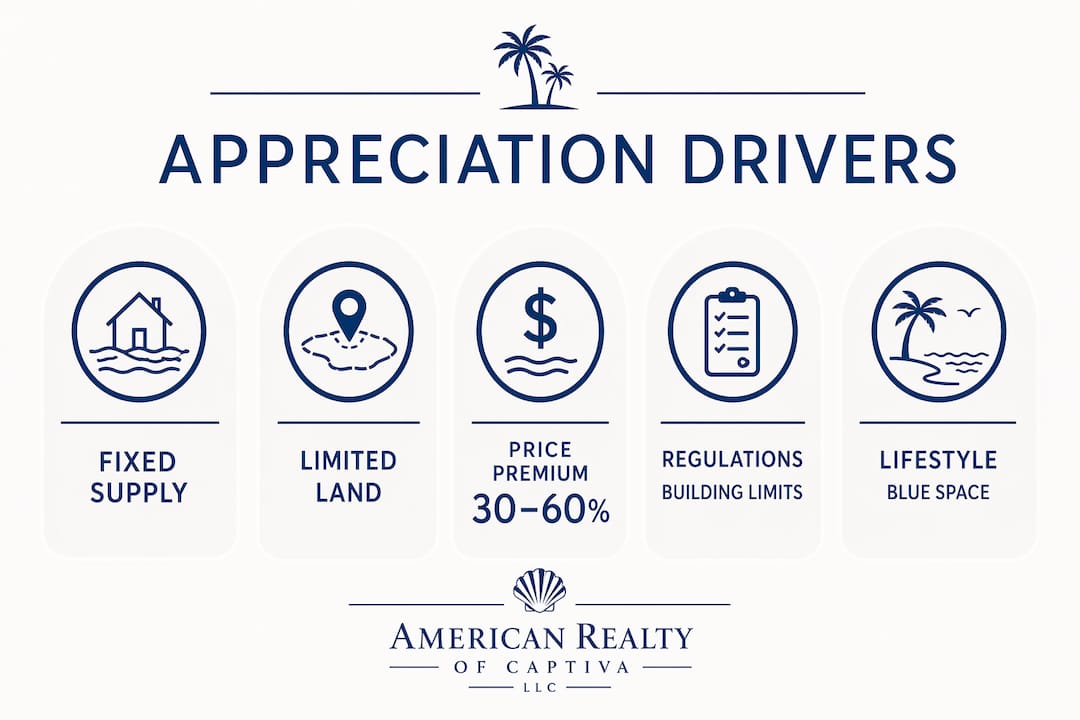
Frontline beachfront properties carry a 30–60% price premium over comparable inland homes in prime markets. That gap reflects pure scarcity. A buyer who wants direct beach access has a very short list of options, and sellers know it.
Land composition tells the same story. In high-end coastal properties, land accounts for 80–92% of total value, compared to a much lower share in typical suburban homes. That ratio means the structure depreciates while the land appreciates, and the land is doing almost all of the heavy lifting.
Regulatory pressure adds another layer. Coastal construction permits in Florida, California, and most of the Gulf Coast require environmental impact reviews, flood zone compliance, and setback adherence. Each requirement raises the cost and time of new supply. The result is a market where existing beachfront homes face almost no competition from new inventory.
Pro Tip: Before buying, check the local Coastal Construction Control Line (CCCL) designation. Properties seaward of this line face stricter building rules, which limits future competition and protects your land value.
Factor | Effect on appreciation |
Fixed coastal geography | Supply cannot expand to meet demand |
Zoning and setback laws | New construction is costly and slow |
Environmental restrictions | Limits redevelopment of existing parcels |
Land-to-value ratio (80–92%) | Appreciation concentrates in the land, not the structure |
What is “Blue Space” and how does it push prices higher?
Demand for beachfront real estate is not purely rational. Humans possess an innate “Blue Space” psychological attraction to water that pushes prices beyond what land utility alone would justify. Proximity to the ocean lowers stress, improves mood, and creates a sense of calm that buyers are willing to pay a significant premium to access every day.
This emotional pull shapes buyer behavior in ways that standard investment analysis misses. A buyer comparing two properties of equal square footage will consistently choose the one with ocean views, even at a price that does not pencil out on a pure yield basis. The view carries its own value, and that value is remarkably stable across economic cycles.
“Tourism, scarcity, luxury demand, and infrastructure development combine to continuously push beachfront property values upward. The sea is not just a backdrop. It is an active component of the asset’s worth.”
Lifestyle motivations reinforce this dynamic. Remote work trends have expanded the buyer pool beyond retirees and vacation-home collectors. High-income professionals now seek primary residences on the coast, competing directly with traditional second-home buyers. That demographic shift has deepened demand without adding any new supply.
Short-term rental income adds a financial dimension to the lifestyle appeal. Beachfront homes in markets like Captiva Island, Florida, command premium nightly rates and attract guests who book early and return annually. Tourism and recreation elevate demand in ways that support both occupancy rates and long-term price growth.
How economic dynamics sustain coastal property appreciation over time
The appreciation of coastal properties is not accidental. Several economic mechanisms work together to sustain price growth across market cycles.
Fixed supply meets growing demand. Wealthy buyers are a growing segment globally, and beachfront property is one of the few assets they all want. Supply stays flat while the buyer pool expands.
Rental income supports valuations. Beachfront rentals produce gross yields of 10–18% in high-demand markets, with net yields of 4–6% self-managed or 10–15% professionally managed. That income stream gives investors a return while they wait for appreciation.
Inflation hedging. Hard assets with fixed supply tend to hold real value during inflationary periods. Beachfront land is among the most inflation-resistant real estate categories.
Leverage amplifies gains. A 20% down payment on a property appreciating at 5% annually produces a leveraged return on equity that substantially outperforms the headline appreciation rate.
Statistic callout: Beachfront real estate averages 3–6% annual appreciation in established premium markets. At 5% compounded over 15 years, a $1,000,000 property reaches approximately $2,078,000 without any improvements.
The long-term durability of this appreciation is supported by a fixed, finite coastal supply and growing high-income demand driven by lifestyle preferences and remote work trends. These are structural forces, not cyclical ones. They do not reverse when interest rates rise or when the broader housing market softens.
Does beach quality and proximity actually change how much a property appreciates?
Not all beachfront is equal, and the differences in appreciation rates within coastal markets are significant. Beach width is a measurable driver of land value. Beaches below 30 meters in width see a sharp drop in property value compared to wider, more usable stretches of sand. A narrow beach signals erosion risk and limits the recreational experience that buyers are paying for.
Proximity to the shoreline follows a non-linear price curve. Properties one row back from the beach trade 9–20% less than direct frontline homes. Properties more than one kilometer from the beach drop roughly 20% below the local average. The premium concentrates at the water’s edge and decays quickly as distance increases.
Oceanfront priority locations appreciate faster than ocean-view-only properties because of limited availability and higher prestige. An “ocean view” property is a different product from a true beachfront home, and the market prices them accordingly.
Property features also influence the rate of value gain. Outdoor living spaces, private pools, and direct beach access points add measurable value. The beauty premium around beach quality is a real and significant driver of coastal land prices. Investors who understand this distinction can identify undervalued properties by looking for homes on wide, well-maintained beaches that are priced as if the beach quality were average.
Pro Tip: When evaluating a beachfront property, request historical erosion data from the local county. A beach that has widened over the past decade is a stronger investment than one that has narrowed, regardless of current width.
Property type | Typical price position |
Direct frontline beachfront | Full premium, highest appreciation rate |
One row back from beach | 9–20% discount to frontline |
Ocean view, not direct access | Moderate premium, slower appreciation |
Over 1 km from beach | Roughly 20% below local average |
Practical strategies for capturing beachfront appreciation
Buying in the right market is the single most important decision. Established premium coastal markets with proven track records, strong rental demand, and regulatory barriers to new supply offer the most reliable appreciation. Captiva Island, Florida, fits this profile precisely. The island’s limited land area, strict environmental protections, and consistent tourism demand create exactly the conditions that drive long-term price growth.
Maintaining property quality matters more than most investors expect. Exterior renovations produce better value-add returns than interior upgrades in established beachfront markets, with ROI ranging from 50–150% depending on scope and market. A fresh exterior, well-maintained landscaping, and a functional outdoor living space signal quality to buyers and justify premium pricing.
Understanding local zoning and title issues protects your investment. Coastal properties carry unique risks including flood zone classifications, hurricane exposure, and easement disputes. A clean title review and a current survey are non-negotiable before closing. You can learn more about what drives beachfront pricing before you commit to a market.
Rental income management is the final lever. Properties that generate consistent short-term rental revenue support their own valuations by demonstrating real market demand. Seasonal occupancy variations are normal in coastal markets, but a well-managed property on Captiva Island can produce strong annual returns while the underlying land appreciates. Captiva-island’s rental income strategies offer practical guidance on maximizing occupancy and pricing.
Key Takeaways
Beachfront property appreciates faster than inland real estate because fixed coastal supply, lifestyle-driven demand, and strong rental income create durable upward price pressure that compounds over time.
Point | Details |
Scarcity drives the premium | Coastal land cannot expand; 30–60% price premiums over inland properties reflect this constraint. |
Blue Space demand is structural | Psychological attraction to water creates buyer demand that persists across economic cycles. |
Appreciation averages 3–6% annually | Established premium coastal markets deliver this rate consistently, compounding significantly over 15+ years. |
Beach quality and proximity matter | Frontline homes outperform; properties one row back trade 9–20% less than direct beachfront. |
Exterior improvements maximize returns | Coastal-vernacular exterior renovations yield 50–150% ROI, outperforming interior upgrades. |
What I’ve learned watching beachfront markets over the years
The most common mistake I see investors make is confusing prestige pricing with real market value. Some beachfront listings sit for months, get relisted, and close well below asking price. Below-ask closings and repeated relistings are signals that a property is priced on symbolic status rather than what buyers will actually pay. The scarcity argument is real, but it does not make every beachfront home a good investment at any price.
The investors who do best are the ones who buy with a long horizon and a clear rental strategy. They are not trying to flip in two years. They understand that the appreciation is structural and patient. They also know that a property generating rental income while they wait is a fundamentally different risk profile than a vacant home carrying costs.
One thing I find underappreciated is the role of beach quality itself. Most buyers focus on the address and the view. The smart money looks at the beach width, the erosion history, and the direction of the sand drift. A wide, stable beach is a long-term asset. A narrow, eroding beach is a liability dressed up in a premium price tag.
If you are weighing a beachfront purchase, get a free home valuation before you negotiate. Knowing where the property sits relative to recent comparable sales gives you real leverage at the table.
— Josh
Beachfront rentals and investment properties on Captiva Island
Captiva Island sits at the intersection of everything that makes beachfront real estate valuable: limited land, pristine Gulf beaches, strong year-round tourism, and a rental market that rewards quality properties with consistent demand.
Captiva-island, operated by American Realty of Captiva, has more than 30 years of local expertise connecting investors and vacationers with the island’s finest properties. Whether you are looking to rent a beachfront home on Captiva for a week or evaluate the market for a long-term investment, the team brings the kind of on-the-ground knowledge that national platforms simply cannot match. You can browse the full range of available Captiva rentals to get a real sense of what the market looks like today, from Gulf-front estates to bayfront retreats with private pools.
FAQ
Why does beachfront property appreciate faster than inland homes?
Beachfront property appreciates faster because coastal land supply is fixed while demand from wealthy buyers grows steadily. Regulatory restrictions prevent new development, and the psychological appeal of water access creates buyer demand that persists across market cycles.
What is the average appreciation rate for beachfront real estate?
Beachfront real estate averages 3–6% annual appreciation in established premium coastal markets. That rate compounds significantly over time and is supported by structural supply constraints rather than short-term market conditions.
How much less does a property one row back from the beach sell for?
Properties one row back from direct beachfront typically sell for 9–20% less than frontline homes. Properties more than one kilometer from the beach drop roughly 20% below the local market average.
Does beach width affect property value?
Beach width is a measurable driver of coastal land value. Beaches below 30 meters in width see a sharp drop in property prices, reflecting both reduced recreational appeal and higher erosion risk.
What renovations add the most value to a beachfront property?
Exterior renovations consistently outperform interior upgrades for beachfront properties, producing ROI of 50–150% depending on market and scope. Outdoor living spaces, fresh exteriors, and direct beach access features drive the strongest returns.
Recommended
Comments