
Beach Rental Occupancy Limit: What Every Guest Must Know


A beach rental occupancy limit is the legally defined maximum number of guests permitted to stay in a vacation rental property at the same time. Local fire codes, municipal building permits, and short-term rental ordinances all determine this number. Violating it can mean fines, permit revocation, or removal from the property. If you are planning a beach trip with family or a group of friends, understanding the vacation rental occupancy limit before you book protects everyone and keeps your getaway exactly that.
What is beach rental occupancy limit and how is it set?
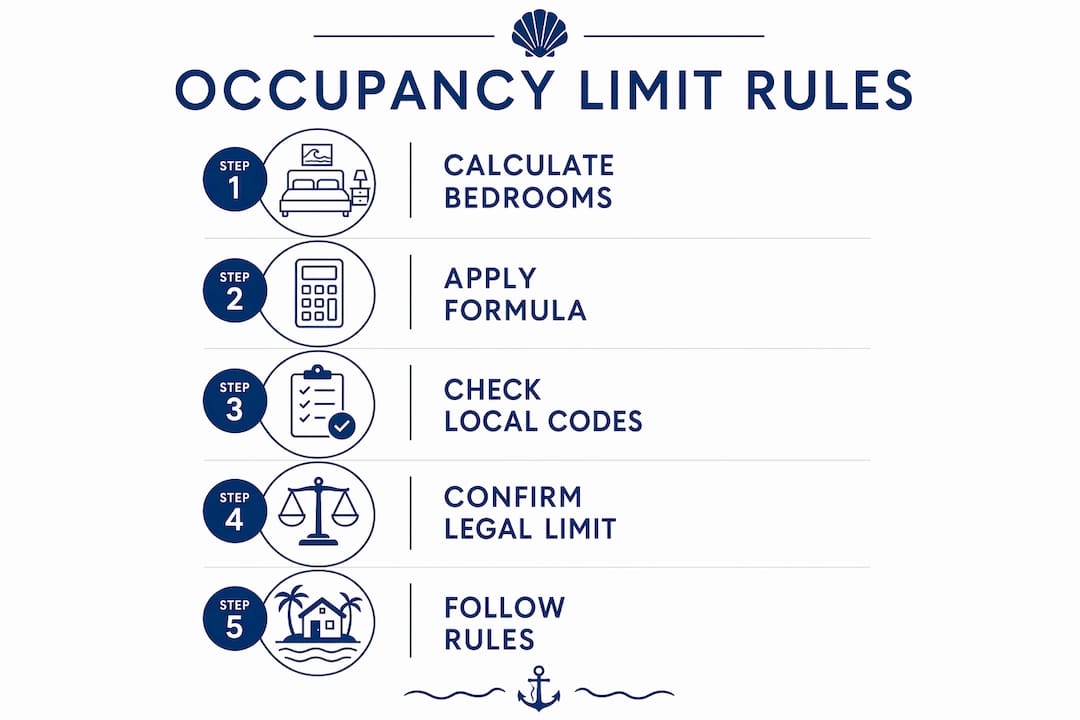
The standard formula used across most jurisdictions is two guests per bedroom plus two additional guests, with a hard cap typically between 10 and 12 persons. That formula exists because it reflects what a property’s plumbing, electrical systems, and exits can safely handle. A four-bedroom beach house, for example, would have a base limit of ten guests under this model.
The legal limit comes from whichever source is most restrictive. Fire codes, building permits, and short-term rental permit conditions each set their own ceiling, and the lowest of those numbers becomes the enforceable limit. A property may have a building permit that allows twelve guests, but a short-term rental ordinance that caps it at ten. The ten applies.

Bedroom count and square footage both factor into the calculation. Larger square footage can sometimes support a higher count, but only when the building permit and fire code agree. The table below shows the main factors that shape a maximum occupancy beach house limit.
Factor | How it affects the limit |
Bedroom count | Base formula: 2 guests per bedroom plus 2 |
Square footage | Larger floor area may support a higher count |
Fire code | Sets the absolute safety ceiling |
Building permit | Reflects structural capacity at time of construction |
Short-term rental permit | Local ordinance cap, often the most restrictive |
Children’s age | Children under a certain age may be exempt by jurisdiction |
Pro Tip: Always ask the host or property manager for the permit-stated occupancy number, not just the advertised guest count. These two figures do not always match.
Why do occupancy limits exist?
Occupancy limits protect guests, neighbors, and the property itself. The most direct reason is fire safety. Coastal homes often have limited exit routes, and an overcrowded structure becomes dangerous when an emergency occurs. Coastal construction requirements directly affect how many people a building can safely hold under environmental stress, including high winds and storm surge conditions.
Beyond safety, limits reduce community friction. Noise complaints, parking overflow, and wear on shared infrastructure all increase with guest count. Occupancy limits protect neighborhood peace and keep short-term rental programs politically viable in beach communities. When rentals cause repeated disruptions, municipalities often respond by tightening regulations or banning short-term rentals entirely.
Property damage is a third driver. More guests means more wear on furniture, appliances, and outdoor spaces. Some hosts now use automated monitoring technology to track noise levels and occupancy in real time. Exceeding occupancy risks property damage and community disruption, which is why monitoring tools have become standard practice in professionally managed rentals.
“Occupancy limits are not arbitrary restrictions. They are the point where safety codes, community standards, and property care all converge.”
Pro Tip: If a listing advertises a guest count that seems high for the bedroom count, verify it against the local permit. A five-bedroom home advertising sixteen guests is a red flag worth investigating before you book.
How do coastal zone rules affect occupancy limits?
Coastal rentals carry additional restrictions that inland properties do not face. Coastal properties have restrictions based on construction standards and environmental risks that go beyond standard building codes. Flood zone designations, wind load requirements, and elevated foundation designs all influence how many people a structure can safely accommodate.
Parking rules add another layer. Off-street parking must correlate with occupant count to comply with local codes, and some beach communities require one parking space for every three guests. A property that legally holds ten guests but only has two parking spaces may effectively cap your group at six under local enforcement rules. This is a detail many renters miss entirely.
Local zoning boards in coastal communities also impose noise curfews and quiet hours that tie directly to occupancy. A larger group is statistically more likely to trigger a noise complaint, which means some municipalities apply stricter occupancy caps to properties in residential coastal zones. Before booking a beach house for a large group, check the local zoning classification, not just the listing description.
Renters planning trips to places like Captiva Island should review the specific county and municipal rules that apply to their rental. Florida’s coastal communities each maintain their own short-term rental frameworks, and what applies in one beach town may differ significantly from the next.
What should you know about complying with occupancy limits?
Understanding who counts as an occupant is the first step. An occupant is typically any person present between 11:00 p.m. and 7:00 a.m., regardless of age or relationship to the primary renter. That overnight window is the legal definition in many Florida jurisdictions. Daytime visitors who leave before 11:00 p.m. may not count, but confirm this with the host before assuming.
Children six and under are typically exempt from the count in some jurisdictions, while others count all occupants regardless of age. This distinction matters for families traveling with young children. A family of six adults and two toddlers may legally stay in a property with an eight-person limit in one county but not in another.
Here are the practical steps every renter should take before finalizing a booking:
Ask the host for the permit-stated maximum occupancy, not just the listing’s advertised number.
Confirm whether children are counted and at what age threshold.
Check whether daytime visitors count toward the limit or only overnight guests.
Verify parking requirements and confirm your group has enough vehicles to comply.
Read the rental agreement carefully for any occupancy clauses that go beyond the legal minimum.
Hosts sometimes advertise a guest count below the legal maximum as an operational buffer. This practice reduces noise complaints and extends the life of the property. It also means the listed capacity may not reflect what the permit actually allows. If your group is close to the advertised limit, a direct conversation with the host can clarify whether there is any flexibility.
Undisclosed extra guests breach rental agreements, giving hosts grounds to impose penalties or pursue damages claims. Beyond the contractual risk, violations can cause fines or loss of the short-term rental permit. The renter, not just the host, can face consequences when a property is found to be over capacity. Respecting beach house guest restrictions is not just courteous. It is legally and financially protective for you.
For a broader look at how accommodation type affects occupancy expectations, the types of beach vacation accommodations guide covers the full range of options and what each typically allows. Families planning larger gatherings may also find the family beach house rentals guide useful for matching property size to group needs.
Key Takeaways
A beach rental occupancy limit is a legally binding number set by fire codes, building permits, and short-term rental ordinances, and exceeding it carries real financial and legal consequences for renters.
Point | Details |
Standard formula | Most limits follow 2 guests per bedroom plus 2, capped at 10–12 persons. |
Most restrictive rule applies | Fire codes, building permits, and STR permits each set a ceiling; the lowest number governs. |
Overnight definition matters | Occupancy is typically counted between 11 p.m. and 7 a.m.; daytime visitors may not count. |
Coastal zones add restrictions | Environmental and structural requirements create stricter caps in beachfront properties. |
Violations carry real risk | Renters face fines, contract penalties, and potential removal for exceeding the limit. |
What I have learned from watching renters get this wrong
Renters consistently underestimate how specific occupancy rules are. The most common mistake I see is treating the advertised guest count as the final word. It is not. That number reflects what the host chose to list, which may be lower than the permit allows or, in rare cases, higher than what local zoning actually permits. The permit is the only number that matters legally.
The second misunderstanding involves children. Families often assume young kids do not count. Sometimes they are right. But in jurisdictions that count all overnight occupants regardless of age, a family of four adults and three children in a six-person property is already at the limit. One extra adult guest becomes a violation. Asking this question before you arrive is not overcautious. It is just good planning.
What I find most reassuring about well-managed properties is the transparency. When a host clearly states the permit number, explains the overnight definition, and outlines parking requirements upfront, that is a signal the property is professionally managed and compliant. That transparency protects you as much as it protects the host. A calm, well-run rental where everyone knows the rules is simply a better vacation.
— Josh
Captiva-island rentals with clear occupancy standards
Planning a beach trip with a group means finding a property where the occupancy rules are clear, the space is genuinely comfortable, and the management team knows the local regulations inside and out.

Captiva-island, operated by American Realty of Captiva with over 30 years of local expertise, lists properties with defined occupancy limits and full compliance with Florida’s short-term rental regulations. Whether you are looking for a beachfront vacation rental for a family reunion or a quieter bayfront home for a smaller group, the inventory reflects properties where the rules are stated clearly and the experience is built around your comfort. Browse the full selection of Captiva Island rentals to find a home that fits your group size and your idea of a perfect stay.
FAQ
What is the standard occupancy limit for a beach rental?
Most jurisdictions set the limit at two guests per bedroom plus two additional guests, with a cap typically between 10 and 12 persons total. The most restrictive rule among fire codes, building permits, and short-term rental permits applies.
Do children count toward the occupancy limit?
It depends on the jurisdiction. Some areas exempt children six and under, while others count all persons present overnight between 11:00 p.m. and 7:00 a.m. Always confirm the local rule with your host before arrival.
What happens if you exceed the occupancy limit?
Renters can face daily fines, removal from the property, and breach of contract claims from the host. The host may also risk losing their short-term rental permit, which creates additional legal exposure for all parties.
Why is the advertised occupancy sometimes lower than the legal maximum?
Hosts often set a buffer below the permit maximum to reduce noise complaints and protect the property from excessive wear. This is a common practice in professionally managed rentals and does not indicate a problem with the listing.
Are parking requirements connected to occupancy limits?
Yes, in many coastal communities. Local codes often require one off-street parking space per a set number of guests, and failing to meet parking standards can trigger enforcement action independent of the occupancy count itself.
Recommended
Comments