
Book Early Vacation Rental Discount: Save on Your Next Trip


An early booking discount is a preset price reduction that applies automatically when you reserve a vacation rental well before your arrival date, typically 60–120+ days out. Most travelers who use this tactic can expect to save a modest percentage off the base nightly rate, and the real advantage compounds when you layer in weekly discounts or book direct to avoid marketplace service fees.
Here is what you need to know right now:
Check dates 60–120+ days out. That window is where most early-bird triggers activate. The further out you book, the more likely the discount applies and the more premium inventory remains available.
Always compare the all-in price. A lower nightly rate can be offset by a large cleaning fee or a marketplace service charge. Run the full math before you commit.
Stack discounts when you can. Platforms and property managers often allow weekly or monthly discounts to combine with early-bird pricing, producing savings that exceed either discount alone.
Pro Tip: For high-demand weeks like spring break, Fourth of July, or school holiday windows, treat early booking as securing your first choice of home rather than chasing a bigger percentage off. The best beachfront properties on a barrier island like Captiva go fast, and no discount makes up for missing the home you wanted.
Table of Contents
How early-bird discounts work on vacation rental platforms
An early-bird discount is a lead-time trigger: a host or property manager sets a percentage reduction that activates automatically when a guest books a defined number of days before check-in. The guest sees the lower price without entering a promo code. The host’s goal is to motivate advance commitment and smooth out the booking calendar before peak demand fills dates at full rate.
Common configurations look like this:
Threshold windows: 60, 90, or 120+ days before arrival are the most typical trigger points. Some operators run tiered programs where a 120-day booking earns more than a 60-day booking.
Discount sizing: A moderate discount range is standard for standalone vacation rentals. Larger discounts (sometimes 20%+) appear on new listings as introductory offers or on bundled travel packages, which carry different deposit and cancellation terms.
Platform display: On Airbnb and Vrbo, qualifying listings show a discount badge or a strikethrough price in search results. On direct-booking sites, the reduced rate typically appears in the quote or on the property calendar.
Peak-date exclusions: Hosts routinely exclude their highest-demand dates from early-bird programs. A discount that applies to a quiet October week may not apply to the same property over Thanksgiving.
One nuance worth knowing: many property managers configure these triggers inside their property management system, so the discount fires automatically. If you book well in advance and no discount appears, the host likely has not enabled that trigger for those specific dates. It is always worth asking directly.

How far ahead should you book, and how much will you actually save?
Experienced hosts recommend booking 2–3 months out for most trips and 4–6 months out for peak summer weeks or major holidays. That guidance aligns closely with where early-bird thresholds sit and with what the data shows about booking behavior.
Market lead times vary considerably. AirROI’s market analysis shows median booking lead times ranging from roughly 35 days in markets like Miami to about 57.7 days in markets like Gatlinburg and New Orleans. When the median traveler books only 35–58 days out, a host who sets an early-bird trigger at 60+ days is genuinely rewarding behavior that is above average for that market.
Statistic callout: Early-bird discount triggers most commonly activate at 60–120+ days before check-in, with typical savings of 5–15% off the base nightly rate. Markets with shorter median lead times make the 60-day threshold relatively easy to hit; markets with longer lead times require more planning.
Here is a simple example of what that looks like in practice:
Scenario | Nightly Rate | Nights | Early-Bird (10%) | Cleaning Fee | Service Fee | Total |
No discount | $400 | 7 | — | — | — | $3,180 |
10% early-bird | — | 7 | — | — | — | $2,882 |
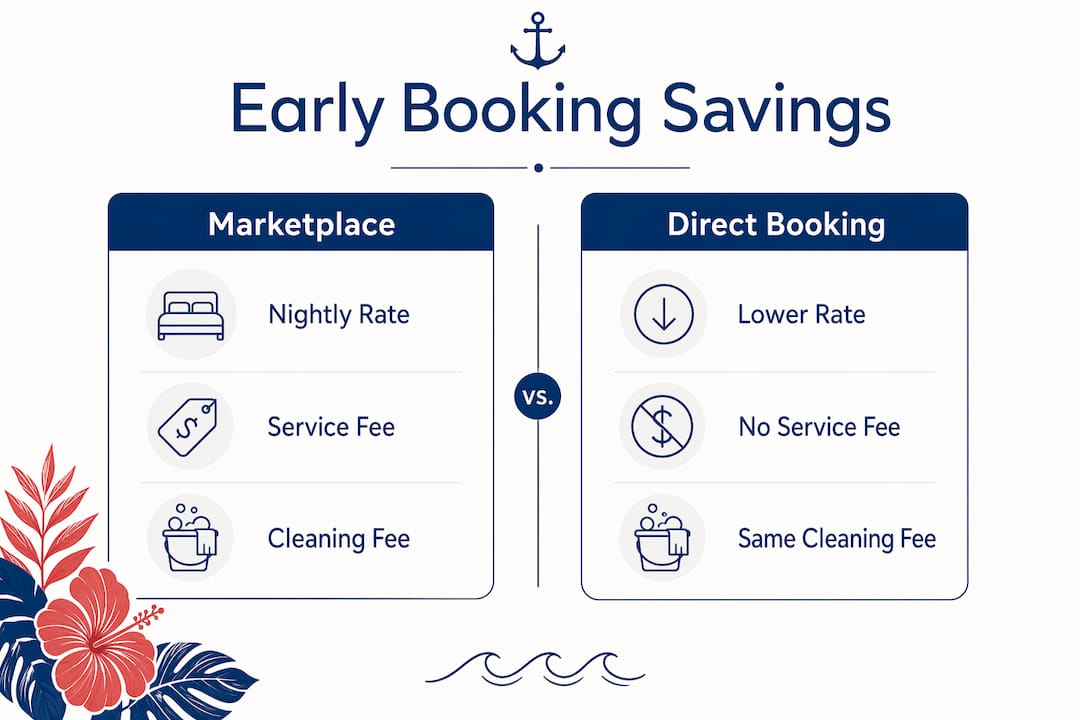
The $298 difference in that example assumes the service fee scales with the nightly rate, which it often does on marketplace platforms. On a direct booking where the service fee is waived or reduced, the savings grow further.
A few additional patterns to keep in mind:
Shoulder-season dates (May, September, early October for beach destinations) tend to carry the most reliable early-bird discounts because demand is softer and hosts want to fill calendars.
Peak holiday dates are frequently excluded from discount programs entirely.
Booking 90–119 days out often hits the sweet spot: discount still active, and a wide selection of properties still available.
Where early-bird discounts deliver the most value
Early-booking strategies work best in specific contexts. Knowing where they shine helps you decide whether to commit months in advance or stay flexible.
High-effect scenarios:
Beach resort destinations and barrier islands. Premium inventory (beachfront homes with private pools, gulf-front views) is finite. On places like Captiva Island, the combination of limited supply and strong seasonal demand means the best homes are reserved well before the early-bird window even closes.
Ski chalets and mountain cabins. Peak winter weeks and holiday ski periods follow the same pattern: limited supply, predictable demand spikes.
Event cities and festival weekends. Cities hosting major events see accommodation prices surge as the date approaches. Booking early locks in a rate before that surge.
Family and school-holiday travel. When your dates are fixed by a school calendar, flexibility is low. Early booking is the only reliable way to secure the right size home at a reasonable price.
Where it is less effective:
Urban business travel with flexible dates and abundant supply.
Off-peak weekday gaps in markets where hosts routinely drop rates to fill empty nights.
Situations where your travel plans are genuinely uncertain, since a nonrefundable early-bird rate carries real financial risk.
For luxury and unique inventory, the calculus shifts. A beachfront home with a private pool and direct gulf access is not interchangeable with a comparable-priced condo two blocks from the water. Booking early on premium properties is often about securing the exact home, not maximizing the discount percentage.
Pro Tip: Shoulder-season weeks are where early-bird discounts move the needle most. A host who fills a mid-May week at 10% off is far better off than leaving it empty. That dynamic works in your favor — you get a real discount, and you still have excellent selection.

How to compare the true all-in cost before you book
The nightly rate is the starting point, not the final number. Two listings with identical nightly rates can differ by hundreds of dollars once all fees are added. Here is what to check on every booking:
Nightly rate (after any early-bird or length-of-stay discount)
Cleaning fee (often flat, sometimes scaled to property size)
Marketplace service fee (Airbnb and Vrbo typically charge guests a percentage of the subtotal)
Local taxes (Florida levies state sales tax plus a county tourist development tax on short-term rentals)
Resort or booking surcharges (some property managers add a reservation fee)
Refundable security deposit (not a cost, but affects your cash flow at booking)
Cost Component | Marketplace Booking | Direct Booking |
Nightly rate | Listed rate | Same or lower |
Service fee | 6% of subtotal | Often waived or reduced |
Cleaning fee | Shown at checkout | Shown in quote |
Local taxes | Added at checkout | Added in quote |
Early-bird discount | Automatic if enabled | Automatic or negotiable |
The most significant savings from booking direct often come from eliminating the marketplace service fee, which can add hundreds of dollars to a week-long stay. Always request a full quote before comparing.
Stacking discounts is possible on many platforms. A 10% early-bird discount combined with a weekly stay discount can produce a meaningful reduction in the effective nightly rate. Some property managers also offer loyalty credits or repeat-guest rates that layer on top. What is generally not stackable: promo codes on top of an already-discounted early-bird rate, or introductory new-listing discounts combined with other active promotions.
Pro Tip: For group bookings, divide the total all-in cost by the number of guests and the number of nights. A $3,000 week for eight people works out to $53.57 per person per night, which often compares favorably to hotel rooms in the same destination.
Practical tactics to find and lock in early-booking deals
Finding discounted vacation rentals before they disappear takes a bit of system. These steps, taken in order, give you the best chance of capturing an early-bird rate on the home you actually want.
Set calendar reminders for your booking windows. Decide your travel dates, count back 90 and 120 days, and put both dates in your calendar. When those reminders fire, check availability immediately.
Use flexible-date searches. Both Airbnb and Vrbo allow you to search across a range of dates. Shifting your arrival by two or three days can move you into a lower-demand window where discounts are active.
Filter for discount badges. Airbnb’s search filters include a “discounts” option. Vrbo surfaces special offers in search results. Use these filters to surface properties where early-bird pricing is already active.
Watch for new-listing introductory offers. New listings sometimes offer introductory discounts on the first few bookings, occasionally 20% or more, which can exceed a standard early-bird rate. Sorting by “newest” on a platform surfaces these.
Sign up for property-manager newsletters. Many professional managers announce seasonal pricing launches and early-bird windows by email before they appear on marketplace platforms. Getting on those lists puts you ahead of the general public.
Book direct when possible. Contacting a property manager directly, or booking through their own website, can avoid marketplace service fees and sometimes surface rates or bundled amenities not visible on third-party platforms. A quick phone call or email asking about early-bird availability takes two minutes.
Align lead time with shoulder-season dates. The combination of a 90–120-day lead time and a non-peak travel week is where early-bird discounts are most reliably available and most meaningful in dollar terms.
Pro Tip: When a new pricing season opens (typically when a property manager loads the following year’s calendar, often in late summer or early fall), that is the moment to book. Inventory is fresh, discounts are active, and the best homes have not been claimed yet. For a guide to holiday home selection that covers timing and choice in more depth, that resource is worth a read before you start your search.
When early booking is a weak or risky move
Early-bird pricing is not always the right call. A few scenarios where it can cost you more than it saves:
Nonrefundable rates with uncertain plans. If your travel dates might shift due to work, health, or family changes, a nonrefundable early-bird booking can turn a 10% discount into a 100% loss.
Markets with dynamic pricing engines. AI-driven pricing tools optimize for revenue, not guest convenience. They don’t automatically drop rates as check-in approaches. Waiting for a last-minute deal in a high-demand market is a gamble, not a strategy.
Off-peak weekday gaps. In some markets, hosts do drop rates for hard-to-fill mid-week nights close to the date. If your schedule is flexible and your destination is not a peak-demand market, monitoring for those gaps can pay off.
When flexibility matters more than savings. A 10% discount rarely compensates for being locked into dates that no longer work.
Red flags that should make you pause before committing to a nonrefundable early booking: The cancellation policy is “strict” or “nonrefundable.” The property has few or no reviews. The discount is unusually large (30%+) without a clear reason. The booking window is more than six months out and your plans are not confirmed. Travel insurance is not available or is excluded for the destination.
The honest trade-off is this: early booking rewards certainty. If your dates are fixed, your group is confirmed, and the property is exactly what you want, the early-bird discount is a straightforward win. If any of those conditions are uncertain, the flexibility of waiting often has more value than the percentage saved.
Why booking direct often increases your effective savings
Direct booking tends to produce the best all-in price for a simple reason: marketplace service fees are often the largest single add-on to a vacation rental booking, and booking direct eliminates or reduces them. On a week-long stay at a $400-per-night property, a 12% guest service fee adds nearly $340 to the total. That figure alone can exceed the value of a 10% early-bird discount applied through a marketplace.
Professional property managers configure early-bird discounts as automated triggers inside their property management systems. When you book direct, those same triggers apply, and you also avoid the layer of fees that marketplaces add on top. Some managers go further, offering bundled amenities, waived reservation fees, or flexible cancellation terms that are not available through third-party channels.
For Captiva Island specifically, booking direct gives you access to the full inventory of beachfront and bayfront homes, including properties that may not be listed on every marketplace. When you are looking for a specific combination of amenities (gulf-front location, private pool, a certain number of bedrooms), direct contact with a property manager lets you confirm availability and pricing in one conversation rather than filtering through search results.
Pro Tip: When you contact a property manager directly, ask three things: what fees are included in the quoted rate, what the cancellation window is, and whether early-bird pricing is already reflected in the quote. Those three questions take thirty seconds and can save you a meaningful amount on a premium booking.
Key Takeaways
Booking an early vacation rental discount works best when your dates are fixed, your destination has limited premium inventory, and you compare the full all-in cost rather than the nightly rate alone.
Point | Details |
Book 60–120+ days out | Early-bird triggers activate at this lead time; 90–120 days is the sweet spot for selection and savings. |
Expect 5–15% off the base rate | Standard early-bird discounts are in the 5–15% range; stack with weekly discounts for greater savings. |
Always compare all-in cost | Add cleaning fees, service fees, and taxes before comparing marketplace vs. direct booking prices. |
Direct booking reduces fees | Eliminating marketplace service fees often saves more than the early-bird percentage itself. |
Captiva-island for direct access | Captiva-island offers direct booking on beachfront and bayfront homes, with seasonal discounts and no marketplace service fee layer. |
The early-booking calculus on Captiva Island
There is a particular kind of clarity that comes from booking a Captiva Island week six months out. You know exactly which home you are getting, you know the view from the lanai, and you know the pool faces the right direction for afternoon sun. That peace of mind is not a small thing.
Over three decades of working with guests on Captiva, the pattern is consistent: the travelers who wait until sixty days out to start looking for a beachfront home with a private pool in July are almost always disappointed. Not because the island is overpriced, but because the best homes are simply gone. The early-bird discount on a Captiva booking is real and worth capturing, but the deeper value is inventory control. A 10% discount on your second-choice property is not a better outcome than paying full rate for the home you actually wanted.
Shoulder-season weeks tell a different story. A late-September or early-October booking made in the spring often carries a genuine early-bird reduction, and the selection at that time of year is excellent. That combination, a real discount and a premium home, is where the strategy delivers everything it promises.
Captiva-island makes direct booking straightforward
When you have done the research and you know that direct booking produces the best all-in price, the next question is where to find a property manager who makes that process easy. Captiva-island, operated by American Realty of Captiva with over 30 years of local expertise, offers direct booking on a curated collection of beachfront and bayfront homes on Captiva Island, Florida. Private pools, gulf-front locations, fully equipped kitchens, and personalized concierge service are standard features, not upgrades.
Booking direct through Captiva-island means your quote reflects the actual all-in price, seasonal discounts are applied automatically, and you can ask about early-bird availability and cancellation terms in a single conversation. No marketplace service fee layer, no guessing about what the final invoice will show.
Browse available Captiva Island rentals to check dates and pricing, or contact the team directly to ask about early-booking rates for your preferred weeks. The homes that are still available six months from now are the ones worth knowing about today.
Useful sources
These are the primary sources behind this guide. They are worth bookmarking if you want to go deeper on any specific topic.
AirROI: Early-Bird Discount in Short-Term Rentals — the best single source for market lead-time data and discount-range benchmarks. Use this to understand how early-bird triggers are configured and how median lead times vary by market.
RentalRecon: Best Time to Book Vrbo — host-side perspective on booking timing, including guidance on new-listing introductory discounts and peak-season windows.
Elite Rental Management: Direct vs. Marketplace Booking — detailed breakdown of how marketplace service fees affect the all-in price and what direct booking actually includes.
PriceLabs: AI-Driven Dynamic Pricing — explains why last-minute price drops are not guaranteed in markets using dynamic pricing engines.
Captiva-island: Why Book Vacation Rental in Advance — client-side guide comparing total guest costs for direct vs. marketplace bookings on Captiva Island.
Captiva-island: When to Book Captiva Vacation Homes — local timing guidance specific to Captiva Island booking windows and seasonal demand patterns.
For current property-specific early-booking terms, check directly with the property manager or the listing page, since discount configurations change with each pricing season.
Recommended
Comments