
Budget Luxury Beach Vacation Planning: Your 2026 Guide


What are the best affordable luxury beach destinations for 2026?
The smartest approach to budget luxury beach vacation planning is choosing the right destination first, then layering timing and lodging decisions around it. Get those three elements right, and the rest of the budget tends to fall into place.
For 2026, these destinations offer the clearest path to upscale experiences without the premium price tag:
Captiva Island, Florida. Private beachfront homes, calm Gulf waters, and a quiet, unhurried pace that feels genuinely removed from the world. Luxury rentals here come with private pools, full kitchens, and direct beach access, making them surprisingly cost-effective for families or groups splitting the rate.
Gulf Shores, Alabama. One of the most affordable family beach destinations in the country, with weekly costs for a family of four running within a moderate range. White sand, warm water, and a solid range of upscale rental properties.
Myrtle Beach, South Carolina. A wide range of accommodations from oceanfront condos to full beach houses, with shoulder-season rates that drop considerably from peak summer pricing.
Virginia Beach, Virginia. Accessible by car for much of the East Coast, with a long stretch of public beach and a growing inventory of well-appointed rental homes.
Outer Banks, North Carolina. Barrier island seclusion with large, well-equipped homes that become genuinely affordable when shared among two or three families.
The planning principles that hold across all of them: travel in shoulder season (May, September, or early October), book directly with local property managers to avoid platform fees, and choose rentals with full kitchens. Those three moves alone can reshape your total trip cost more than any other decision.
Table of Contents
Which U.S. beach destinations give you the most luxury for your money?
How can you save money on a luxury beach vacation without sacrificing comfort?
How does beach vacation budgeting actually work for a luxury trip?
Why do luxury beach rentals offer better value than hotels for budget travelers?
What should you pack to avoid extra expenses at a luxury beach rental?
Which U.S. beach destinations give you the most luxury for your money?
Affordable luxury is not about finding the cheapest place on the map. It is about finding destinations where the gap between what you pay and what you experience is widest. These five deliver that gap reliably.
Captiva Island, Florida. The island’s small size and limited commercial development give it a privacy and calm that larger resort towns cannot replicate. Beachfront rental homes here often include private pools, screened lanais, and full kitchens, which means you are getting amenities that a comparable hotel room simply cannot offer. The Gulf side of Florida also tends to run warmer and calmer than Atlantic beaches, which matters if you are traveling with children.
Gulf Shores, Alabama. The combination of white quartz sand, emerald water, and lower overall price points makes Gulf Shores one of the most consistent value destinations on the Gulf Coast. A well-appointed rental for a family of four can come in at $1,500–$2,200 for a full week, all-in.
Myrtle Beach, South Carolina. The sheer volume of rental inventory here keeps prices competitive. Traveling in May or September rather than July can cut nightly rates noticeably while the water is still warm enough to swim.
Virginia Beach, Virginia. The long boardwalk, accessible location, and mix of rental types make this a practical choice for East Coast families who want comfort without a flight.
Outer Banks, North Carolina. Large multi-bedroom homes on the barrier islands are built for groups. Split among two families, a five-bedroom oceanfront home often costs less per person than a single hotel room at a resort.
Captiva Island stands apart because it offers something the larger destinations cannot: genuine quiet. The island has no traffic lights, no chain restaurants, and no crowds pressing against you at the waterline. For travelers who define luxury as space and calm rather than amenities and activity, that is a meaningful distinction. Captiva-island’s beachfront rental homes bring that experience within reach for families and groups who plan thoughtfully.

How can you save money on a luxury beach vacation without sacrificing comfort?
The single biggest lever is timing. Traveling in shoulder season rather than peak summer can cut total trip costs by 30–40%. May and September offer warm water, lighter crowds, and meaningfully lower rental rates at virtually every destination on this list.
Beyond timing, these strategies make a real difference:
Book directly with local property managers. Booking through a local management company rather than a major platform eliminates service fees that can add hundreds or more to your total. Local managers also tend to know their properties well and can match you to the right home for your group.
Choose rentals with full kitchens. Cooking most of your meals at the rental saves $250–$400 per week for a family compared to eating out every meal.
Avoid peak weekend travel. Arriving on a Sunday or Monday rather than Friday or Saturday often unlocks lower rates and shorter minimum-stay requirements.
Bring your own gear. Beach chairs, umbrellas, snorkel sets, and coolers are all available at rental shops near most beach destinations, but buying or bringing your own eliminates daily rental fees that accumulate quickly.
Look for properties with private pools. A home with a pool means you spend less on paid water parks or resort day passes, especially with kids.
Pro Tip: Treat your trip like a logistics problem before you treat it like a dream. Map every cost category before you book anything, including parking, cleaning fees, and groceries. The travelers who overspend are almost always the ones who anchored their budget to the nightly rate and ignored everything else.
Loyalty programs and travel credit cards with points redemption can also reduce flight or car rental costs, particularly if you are booking several months out. The key is stacking these savings rather than relying on any single one.

How does beach vacation budgeting actually work for a luxury trip?
Most travelers underestimate their total trip cost because they anchor to the headline nightly rate. The actual total cost of a beach vacation is often 40–70% higher than the base nightly lodging rate once you account for cleaning fees, parking, resort charges, groceries, activities, and transportation.
Building an accurate budget means working through every cost layer before you commit to a property.
Lodging. This typically accounts for about 35% of a family’s total beach vacation budget. A luxury rental that looks expensive per night may actually cost less than a hotel when you factor in space, kitchen access, and the absence of daily resort fees.
Transportation. Flights or driving, car rental, parking, and local getting-around costs together represent roughly 28% of the total budget. If you can drive to your destination, that percentage drops and gives you more room in the lodging or food category.
Food. With a kitchen-equipped rental, you can realistically plan for two home-cooked meals per day and one restaurant meal, which keeps food costs manageable without feeling like you are skimping.
Activities. Paddleboarding, kayak rentals, dolphin tours, and similar experiences add up. Budget for two or three paid activities per trip and fill the rest with beach time, which costs nothing.
Ancillary fees. Cleaning fees, pet fees, parking passes, and travel insurance are the line items that most often surprise travelers. List them explicitly before you finalize any booking.
Statistic callout: Travelers who build a line-item budget before booking are far less likely to overspend. Ignoring layered fees beyond the nightly rate is the single most common reason beach vacation budgets run over by 40–70%.
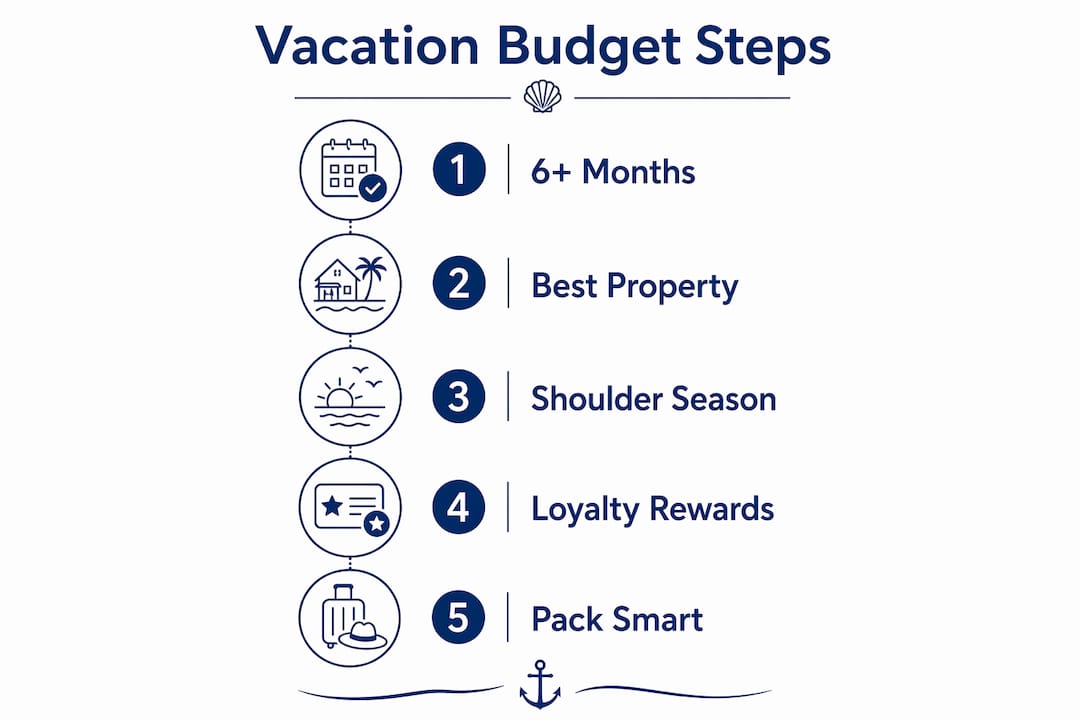
For planning sequence, starting at least six months out gives you the best selection of properties at the best prices, particularly for peak-adjacent shoulder season dates. Eight weeks out, confirm transportation and start building your grocery and activity list. Two weeks out, pack strategically so you are not buying forgotten items at inflated beach-town prices.
Why do luxury beach rentals offer better value than hotels for budget travelers?
The cost structure of a luxury rental works differently than a hotel, and that difference tends to favor families and groups. A hotel charges per room per night, with food, parking, and amenities billed separately. A rental charges per property per night, and the more people sharing that cost, the lower the per-person rate becomes.
Space. A three-bedroom beachfront home gives a family of six room to spread out, cook together, and feel at home. A hotel requires multiple rooms, multiple parking spots, and multiple sets of resort fees.
Kitchen access. The food savings from a full kitchen are real and consistent. Cooking breakfast and lunch at the rental, then going out for one dinner, typically saves families $250–$400 per week compared to eating out for every meal.
Private outdoor space. A screened lanai, a private pool, or a direct beach path are amenities that hotels charge premium rates to approximate. In a rental, they are part of the base package.
Flexibility. Rentals do not have checkout-time pressure for meals or pool access. The space is yours for the duration, which changes the pace of the whole trip.
No resort fees. Many hotels add daily resort fees that cover amenities you may not use. Rentals typically have a one-time cleaning fee, which is easier to evaluate and compare.
Captiva Island’s rental portfolio reflects this philosophy directly. The homes managed by American Realty of Captiva are fully equipped luxury properties with private pools, beachfront locations, and the kind of space that makes a week feel genuinely restorative rather than just busy. For a group or family splitting the cost, the per-person value is difficult to match through any hotel at a comparable location.
What should you pack to avoid extra expenses at a luxury beach rental?
Packing with intention is one of the quieter forms of vacation budgeting. The items you forget at home are the ones you end up buying at a beach-town shop at twice the normal price.
Start with sun protection. Sunscreen, reef-safe formulas in particular, costs noticeably more at beach-adjacent stores than at a regular pharmacy. Pack enough for the full trip, including a dedicated bottle for each person if you are traveling with children. Aloe vera gel and after-sun lotion belong in the same bag.
Beach gear is the second category where packing ahead pays off. A quality beach umbrella, two or three low-profile beach chairs, and a large insulated cooler cover most of what you would otherwise rent or buy on arrival. Snorkel sets, water shoes, and a mesh bag for shells and wet gear are small additions that eliminate daily rental fees at the beach.
For the kitchen, bring a few pantry staples from home: olive oil, spices, coffee, and a couple of your family’s preferred snacks. Most luxury rentals are well-stocked with cookware, but the pantry starts empty. Arriving with basics means your first grocery run stays focused on fresh food rather than rebuilding a kitchen from scratch.
Finally, a small first-aid kit, a portable Bluetooth speaker, and a power strip with USB ports round out the practical side. These are the items that seem unnecessary until the moment you need them, and beach-town convenience stores charge accordingly.
Pro Tip: Make a “forgotten items” list after every trip. The things you bought on arrival last time are the things to pack first next time. Three or four trips in, your packing list becomes nearly perfect.
Key Takeaways
Luxury beach vacations on a real budget come down to a handful of decisions made before you ever leave home. Choose the right destination, time your trip for shoulder season, and build a budget that accounts for every cost layer, not just the nightly rate.
Point | Details |
Travel in shoulder season | Shifting travel dates from peak summer can cut total trip costs by 30–40%. |
Choose kitchen-equipped rentals | Weekly food savings of $250–$400 are realistic for families who cook most meals in a kitchen-equipped rental instead of eating out every meal. |
Budget beyond the nightly rate | Total trip cost is often 40–70% higher than the base lodging rate once fees and transportation are included. |
Book directly with local managers | Direct bookings with property management companies avoid platform service fees and often unlock better rates. |
Captiva Island as your benchmark | Captiva-island’s beachfront homes offer private pools, full kitchens, and Gulf-front access at rates that reward group and family travel. |
Captiva-island brings luxury beach rentals within reach
Thirty years of local expertise on Captiva Island is not something you find on a booking platform. American Realty of Captiva manages a curated collection of beachfront and bayfront homes that give families and groups the space, privacy, and comfort of a luxury property without the overhead of a resort stay.

The homes on Captiva Island’s roster come with private pools, full kitchens, screened lanais, and direct Gulf access. For a group splitting the cost, the per-person rate is often lower than a comparable hotel room, and the experience is quieter, more personal, and genuinely restorative. Direct booking through Captiva Island means no platform service fees and access to seasonal offers that do not appear elsewhere.
Browse the full collection of Captiva Island rentals and check availability for your 2026 dates. The right home, at the right time of year, makes the difference between a vacation that feels rushed and one that actually lets you breathe.
Recommended
soi cầu mb làm mình nhớ mấy trang thống kê số hồi trước mình hay mở lúc rảnh, kiểu vào là thấy họ bày dữ liệu theo ngày cho dễ lướt. Mình vốn không kỳ vọng gì nhiều nên chỉ định nghía qua bố cục thôi (đỡ mất công đọc dài), mà thấy họ ghi mốc 3 9 2026 khá rõ nên khỏi phải đoán “đang nói ngày nào” như nhiều chỗ khác. Nội dung chủ yếu xoay quanh thống kê kết quả quay trước và chốt vài cặp số gợi ý, nhìn gọn gàng nên cuộn một đoạn là nắm ý chính. Mình cũng hơi bật cười vì tiêu đề “Dự đoán XSMB hôm nay” đặt khá nổi, kiểu…