
How Luxury Rental Pricing Is Structured for Smart Travelers


Most travelers look at the nightly rate and think they know what a luxury vacation costs. They don’t. Understanding how luxury rental pricing is structured means looking well beyond that number, because the final bill at checkout regularly runs 50% higher than the advertised rate once cleaning fees, platform service charges, and local taxes are factored in. Whether you’re booking a beachfront home for a family getaway or evaluating a property as an investment, the same pricing architecture applies. Knowing how it works puts you in control of both your budget and your returns.
Table of Contents
Key takeaways
Point | Details |
Base price anchors everything | All dynamic adjustments depend on a correctly set base rate; a wrong anchor makes the whole pricing system fail. |
Fees add up fast | Total luxury rental costs can run 50% above the nightly rate due to cleaning fees, service charges, and local taxes. |
Dynamic pricing raises returns | Properties using dynamic pricing tools see profit margins increase by 12 to 18% compared to static pricing. |
Long-term and short-term differ | Furnished luxury monthly rentals command a 20 to 40% premium over unfurnished long-term rentals, requiring a separate pricing build-up. |
Direct booking saves money | Booking directly avoids platform service fees that can reach 15%, saving roughly $139 on a typical four-night stay. |
How luxury rental pricing is structured at the base level
The nightly rate you see advertised is the starting point, not the full picture. That base price is shaped by a combination of forces that work together to establish what a property is worth in its market.
Location is the single most powerful driver. A beachfront home on a barrier island like Captiva commands a fundamentally different rate than a similar home two miles inland. Exclusivity matters. When access to a destination is limited by geography, the price reflects that scarcity. The Florida vacation rental market has seen this dynamic strengthen consistently, with coastal demand outpacing supply in premium areas year after year.
Beyond location, the physical qualities of the property carry serious weight. Square footage, architectural design, the quality of furnishings, and the presence of premium amenities like private pools, outdoor kitchens, or direct water access all justify rate premiums. A four-bedroom home with a private heated pool and a screened lanai overlooking the Gulf is priced differently from a comparably sized home without those features. Guests paying luxury rates expect every detail to reflect that standard.

Personalized guest services also factor into the base price. Concierge support, professional property management, linen packages, and welcome provisions are not free to provide. When these are included in the rental, they are priced into the base rate rather than listed as separate charges.
Pro Tip: Before you assume a property is overpriced, check what services and amenities are included in the base rate. A rate that looks high may include services that competitors list as add-ons.
Setting the correct base price is the most consequential pricing decision a property manager makes. Every dynamic adjustment made later, including seasonal multipliers and event surcharges, builds on that anchor. Get it wrong at the foundation and every subsequent adjustment is miscalibrated from the start.
Seasonal shifts and dynamic pricing adjustments
Luxury rental rates are not static. They move constantly in response to demand signals, and understanding those movements helps you anticipate what you will pay or earn at any given time of year.
Dynamic pricing works by adjusting rates in real time based on occupancy levels, competitor availability, and market demand. Properties using these tools see profit margins increase 12 to 18% compared to those using fixed rates throughout the year. The logic is straightforward. A property that charges the same rate in January and March on Captiva Island is leaving money on the table during peak season and possibly overpriced during slower periods.
Here is how the main seasonal and demand factors shape rates for luxury rentals:
Peak season premiums. Spring break, summer school holidays, Thanksgiving week, and the weeks between Christmas and New Year’s all push rates to their highest levels. Demand concentrates, supply tightens, and rates reflect that reality.
Shoulder season softening. Weeks before and after peak periods offer good availability at moderately reduced rates. Travelers who book just outside the peak window often access the same premium properties at noticeably better prices.
Local event surcharges. Sporting events, festivals, and major regional gatherings cause short spikes in demand that dynamic pricing tools capture automatically. A beachfront property near a major event can see rates double for a specific weekend.
Last-minute adjustments. If a property has unsold inventory within a few days of an arrival date, dynamic systems often lower rates to fill gaps. Conversely, high demand close to the date pushes rates up.
The goal of dynamic pricing is not to maximize rate. It is to maximize revenue across the full calendar. A property that sits empty at a high rate earns nothing. Smart pricing balances occupancy and rate together.
Luxury rental pricing models that rely on dynamic pricing flexibility need defined guardrails, particularly for properties distributed across multiple booking channels, to protect margins and maintain consistency with B2B partners.
What fees and taxes actually add to your total
This is where many travelers experience genuine sticker shock. The base nightly rate is only the beginning of what you pay.
Fee Type | Typical Range | Notes |
Cleaning fee | $150 to $500+ | Scales with property size; charged per stay |
Platform service fee | 12% to 15% of booking subtotal | Charged by OTAs to guests; not present on direct bookings |
Local occupancy tax | 6% to 13% | Varies by county and state; not negotiable |
Resort or destination fee | $25 to $100/night | Property or community specific; often excluded from listed rate |
A typical four-night booking at a base rate of $200 per night can reach $1,203 total once platform fees, cleaning, and taxes are added. That is more than 50% above what the listing showed. The same math applies at the luxury tier, where cleaning fees alone can exceed $400 for a large beachfront home and platform service fees apply to the entire booking subtotal.
Direct booking sidesteps a meaningful portion of this. Guests who book directly with the property management company avoid the platform service fee entirely, which saves approximately $139 on a four-night stay. For investors, the story is the same in reverse. OTA commissions on the host side typically range from 3% to 20% depending on the platform and agreement, all of which reduces net revenue per booking.
Short-term vs. long-term luxury rental pricing
The pricing structures for short-term vacation rentals and long-term monthly rentals look different because the guest profile, expectations, and cost structure are genuinely different.
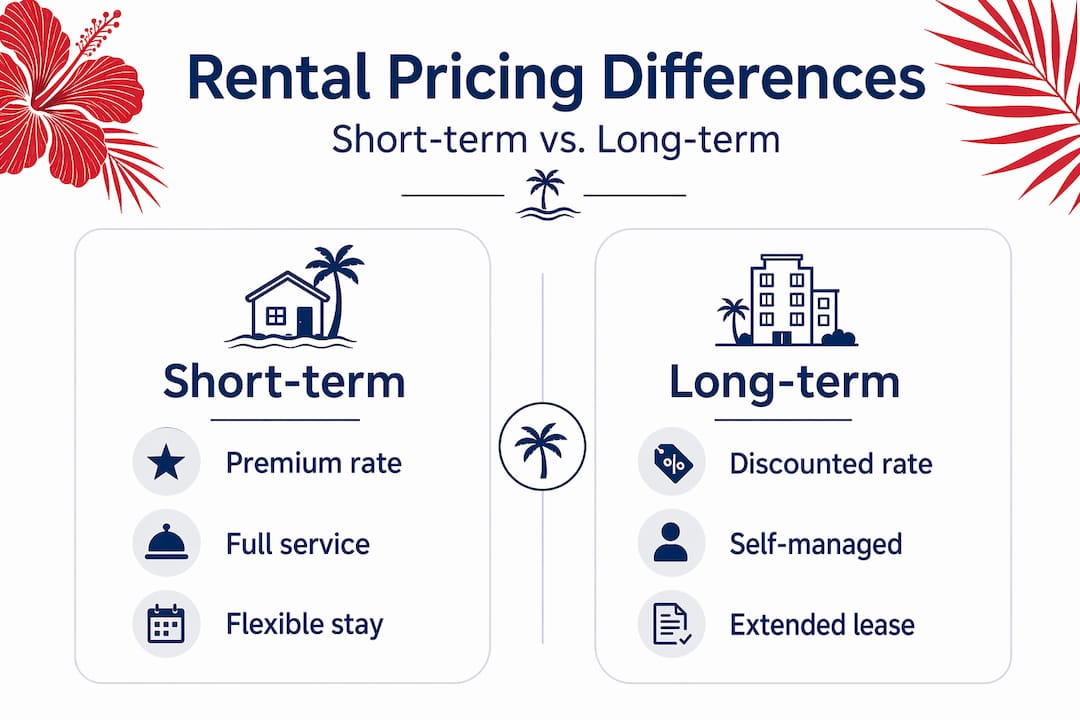
Short-term guests pay a premium for flexibility, full furnishings, and a fully managed experience. They expect linens, kitchen supplies, and a property ready to enjoy from the moment they arrive. That convenience carries a cost, and short-term rates reflect it. A turnkey luxury vacation home includes furniture, appliances, utilities, and management services that a standard unfurnished rental simply does not.
Long-term luxury renters, those staying for a month or more, typically receive a discounted nightly equivalent rate in exchange for the booking certainty they provide. However, well-furnished luxury monthly rentals still command a 20 to 40% premium over comparable unfurnished long-term rentals because the cost of furnishings, utilities, and active management does not disappear.
The common mistake property managers make is applying a discounted short-term rate to build out a long-term rate. These are separate pricing models. Long-term pricing should be built up from the local unfurnished rental market baseline and then adjusted upward to account for the furnished premium, utility inclusion, and turnover management.
Pro Tip: If you are considering a monthly luxury rental, ask what is included before comparing rates. A monthly rate that covers utilities, pool service, and Wi-Fi is often the better value even if the headline number looks higher than a comparable unfurnished option.
High-end vacation rental types vary considerably in how their pricing is structured, and matching the right rental type to the right stay length prevents costly assumptions on both sides.
Practical guidance for travelers and investors
Knowing what influences luxury rental prices is only useful if you act on that knowledge. Here is how both travelers and investors can apply these insights to real decisions.
Calculate total cost before comparing properties. Add the estimated cleaning fee, platform service fee, and local tax rate to any nightly rate before judging whether a property is priced fairly. Two listings at the same nightly rate can have very different checkout totals.
Consider booking direct. When the property management company offers a direct booking option, use it. You avoid the OTA guest service fee, and management teams are often able to offer personalized service that platforms cannot replicate.
Understand RevPAN as an investor metric. Revenue Per Available Night combines your nightly rate with your occupancy rate into a single performance number. A property earning $200 per night at 60% occupancy delivers a $120 RevPAN. The same property priced at $150 at 90% occupancy delivers $135 RevPAN. Higher rates do not always mean higher total revenue.
Use dynamic pricing tools with guardrails. Set a minimum rate that covers your operating costs and a maximum rate that keeps you competitive with similar properties. Let the algorithm work between those limits. Luxury pricing strategies must function as a living architecture, adapting across OTAs, direct channels, and B2B partners without undercutting any of them.
Factor in variable costs at the investor level. Variable cost ratios in high-end rentals can exceed 50% of revenue when you account for homeowner splits, cleaning commissions, and marketing fees. Keeping these costs below 170% relative to gross revenue is a useful threshold for sustainable profitability.
Pro Tip: For travelers, book during shoulder season on premium properties rather than settling for lower-quality properties during peak. You often get a significantly better home at a comparable or lower total price.
What I’ve learned from watching luxury pricing evolve
I’ve spent years watching property managers wrestle with the same tension. They want to maximize revenue, but they’re nervous about setting rates that push guests away. The result is often a base price that was set thoughtfully years ago and never seriously revisited. That is the single most expensive mistake in this business.
What I’ve observed is that dynamic pricing is misunderstood as a tool for raising rates. It is actually a tool for not losing revenue you were already entitled to. Properties with well-configured dynamic pricing don’t just earn more during peak weeks. They hold a reasonable rate during slow periods rather than dropping to rates that don’t reflect the property’s quality.
The other thing travelers rarely factor in is the hospitality dimension of events. When a major event hits a destination, experienced property managers have already set rate floors weeks in advance. Travelers who wait until ten days out wondering why prices spiked are simply watching a well-designed system do its job.
From an investor’s perspective, I’d argue that the gap between properties with professional management and pricing discipline versus those without is wider than most people realize. Same market. Same property quality. Vastly different annual revenue. Pricing is not a one-time decision. It is an ongoing practice.
— Josh
Explore luxury rentals on Captiva Island with transparent pricing

When you understand how luxury rental pricing works, you also appreciate what makes a well-managed property different. At Captiva-island, American Realty of Captiva has spent over 30 years building a rental portfolio that reflects exactly what premium pricing should deliver: honest rates, no hidden surprises, and properties that justify every dollar. From beachfront homes on the Gulf to private pool retreats and bayfront escapes, each property is managed with the same local expertise that only comes from decades of knowing this island.
Booking directly with American Realty of Captiva means no third-party service fees layered onto your total, and it means a team that actually answers the phone when you have a question. Browse the full selection of luxury rentals available on Captiva and let the pricing speak for itself.
FAQ
What makes luxury rental rates higher than standard vacation rentals?
Luxury rental rates reflect the combined value of prime location, premium furnishings, private amenities like pools and direct beach access, and professional management services. All of these factors are priced into the base rate rather than added separately.
How much more will I actually pay beyond the nightly rate?
Total luxury rental costs can run approximately 50% above the advertised nightly rate once cleaning fees, platform service charges around 15%, and local occupancy taxes averaging 12% are included. A $200 per night booking can reach over $1,200 for a four-night stay.
Is it cheaper to book a luxury rental directly instead of through a platform?
Yes. Direct booking avoids the guest service fee charged by OTA platforms, which typically runs 12 to 15% of the booking subtotal. On a four-night luxury rental stay, that savings amounts to approximately $139 compared to booking through a third-party platform.
How does dynamic pricing affect luxury rental rates?
Dynamic pricing adjusts rates in real time based on demand, occupancy levels, competitor availability, and local events. Properties using these tools earn 12 to 18% more than those using static pricing, by capturing peak demand fully while staying competitive during slower periods.
What is the difference between short-term and long-term luxury rental pricing?
Short-term luxury rentals carry higher per-night rates because they include full furnishings, utilities, and professional turnover services. Long-term luxury rentals offer a lower equivalent nightly rate but still command a 20 to 40% premium over unfurnished long-term rentals due to the added services and management involved.
Recommended
Comments