
How Luxury Rental Vetting Protects Travelers in 2026
- Josh Wheeler
- 17 hours ago
- 8 min read


Luxury rental vetting is the process of rigorously verifying properties, hosts, and payment channels to protect travelers from fraud, safety risks, and privacy violations. For anyone booking a high-end vacation home, understanding how luxury rental vetting protects travelers is not optional knowledge. It is the difference between a tranquil, private retreat and a costly, stressful ordeal. Modern vetting draws on identity verification technology, legal due diligence, and on-the-ground property inspections to give you genuine peace of mind before you ever unpack your bags.
What are the key components of luxury rental vetting?
Property vetting in the luxury market covers several distinct layers, and each one addresses a specific risk that a casual booking process would miss entirely.
Identity and host verification is the first line of defense. Automated systems now combine government ID checks with liveness selfie scans, and under 60 seconds this process stops stolen-card bookings before a single entry code is issued. That speed matters because fraud attempts in luxury rentals often target the gap between booking confirmation and key handover.

Property security standards form the second layer. Reputable luxury agencies apply strict acceptance criteria to every property they list. In practice, about 70% of villas inspected by elite agencies are rejected for failing to meet security and privacy benchmarks. The most common failure points are shared access control and perimeter security gaps. That rejection rate tells you something important: most properties on the open market are not held to this standard.
Ownership and legal verification is the third layer, and it is the one most travelers overlook. A 6-point due diligence checklist for high-value international rentals covers title verification, landlord authority, contract review, local tax compliance, and payment safeguards. Skipping any one of these steps on a seven-figure property creates real liability exposure.
Payment security closes the loop. Verified payment channels, including attorney-held escrow accounts, eliminate phantom property scams by releasing funds only when verifiable milestones like key handover are confirmed. This structure is standard practice among sophisticated renters and their legal counsel.
Surveillance disclosure is the final component, and it carries legal weight. Written disclosure of all camera locations is required by law in many regions, and indoor surveillance is illegal and punishable in most jurisdictions. You have the right to request this document before you check in.
Pro Tip: Ask your rental agency for a written surveillance disclosure map before you sign any agreement. Legitimate agencies provide this without hesitation. Hesitation is itself a red flag.
How do luxury vetting standards differ from standard vacation rentals?
The gap between luxury rental vetting and general vacation rental screening is wider than most travelers expect. Understanding what defines a luxury vacation rental helps clarify why the vetting process must also operate at a higher level.
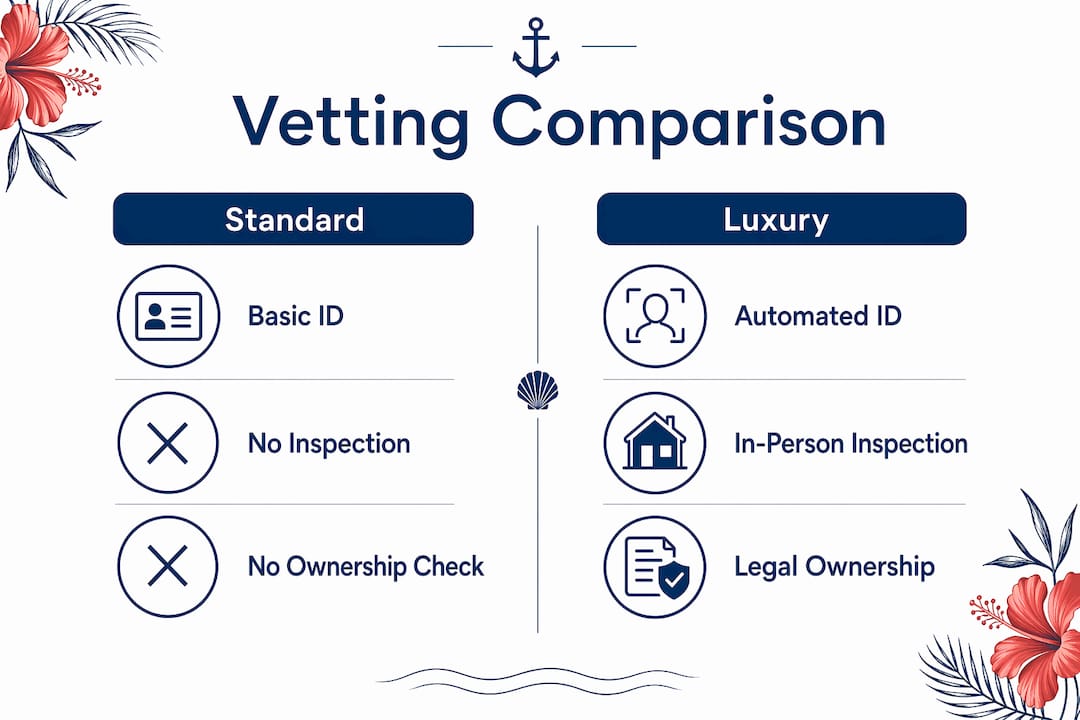
Vetting Area | Standard Vacation Rental | Luxury Rental |
Identity checks | Basic ID or email confirmation | Government ID plus liveness selfie scan |
Property inspection | Self-reported or photo-based | Physical inspection with security audit |
Privacy standards | No formal requirement | No shared access, perimeter controls required |
Payment structure | Full upfront payment | Escrow with milestone-based fund release |
Legal review | Rarely included | Contract review, tax compliance, title check |
Surveillance disclosure | Informal or absent | Written disclosure document required |
The table above shows that luxury vetting is not simply a more thorough version of standard screening. It is a structurally different process. Standard rentals rely heavily on platform reputation and guest reviews. Luxury vetting relies on physical inspections, legal counsel, and verified financial channels.
Local expertise adds a dimension that no online platform can replicate. Physical blind spots like shared entry points, neighboring construction activity, and improperly placed cameras require someone on the ground to identify them. A property can pass every online check and still have a shared garden gate that compromises your privacy entirely.
Pro Tip: When evaluating a luxury rental agency, ask specifically whether they conduct in-person property inspections or rely on owner-submitted documentation. The answer tells you everything about their actual vetting depth.
What practical steps can travelers take to verify a luxury rental is safe?
Knowing that vetting exists is useful. Knowing how to confirm it has actually been done is what protects you. Here are the steps that matter most.
First, request the surveillance disclosure document. This is a written record of every camera on the property, its location, and its purpose. Legitimate surveillance is designed to protect guests, not monitor them. Any agency that cannot produce this document on request has not completed a proper privacy audit.
Second, choose agencies or platforms with documented screening policies. Understanding how to screen a vacation rental management company before you book is one of the most effective steps you can take. Ask for their written vetting criteria and property acceptance rate. An agency that rejects a high percentage of candidate properties is applying real standards.
Third, verify property ownership independently. Ask for the official registry document confirming the landlord’s authority to rent the property. For international rentals, this step is especially critical. A verified ownership check is the single most reliable way to confirm the property is not a phantom listing.
Fourth, use verified payment channels only. Wire transfers to personal accounts are a common vector for luxury rental fraud. Escrow accounts held by a licensed attorney or verified third party release funds only upon confirmed key handover. This structure protects you if the property turns out to be misrepresented.
Fifth, ask about neighborhood-level privacy. A property with perfect perimeter security can still sit next to an active construction site or a shared beach access path. Local blind spots like these are only visible to someone with on-the-ground knowledge of the area. Ask your agency directly whether they have assessed the surrounding environment, not just the property itself.
Sixth, confirm the refund and cancellation policy in writing. A vetted agency will have a clear, documented policy. Vague or verbal assurances about refunds are a warning sign that the booking process lacks the structure that proper vetting requires.
What vetting pitfalls and misconceptions should travelers avoid?
Several common assumptions about luxury rental safety are simply wrong, and they leave travelers more exposed than they realize.
The most widespread misconception is that a large security deposit equals strong protection. Relying solely on deposits without verifying ownership and payment legitimacy is insufficient. A deposit held by a fraudulent host offers no real recourse. The deposit creates the illusion of security without the substance.
A second pitfall is treating platform guarantees as equivalent to comprehensive vetting. Major booking platforms offer dispute resolution and some fraud protection, but they do not conduct physical property inspections, legal title checks, or surveillance audits. Platform protection and property vetting are two separate things. Confusing them is a costly mistake.
Privacy risks from improperly placed surveillance are also underestimated. Travelers often assume that cameras are either obviously present or completely absent. The reality is more nuanced. Cameras placed in outdoor areas near private spaces, or disclosed only in general terms without specific location maps, can still compromise your comfort and privacy. Detailed camera maps are the only reliable standard.
Travel insurance is another area of confusion. Insurance covers financial loss after a problem occurs. Vetting prevents the problem from occurring in the first place. Both have value, but they are not interchangeable. Travelers who rely on insurance as a substitute for due diligence are managing risk after the fact rather than eliminating it at the source.
Pro Tip: Before booking, search the property address in local government records to confirm ownership. This takes less than ten minutes and immediately reveals whether the person renting to you has the legal authority to do so.
Key takeaways
Rigorous luxury rental vetting protects travelers by combining identity verification, physical property inspection, legal ownership checks, and secure payment structures into a single, layered process.
Point | Details |
Identity verification speed | Automated ID and liveness checks stop fraud in under 60 seconds before entry codes are issued. |
Property rejection rates | Elite agencies reject about 70% of candidate villas for failing security and privacy standards. |
Ownership verification | Title checks and landlord authority documents are non-negotiable for high-value rentals. |
Escrow payment structure | Attorney-held escrow releases funds only at verified milestones, eliminating phantom property risk. |
Surveillance disclosure rights | Travelers can and should request a written camera location map before signing any rental agreement. |
Why vetting is the most underrated part of luxury travel planning
I have spent years watching travelers invest enormous care in choosing the right destination, the right season, and the right amenities, and then hand over a significant sum of money based on a handful of photos and a five-star review average. The vetting conversation almost never happens until something goes wrong.
What I find most telling is the two-way nature of screening. Vetting is not just about protecting the traveler from a bad property. It also protects the property owner from guests who would damage or misuse a premium home. When both sides of that equation are verified, the entire rental environment becomes calmer and more reliable. Review scores improve. Disputes drop. The experience feels the way a luxury stay should feel.
The technology side of this has moved quickly. Automated verification tools that once took days now complete in seconds. But technology does not replace local knowledge. I keep coming back to the blind spot problem because it is the one that surprises people most. A property can be legally clean, beautifully photographed, and genuinely owned by the person renting it, and still have a shared access gate that three neighboring families use every morning. No algorithm catches that. Only someone who has walked the property and the surrounding block will know.
For travelers considering a secluded vacation rental, the vetting conversation matters even more. Privacy is the product. If the vetting has not confirmed that privacy is real and not just marketed, you are paying a premium for something that may not exist.
— Josh
Experience the difference that real vetting makes on Captiva Island
Captiva-island, through American Realty of Captiva, has spent over 30 years building a portfolio of luxury beachfront and bayfront homes that meet genuine safety and privacy standards. Every property in the collection is personally known to the local team, which means the blind spots, the neighborhood context, and the security features are verified by people who are on the island year-round, not reviewing a listing from a distance.

If you are ready to book with confidence, browse the full collection of vetted luxury rentals available on Captiva Island. For travelers who prioritize privacy and direct beach access, the beachfront homes offer the kind of seclusion that only a properly inspected property can deliver. American Realty’s team is available to walk you through every detail of the booking process, from ownership confirmation to payment structure, so you arrive knowing exactly what to expect.
FAQ
What is luxury rental vetting?
Luxury rental vetting is the process of verifying a property’s ownership, security standards, surveillance disclosures, and payment channels before a booking is confirmed. It goes well beyond standard platform screening to include physical inspections and legal document review.
Is rental vetting necessary for short stays?
Vetting is necessary regardless of stay length when significant money is involved. Fraud, privacy violations, and misrepresented properties can occur on a three-night booking just as easily as a three-week one.
How do escrow payments protect travelers in luxury rentals?
Attorney-held escrow accounts release funds only upon verified milestones such as confirmed key handover. This structure prevents phantom property scams where payment is collected for a property that does not exist or is not available.
Can I trust platform guarantees instead of vetting?
Platform guarantees cover dispute resolution and some financial protection, but they do not replace physical property inspections, title verification, or surveillance audits. Vetting and platform protection serve different purposes and should both be in place.
What should I ask a luxury rental agency before booking?
Ask for their written property acceptance criteria, a surveillance disclosure document, proof of landlord authority, and confirmation of the payment structure. A reputable agency answers all four questions without hesitation.
Recommended
Comments