
Luxury Rental Security Deposit: What Renters Need to Know


A luxury rental security deposit is a refundable amount held by the property owner to cover potential damages, missing items, or excessive cleaning costs during your stay. Unlike a standard apartment deposit, this hold is scaled to the replacement value of the property’s assets, not simply the nightly rate. Knowing how these deposits work before you sign a contract protects your money and sets clear expectations on both sides. This guide covers what determines the amount, how it differs from other fees, and what to watch for in any luxury lease agreement.
What is a luxury rental security deposit, and how is it calculated?
A luxury rental security deposit is a refundable financial hold, not a fee. The property owner collects it before your stay and returns it after a post-stay inspection confirms the home is in good condition. The industry term for this practice is a “damage deposit” or “security hold,” though “security deposit” is the phrase most renters and property managers use interchangeably.
The amount is based on the replacement value of furnishings and property assets, not the nightly price. A glass-and-steel villa with original artwork and imported stone countertops carries a higher deposit than a beach cottage renting at the same weekly rate. That distinction matters because two properties at the same price point can represent very different financial risk for the owner.

Luxury vacation rental deposits typically range from $1,500 to $50,000 depending on property value and amenities. Smaller luxury homes commonly fall in the $1,500–$3,000 range, while large villas with private pools, boat docks, and curated interiors can require $5,000–$50,000 or 10–20% of the total booking value. That range reflects genuine differences in what it would cost to repair or replace damaged assets.
For long-term luxury leases, the calculation shifts slightly. Security deposits for residential leases generally range from one to three months’ rent, with 24 states placing no legal cap on the amount. That means the market, not the law, sets the ceiling in many locations.
Pro Tip: Ask the property manager to explain exactly what assets the deposit covers. A written breakdown tells you whether the amount is proportional to the actual risk, or simply a round number.
How does a luxury security deposit differ from other fees?
Renters frequently confuse three separate payments: the security deposit, the booking deposit, and the damage waiver. Each works differently, and mixing them up can cost you money.
A security deposit is fully refundable if no damage occurs. A booking deposit is part of the total rental price, credited toward your balance at checkout. It is not held against damage. A damage waiver is a non-refundable fee, typically a flat charge, that the property manager collects to cover minor accidental damage up to a set dollar limit.
Contracts that blur these payments create real risk for renters. When a contract combines a booking deposit and a security deposit into one line item, you may not know how much of your upfront payment is refundable. Reading the contract carefully before signing is the only way to catch this.
The bigger problem is redundancy. Many luxury rentals charge both a non-refundable damage waiver and a refundable security deposit covering the same category of damages. You end up paying twice for the same protection. Experienced renters ask directly: “If I pay a damage waiver, what does the security deposit cover that the waiver does not?”
Here is how to read a rental contract clearly before you commit:
Find every line item labeled “deposit,” “hold,” “waiver,” or “fee” and list them separately.
Confirm which amounts are refundable and which are not.
Check whether the booking deposit is credited toward the rental balance or held separately.
Identify the return timeline for the security deposit and the conditions for deductions.
Ask for clarification in writing if any term is ambiguous.
Pro Tip: If a contract charges both a damage waiver and a security deposit, ask the property manager to explain the specific coverage each one provides. If the answer is vague, that is a signal to negotiate or walk away.
How are luxury rental security deposits held and returned?
The method used to collect your deposit matters as much as the amount. Most luxury rental managers use one of two approaches: a credit card pre-authorization hold or an actual charge to your account.
A pre-authorization hold reserves available credit on your card without withdrawing cash. Credit card holds are preferable to debit card holds because a debit hold freezes real money in your bank account, which may not be released for several business days after checkout. On a $5,000 deposit, that delay has a real impact on your available funds during and after your trip.
Return timelines vary by property and state law. Some states require property managers to provide an itemized list of deductions within 14–60 days of checkout. Others have no mandated timeline, leaving the return schedule entirely to the contract terms. Florida, for example, requires landlords to return deposits or provide written notice of deductions within 15–60 days depending on whether a claim is made.
Common reasons for partial or full deposit deductions include:
Damage to furniture, appliances, or fixtures beyond normal wear
Missing items such as linens, kitchenware, or remote controls
Excessive cleaning costs when the property is left in poor condition
Unauthorized guests or pets that violate the rental agreement
Early departure fees or rule violations specified in the contract
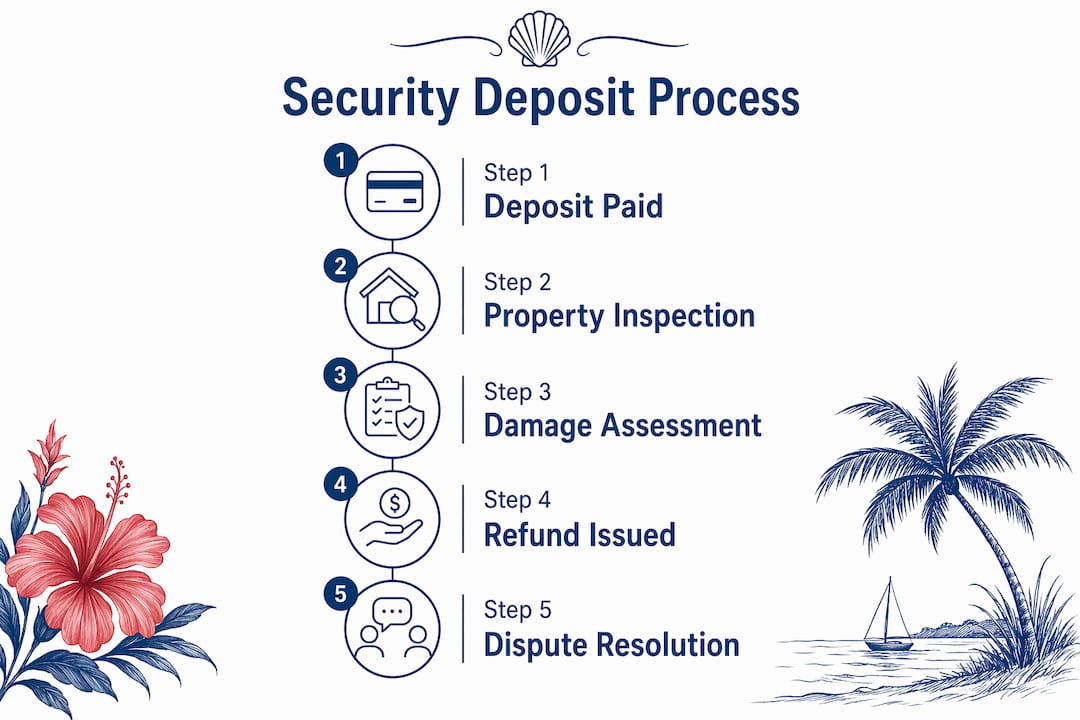
The property inspection after your stay determines whether any deductions apply. Most managers conduct this inspection within 24–48 hours of checkout. Understanding how luxury rental vetting works on both sides helps you prepare for that process and avoid surprises.
Deposit method | Effect on your funds | Typical release timeline |
Credit card pre-auth | Holds available credit only | 3–7 business days after checkout |
Debit card hold | Freezes actual cash | 5–14 business days after checkout |
Direct charge | Cash withdrawn immediately | Refunded after inspection |
Wire transfer | Cash sent and held | Refunded per contract terms |
What should you know before agreeing to a luxury rental deposit?
Reading the contract before you pay anything is the single most protective step you can take. Luxury rental agreements vary widely, and the deposit section is where the most costly misunderstandings happen.
Contracts should explicitly separate the booking deposit from the security deposit so you know exactly what is refundable. If a contract lists one combined “deposit” amount without clarifying which portion is refundable, request a written amendment before signing. This is a standard ask, and any reputable property manager will accommodate it.
Pay or hold your deposit with a credit card whenever possible. Credit card pre-authorizations protect your liquid funds and give you a dispute mechanism if a refund is withheld unfairly. Debit cards offer neither advantage. Understanding how luxury rental pricing is structured helps you see where the deposit fits within the full cost picture.
Document the property condition thoroughly at check-in. Photograph every room, note any existing damage in writing, and send that documentation to the property manager immediately. That record is your primary defense if a deduction is disputed after checkout. A quick walkthrough with the property manager at arrival, when possible, eliminates most disagreements before they start.
Pro Tip: Request a copy of the property’s check-in condition report before your arrival. Many luxury managers maintain one. Comparing it against your own photos gives you a clear baseline for any post-stay disputes.
State law shapes your rights as a renter, even for vacation properties. Many states cap deposits or require itemized deductions within a set number of days. Knowing the rules in the state where you are renting gives you a clear framework for following up if a refund is delayed. Deposits that exceed legal caps or are withheld without itemization are often recoverable through small claims court.
Key Takeaways
A luxury rental security deposit is a refundable hold scaled to property value, not rental price, and understanding its distinctions from damage waivers and booking deposits protects your money before and after your stay.
Point | Details |
Deposit is refundable | A security deposit is returned in full if no damage, missing items, or excessive cleaning costs occur. |
Amount reflects asset value | Deposits range from $1,500 to $50,000 based on furnishings and property value, not nightly rate. |
Damage waivers are separate | A non-refundable damage waiver and a refundable security deposit are two different charges covering similar risks. |
Credit cards protect your funds | Credit card pre-auth holds preserve your cash; debit holds freeze real money for days or weeks. |
State law sets return timelines | Some states require itemized deductions within 14–60 days; know the rules where you are renting. |
What I have learned from watching renters navigate luxury deposit disputes
The most common mistake I see is renters treating the deposit section of a contract as a formality. They focus on the property photos, the amenities list, and the nightly rate. The deposit terms get a quick glance, if that. That approach works fine until something goes wrong, and then it becomes very expensive very fast.
The second mistake is assuming that paying a damage waiver means the security deposit is just a backup. In practice, some contracts use both to cover the same category of damage, which means you are paying for the same protection twice. I have seen guests pay a $500 non-refundable damage waiver and a $3,000 refundable security deposit on the same booking, with no clear explanation of what each one actually covered. That is not a fair structure, and it is negotiable if you ask the right questions before signing.
What I find encouraging about 2026 is that more luxury property managers are moving toward transparent, itemized contracts. The market has pushed them in that direction because informed renters ask better questions. Short-term rental insurance has also matured as a product, which means excessively high deposits are no longer the only tool owners have for managing catastrophic risk. That shift benefits renters because it reduces the pressure to set deposits at levels that feel punitive rather than protective.
My advice is simple. Read the deposit section first, not last. Ask what each payment covers. Use a credit card. Document everything at check-in. Those four steps resolve the vast majority of deposit disputes before they start. A well-run luxury rental should feel like a privilege, not a financial risk. The deposit terms are one of the clearest signals of how a property manager operates.
— Josh
Luxury rentals with clear, fair deposit policies on Captiva Island
Booking a luxury property should feel calm and clear from the first inquiry to the final refund. Captiva-island, operated by American Realty of Captiva with over 30 years of local expertise, lists premium beachfront and bayfront homes with transparent rental terms you can review before you commit.

Every property in the Captiva-island rental portfolio comes with straightforward deposit policies and a team ready to answer your questions directly. Whether you are considering a private pool home or a beachfront retreat, you will know exactly what is refundable, what is not, and when to expect your deposit back. Browse current beachfront vacation rentals or reach out to the American Realty team to discuss the specific deposit terms for any listing.
FAQ
What is a luxury rental security deposit?
A luxury rental security deposit is a refundable hold collected before your stay to cover potential damages, missing items, or excessive cleaning costs. The full amount is returned after a post-stay inspection confirms the property is in good condition.
How much is a security deposit for a luxury vacation rental?
Luxury vacation rental deposits typically range from $1,500 to $50,000, with smaller homes falling in the $1,500–$3,000 range and large villas reaching $5,000–$50,000 or 10–20% of the total booking value.
Is a damage waiver the same as a security deposit?
A damage waiver is a non-refundable fee; a security deposit is refundable. Some luxury rental contracts charge both, so read the contract carefully to confirm what each payment covers and whether any overlap exists.
When will my security deposit be returned?
Return timelines depend on the contract and state law. Some states require itemized deductions within 14–60 days of checkout. Credit card pre-authorization holds typically release within 3–7 business days after the property inspection is complete.
Should I pay a luxury rental deposit with a credit card or debit card?
Pay with a credit card whenever possible. Credit card pre-auth holds reserve available credit without withdrawing cash, while debit card holds freeze real funds that may take one to two weeks to release after checkout.
Recommended
Comments