
Vacation Home Depreciation: What Owners Need to Know
- Josh Wheeler
- 15 hours ago
- 8 min read


Vacation home depreciation is the annual tax deduction that lets you recover the cost of a rental vacation property over its useful life, reducing the taxable income your rental generates each year. The IRS treats this through the Modified Accelerated Cost Recovery System (MACRS), which spreads your property’s cost across a prescribed recovery period for residential rental use. A few fundamentals shape how this works in practice:
Depreciable basis: The portion of your purchase price allocated to the structure (not the land), adjusted for improvements and closing costs.
Useful life: The IRS assigns residential rental property a 27.5-year recovery period under MACRS.
Placed in service: Depreciation begins the day your property is ready and available for rent, not the day you buy it.
Rental portion only: If you also use the home personally, only the rental-use percentage of the basis is depreciable.
Basis reduction: Every dollar of depreciation claimed lowers your property’s cost basis, which matters significantly when you sell.
Depreciation does not eliminate tax liability. It defers it, shifting the cost recovery into annual deductions while building a future recapture obligation.
Table of Contents
How IRS rules on personal use shape your depreciation eligibility
What happens to depreciation when you sell your vacation home
Why profit motive determines how much you can actually deduct
Expert tips for Captiva Island vacation home owners managing depreciation
How to determine the depreciable basis of your vacation home
A worked example for a mixed-use Captiva Island vacation home
What records you need to claim depreciation without problems
How IRS rules on personal use shape your depreciation eligibility
The IRS draws a clear line between a vacation home used as a personal residence and one operated as a genuine rental. If your personal use exceeds 14 days or 10% of the total days rented at fair market price (whichever is greater), the IRS classifies the property as a residence. That classification limits how much of your rental expenses, including depreciation, you can deduct.
Rental-only use: Personal use under the threshold means you report all rental income and claim full expenses, including depreciation.
Mixed use: Personal use above the threshold requires prorating all expenses between rental and personal days.
Maintenance days: Days spent primarily on repairs and upkeep do not count as personal use days, which is a meaningful distinction for active owners.
Fair rental price: Renting to family or friends below market rate counts as personal use, even if you charge something.
Recordkeeping: The IRS expects a contemporaneous log of every day used, by whom, and for what purpose.
Pro Tip: Keep a simple shared calendar, updated in real time, that tags each day as rental, personal, or maintenance. A retroactive log assembled at tax time rarely holds up under IRS scrutiny.
Prorating works straightforwardly. If renters occupy your Captiva Island home for 90 days and you use it personally for 30 days, rental use is 75%. You deduct 75% of allowable expenses, including the depreciation calculated on that same rental-use share.
What happens to depreciation when you sell your vacation home
Selling a vacation rental is where depreciation’s deferred nature becomes very real. Every deduction you claimed (or were entitled to claim) reduces your property’s adjusted cost basis. When you sell, the IRS calculates your gain against that lower basis, not your original purchase price.
Depreciation recapture: The IRS taxes previously claimed depreciation at a maximum rate of 25%, separate from the standard long-term capital gains rate.
Allowable depreciation: The IRS applies allowable depreciation when calculating your gain, whether you actually claimed it or not. Skipping deductions does not protect you from recapture.
Increased taxable gain: A lower adjusted basis means a larger spread between what you paid and what you sold for, increasing the gain subject to tax.
Planning opportunity: Understanding recapture in advance lets you weigh strategies like a 1031 exchange, which can defer both capital gains and recapture taxes.
Depreciation is best understood as a loan from the IRS, not a gift. You get the deduction now; they collect a portion back at sale. Knowing that going in shapes smarter decisions about how long to hold a property and how to plan your exit strategy.
Why profit motive determines how much you can actually deduct
The IRS requires a genuine intent to profit before it allows full rental expense deductions, including depreciation. A vacation home rented casually, with no real effort to maximize occupancy or income, risks being reclassified as a hobby. That classification caps deductions at the amount of rental income earned, eliminating any loss deduction.
Hobby classification: Deductions cannot exceed rental income; losses cannot offset other income.
Passive activity loss rules: Even with profit motive, rental losses are generally passive and can only offset other passive income unless you qualify as a real estate professional.
$25,000 allowance: Owners who actively participate in rental management and have adjusted gross income below $100,000 may deduct up to $25,000 in passive rental losses annually.
Allowable deductions: Mortgage interest, property taxes, insurance, utilities, maintenance, and depreciation all qualify as rental expenses when properly allocated.
Demonstrating profit motive: Consistent marketing, competitive pricing, and documented efforts to increase occupancy all support a profit motive argument.
Pro Tip: Treat your vacation rental like a business from day one. Use a dedicated bank account, track every expense, and document your marketing activity. That paper trail is your best defense if the IRS questions your profit intent.
Reviewing vacation rental income best practices can help you structure your rental operation in a way that satisfies both the IRS and your own financial goals.
Expert tips for Captiva Island vacation home owners managing depreciation
American Realty of Captiva has guided owners through the Captiva Island rental market for over 30 years. That depth of local experience shapes practical advice that goes beyond generic tax guidance.
Separate repairs from improvements: A new roof or kitchen renovation is a capital improvement, added to your basis and depreciated over time. Repainting a room or fixing a leaky faucet is a repair, deductible immediately in the year incurred. Misclassifying one as the other is among the most common and costly errors owners make.
Log maintenance days carefully: Days you spend on the property for upkeep do not count as personal use. Keeping a separate maintenance log, distinct from your personal-use calendar, preserves your rental status and protects your depreciation eligibility.
Understand local rental norms: Captiva Island’s seasonal rental market means occupancy patterns differ from year-round rentals. Knowing peak season rates and realistic occupancy expectations helps you demonstrate profit motive convincingly.
Work with a Florida-familiar tax professional: Vacation home tax rules intersect with Florida’s property tax structure and local rental regulations. A CPA with vacation rental experience in Southwest Florida will catch nuances a generalist might miss.
Review your basis annually: Improvements, insurance settlements, and casualty losses all adjust your depreciable basis. An annual review keeps your depreciation calculation accurate and your records audit-ready.

Captiva-island’s luxury vacation rentals attract discerning travelers who value privacy, premium surroundings, and the calm that comes with a well-managed property. Owners who handle the tax side with the same care tend to hold their properties longer and exit on their own terms.
How straight-line and MACRS depreciation methods compare
Two frameworks matter most for vacation home owners: straight-line depreciation and MACRS. The IRS requires MACRS for residential rental property placed in service after 1986, but understanding straight-line helps clarify the underlying logic.
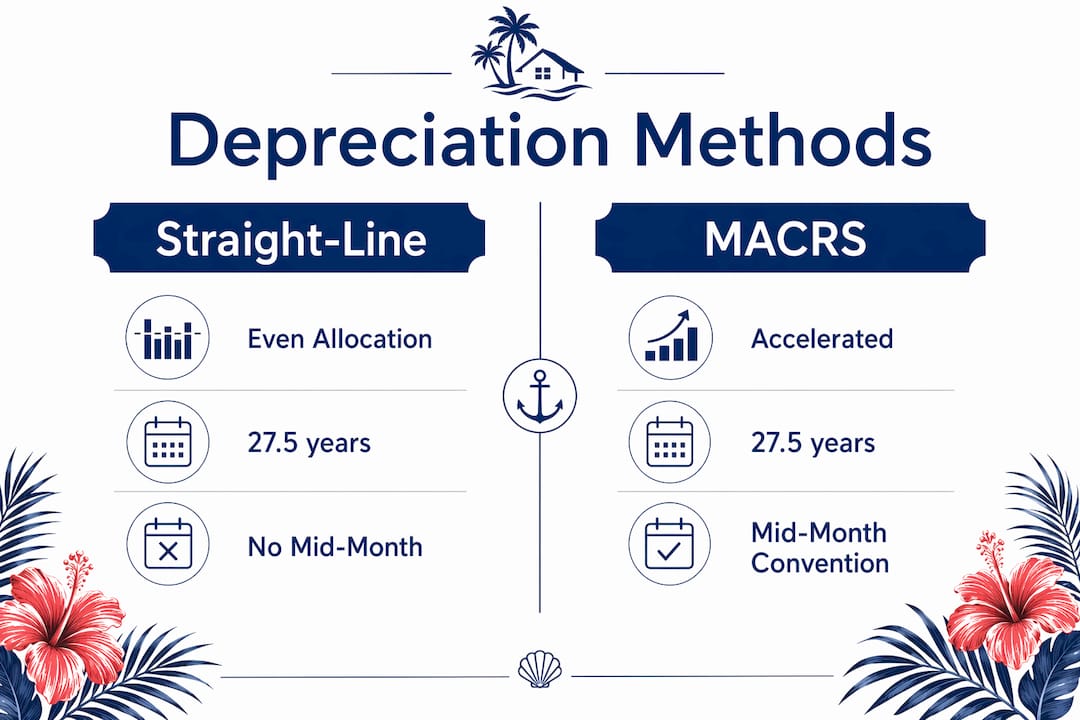
Straight-line depreciation divides the depreciable basis evenly across the asset’s useful life. For a $300,000 depreciable basis over 27.5 years, the annual deduction is roughly $10,909. The math is simple, and the deduction stays constant every year.
MACRS uses the same 27.5-year recovery period for residential rentals but applies a mid-month convention in the first and last years of ownership. This means your first-year deduction is slightly smaller, prorated to the month the property was placed in service. In practice, most vacation home owners find their annual MACRS deduction very close to the straight-line figure, with the mid-month convention being the primary difference.
Land is never depreciable under either method. Only the structure and qualifying improvements count.
How to determine the depreciable basis of your vacation home
Your depreciable basis starts with the purchase price of the property, then adjusts for several factors before you apply any depreciation method.
Start with the allocated value of the structure. Because land cannot be depreciated, you must separate the land value from the building value. County property tax assessments often provide a reasonable allocation, though a formal appraisal gives you a more defensible figure.

Add qualifying closing costs to the basis: title insurance, legal fees, and recording fees paid at purchase. Subtract any seller-paid points or credits you received. Then add the cost of any capital improvements made before placing the property in service.
Finally, if the property has mixed personal and rental use, multiply the total adjusted basis by your rental-use percentage. That figure is your depreciable basis. For second home financing considerations that affect your initial purchase costs, reviewing your loan structure at acquisition can clarify which costs properly enter the basis calculation.
A worked example for a mixed-use Captiva Island vacation home
Say you purchase a Captiva Island vacation home for $800,000. The county assessment allocates 80% of value to the structure, giving you a building value of $640,000. You add $10,000 in qualifying closing costs, bringing your adjusted basis to $650,000.
During the year, you rent the property for 120 days and use it personally for 40 days. Rental use is 75% (120 of 160 total days). Your depreciable basis is $650,000 × 75% = $487,500.
Annual straight-line depreciation: $487,500 ÷ 27.5 = $17,727 per year. In the first year, the mid-month convention reduces this slightly depending on the month you placed the property in service. That annual deduction offsets your rental income directly, reducing the taxable portion of what your Captiva Island property earns each season.
What records you need to claim depreciation without problems
The IRS expects documentation that supports every element of your depreciation claim, and vacation homes face extra scrutiny because of the personal-use rules.
Keep a contemporaneous use log recording each day’s classification: rental, personal, or maintenance. Note the names of renters, rental rates charged, and the purpose of any days you or family members spent on the property. Rental agreements and payment records corroborate your log.
Retain purchase documents including the closing disclosure, appraisal, and any allocation of purchase price between land and structure. Store records of every capital improvement separately from routine maintenance receipts, since the IRS treats them differently. Depreciation schedules filed with your tax returns (IRS Form 4562) should be kept for as long as you own the property plus at least three years after sale, since recapture calculations reach back to the first year of depreciation claimed.
Key Takeaways
Vacation home depreciation reduces taxable rental income annually but creates a recapture obligation at sale, making accurate records and IRS compliance essential from the first year of rental use.
Point | Details |
MACRS governs residential rentals | The IRS requires the 27.5-year MACRS schedule for all residential vacation rental property placed in service after 1986. |
Personal use thresholds matter | Exceeding 14 days or 10% of rental days classifies the home as a residence, limiting deductible rental losses. |
Recapture applies regardless | The IRS applies allowable depreciation to your cost basis at sale whether you claimed the deductions or not. |
Depreciable basis excludes land | Only the structure’s allocated value, plus qualifying improvements and closing costs, enters the depreciation calculation. |
Profit motive is required | Without demonstrated intent to profit, the IRS may classify your rental as a hobby and disallow losses beyond rental income. |
Recommended
Comments