
Why Winter Beach Rentals Are Cheaper: A Clear Guide


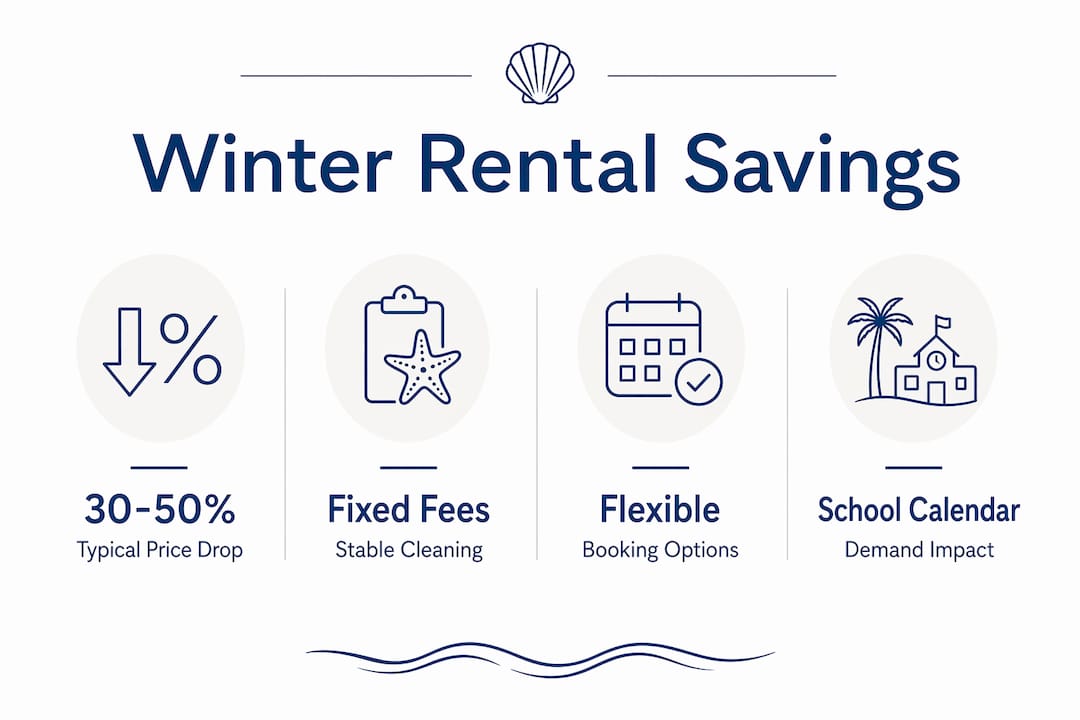
Winter beach rentals are cheaper primarily because demand drops sharply once summer ends, and property owners lower their rates to keep calendars filled rather than sit on empty weeks. The economics are straightforward: fewer travelers searching means less competition for available homes, and that pressure falls directly on price. Rental rates for the same property can vary by up to 60% across the calendar year, with predictable 30% to 50% drops in the off-season months from November through March. For families and individuals who can travel outside the traditional summer window, that gap represents real money saved on a genuinely beautiful experience.
Here is what drives those lower prices:
Seasonal demand falls sharply after Labor Day, removing the competitive pressure that inflates summer rates
Property owners reduce nightly and weekly rates to attract bookings and avoid costly vacancies
Extended winter stays, often called snowbird bookings, unlock additional discounts of 5% to 50% off peak rates
Less competition among renters means more negotiating room and greater booking flexibility
Certain calendar inflection points, like the Tuesday after Labor Day, trigger overnight price resets
Why winter beach rental prices fall: the demand economics explained
Demand is the engine behind seasonal pricing, and winter simply brings far fewer travelers to most coastal markets. When search volume drops, property managers face a clear choice: lower the rate or lose the week entirely. Effective managers adjust rates based on booking pace, local demand signals, and market conditions rather than holding firm on a summer price that no longer fits the season.
The 30%–50% price drops typical of shoulder and off-season periods reflect this dynamic directly, though the maximum variance can reach up to 60% in some cases. A home that commands a premium in july because families are competing for a limited number of desirable weeks simply does not carry that same urgency in january. Owners know it, and the pricing reflects it.
One detail worth understanding: fixed cleaning fees do not drop with the nightly rate. A short two-night winter stay can look affordable at first glance but feel expensive once fees are added. Longer stays spread those fixed costs across more nights, which is why weekly and monthly bookings tend to deliver the clearest savings.
Stay Type | Typical Winter Savings | Notes |
Nightly (short stay) | Modest rate reduction | Fixed cleaning fees reduce apparent savings |
Weekly stay | 30%–50% below peak | Best balance of flexibility and value |
Monthly / snowbird | 19% on average, with discounts ranging from 5% to 50% off peak rates for 28+ nights | Deepest discounts; savings vary depending on property and duration |
The school calendar plays a quiet but powerful role in all of this. As AirDNA economist Bram Gallagher explains, “The school calendar is very important for a lot of vacation planning.” Once kids are back in class, family travel evaporates from most coastal markets, and rates follow. For travelers without school-age children, that timing creates a genuine opening.
Pro Tip: Book a stay of 28 nights or longer during winter and ask directly about snowbird rates. Many owners list a standard nightly price but will apply a monthly discount that does not appear automatically in search results.
Winter availability makes booking easier and more flexible
The winter rental market feels noticeably different from summer, and not just in price. Inventory opens up across the board, minimum stay requirements often shorten, and owners become more willing to negotiate terms they would never consider in july. That flexibility has real value beyond the lower rate.
Last-minute discounts surface roughly 10–21 days before arrival during off-peak periods, as owners would rather fill a week at a reduced rate than leave it empty. This pattern is predictable enough to plan around if your schedule allows it. Summer anchor weeks like the Fourth of July or Memorial Day never behave this way; those book out months in advance at full price and rarely discount.
A few practical advantages of booking in winter:
More properties available across every price point and size
Shorter minimum stay windows, sometimes as few as two or three nights
Greater willingness from owners to accommodate flexible check-in and check-out dates
Midweek nights (monday through thursday) can run 30%–40% below a weekend night for the same property
Sunday-to-Sunday booking often prices below the identical Saturday-to-Saturday week
For families who want a quieter, unhurried experience, this kind of flexibility is part of the appeal. You can take your time choosing, compare a few properties without the anxiety of watching availability disappear, and often find a home that would have been out of reach in peak season. Captiva-island’s off-season rental savings guide covers how to approach this timing well.
What you gain and what you trade away in winter
The price advantage is real, but winter beach rentals come with trade-offs worth thinking through before you book. Knowing them ahead of time helps you choose the right week rather than just the cheapest one.
On the positive side, the experience of a quieter beach is genuinely different. Mornings feel calmer. The water has room to breathe. You are not navigating crowds to find a spot on the sand, and restaurants that are packed solid in august will often seat you without a wait. For many travelers, that atmosphere is the point.
Winter stays do come with compromises, though. Some local restaurants and activity providers close or reduce hours during the off-season. Beach weather can be cooler and less predictable, which affects how much time you actually spend in the water. Daylight hours are shorter, and certain coastal towns feel noticeably quieter in ways that suit some travelers and frustrate others.
The honest summary of winter rental trade-offs:
Gains: lower rates, peaceful beaches, easier reservations, more space and privacy
Gains: booking flexibility and last-minute availability that summer never offers
Trade-offs: some restaurants and shops may be closed or operating on reduced hours
Trade-offs: cooler, less predictable beach weather in most U.S. coastal markets
Trade-offs: fewer local events, shorter days, and a quieter overall atmosphere
If your priority is swimming and a fully active beach town, shoulder season (september and early october) often delivers a better balance. If you want tranquility, privacy, and the lowest possible rate, winter is where those conditions align most naturally.
How regional climate shapes winter rental prices across the U.S.
Not every coastal market behaves the same way in winter, and geography explains most of the difference. AirDNA’s data shows that Northeast and Mid-Atlantic beach towns see the steepest seasonal price swings, with differences of $196 per night between high and low seasons. Cold winters simply eliminate most of the demand that drives summer rates, so prices fall hard and fast.
The Pacific Coast tells a different story. Year-round mild temperatures keep demand steadier, and the price gap between peak and off-season narrows to roughly $42 per night in some markets. Florida occupies its own category entirely. Places like Miami and the Gulf Coast attract northeasterners escaping cold winters, which means demand can actually rise during months that are considered off-season everywhere else.
Region | Seasonal Price Swing | Winter Demand Pattern |
Northeast / Mid-Atlantic | Up to $196/night difference | Sharp drop; coldest months see lowest rates |
Gulf Coast / Florida Panhandle | Moderate to low swing | Winter demand stays strong; snowbird market active |
Pacific Coast | Roughly $42/night difference | Mild year-round climate keeps prices steadier |
South Florida (Miami area) | Can invert typical pattern | Winter rates may exceed summer in some properties |
The Tuesday after Labor Day is one of the clearest illustrations of how quickly the market can shift. A property priced at $700 per night in summer can drop to $380 overnight once the school year begins and family travel stops. That single calendar moment resets the pricing landscape for most of the Eastern Seaboard.
Knowing the key calendar inflection points, like the week after Labor Day, the second week of october, and the first week of december, gives flexible travelers a repeatable way to find the lowest rates of the year.
Captiva Island sits in a particularly interesting position within this regional picture. Its Gulf Coast location and mild winters attract snowbird travelers from november through march, which means the market stays active even as prices soften from summer peaks. For families and couples who want warm days, calm water, and a quieter island pace, that combination is hard to find anywhere else on the East Coast. Captiva-island’s beachfront homes reflect this seasonal rhythm, with winter availability that opens up properties that are simply unavailable in july.
Understanding beach property demand trends helps you read these regional patterns and time your booking to the moment when value and experience align.
Captiva-island has spent over 30 years helping travelers find the right home on Captiva Island at the right time of year. Winter is one of the most rewarding seasons to visit: the Gulf is calm, the island is peaceful, and the rates reflect a market that genuinely rewards travelers who choose to come outside the summer rush.

Browse available winter vacation rentals on Captiva Island and find a home that fits your family, your timeline, and your budget. If you prefer a private pool alongside your beachfront stay, the homes with pools collection is a good place to start.
Key Takeaways
Winter beach rentals are cheaper because seasonal demand drops sharply after summer, forcing owners to lower rates by 30%–50% during off-peak months, though in some cases the variance can reach up to 60%.
Point | Details |
Demand drives pricing | Fewer travelers searching in winter forces rates down to maintain occupancy. |
Price drops reach 30%–50% | The same property typically costs 30% to 50% less in winter than at peak summer rates. In rare cases, savings can reach up to 60%. |
Snowbird discounts add savings | Extended stays of 28+ nights average 19% savings, but can unlock discounts ranging from 5% to 50% off peak rates. |
Regional variation matters | Northeast markets see swings of up to $196/night; Pacific Coast and Florida shift far less. |
Flexibility unlocks the best deals | Last-minute winter bookings and midweek stays can deliver the lowest rates of the year. |
Recommended
Comments