
How Vacation Home Financing Works: A Practical Guide
- Josh Wheeler
- 2 days ago
- 10 min read


Financing a vacation home costs more and demands stronger finances than buying a primary residence. Expect a down payment of 10%–20% or more, a debt-to-income (DTI) ratio at or below 45%, a credit score of at least 640–680, and a mortgage rate running roughly 0.25%–1% higher than what you’d pay on your main home. Government-backed programs through the FHA, VA, and USDA are generally off the table for second homes. Before you start browsing listings, get a lender conversation or preapproval in hand so you know exactly what you can carry.
Down payment: Typically at least about 10%, with higher amounts often required for lower credit or higher DTI
DTI target: Generally expected to be below mid-40% range
Credit score: Minimum around mid-600s; higher scores preferred for conventional financing
Rate premium: Mortgage rates on second homes are generally somewhat above those for primary residences
FHA/VA/USDA: These government-backed loans generally cannot be used for vacation or second homes
Table of Contents
How does vacation home financing work across different loan types?
What does owning a vacation home actually cost beyond the mortgage?
How does renting your vacation home change the financing and tax picture?
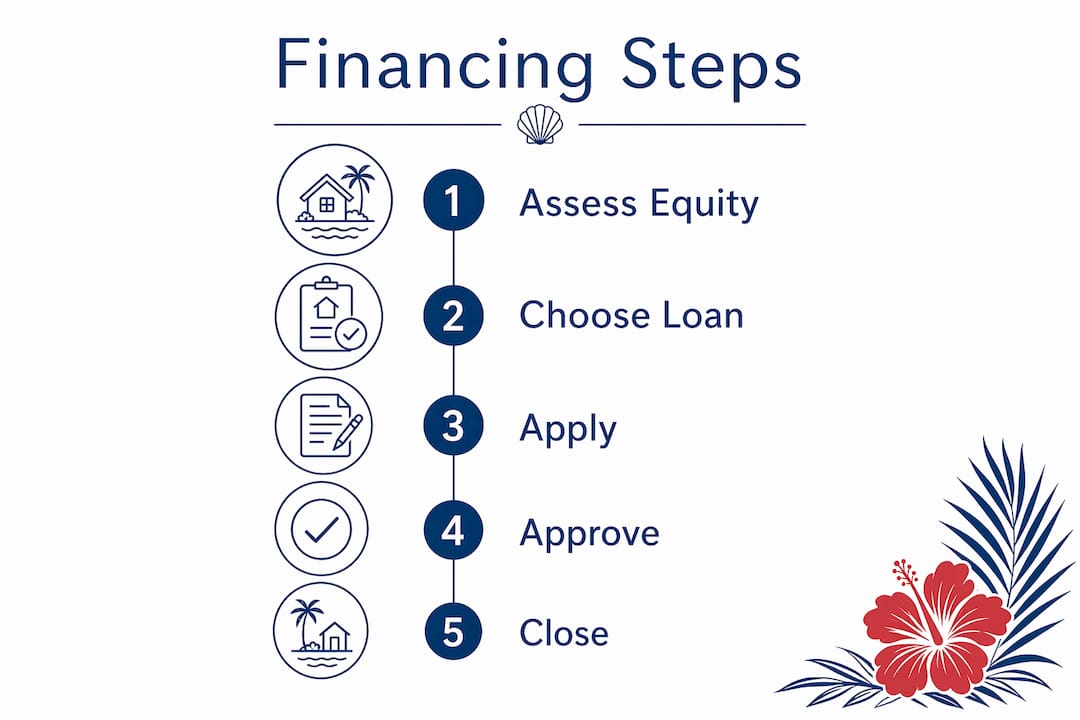
What does the financing timeline look like from start to close?
What mistakes do buyers most often make when financing a vacation home?
Renting on Captiva first is a smarter first step than most buyers realize
How does vacation home financing work across different loan types?
Most buyers have four realistic paths: a conventional second-home mortgage, a home equity line of credit (HELOC), a home equity loan, a cash-out refinance, or investment-property financing. Each carries different costs, risks, and qualification hurdles.

Financing path | Down payment | Rate level | Risk to primary home | Rental income to qualify |
Conventional second-home mortgage | 10%–20%+ | Slightly above primary | None | No |
HELOC | Varies (equity-based) | Variable; often lower | Yes | No |
Home equity loan | Varies (equity-based) | Fixed; competitive | Yes | No |
Cash-out refinance | Equity-based | Depends on current rate | Yes | No |
Investment-property mortgage | 20%–25%+ | Highest | None | Yes (75% of projected rent) |
A conventional second-home mortgage is the most common route. Lenders typically require a down payment starting around 10%, a DTI below about 45%, and a FICO score in the mid-600s or higher. Rates are generally somewhat higher than primary-residence loans, but lower than investment-property rates. You cannot use projected rental income to qualify.
HELOC and home equity loan options let buyers with substantial primary-home equity borrow against that equity at primary-residence terms, avoiding the steeper second-home rate premiums entirely. The trade-off is real: you’re pledging the home your family lives in. Closing costs on these products generally represent a few percent of the loan amount.
A cash-out refinance restructures your existing primary mortgage and pulls equity out as cash. It makes sense when current rates are favorable, but if you locked in a low rate years ago, restarting at today’s rates can cost more than a separate second-home mortgage.
Investment-property financing applies when you plan to rent the home full-time or when lenders determine the property doesn’t meet second-home occupancy rules. Rates are typically 0.5% or more above primary-residence rates, and down payments of 20%–25% are standard.
Two quick scenarios. A young family buying a Gulf Coast beach getaway with strong income but limited equity usually does best with a conventional second-home mortgage: clean qualification, no risk to their primary home, and a predictable fixed payment. A retired couple with $400,000 in equity on a paid-down primary home might prefer a HELOC or home equity loan, borrowing at primary-residence terms and paying cash for the vacation property outright.
Sample payment illustration: On a typical vacation home with a 20% down payment, a 30-year fixed second-home mortgage at a rate modestly above a comparable primary loan adds a moderate amount to the monthly interest cost over the life of the loan compared to primary-residence financing on the same amount.
What do lenders actually check before approving you?
Lenders apply stricter standards for second homes than for primary residences, and they will verify occupancy intent. The core benchmarks from Fannie Mae’s underwriting guidelines are clear: DTI at or below 45%, a minimum FICO of 640 (680+ preferred), and a down payment of at least 10%.
Cash reserves matter just as much as credit. Lenders count reserves in months of PITI (principal, interest, taxes, and insurance) covering both your primary residence and the new property. Well-qualified wage earners typically need two months of reserves; self-employed borrowers or those with weaker profiles may need 3–6 months.
Documents to prepare:
Two years of federal tax returns and W-2s
Recent pay stubs (30 days)
Bank and asset statements (two months minimum)
Proof of primary residence ownership or lease
Profit-and-loss statements if self-employed
Rental agreements, if applicable
Pro Tip: Lenders will ask directly about your intended use of the property. Claiming a home as a second residence when you plan to rent it full-time is occupancy fraud, a serious legal risk that can trigger loan acceleration or federal penalties. Be straightforward with your lender from the start.
What does owning a vacation home actually cost beyond the mortgage?
Ownership costs often add 20%–40% or more on top of your mortgage payment, particularly for beachfront properties where insurance, maintenance, and management fees run higher than inland homes.
Cost category | Typical annual estimate |
Homeowners insurance (standard) | Often around 1%–2% of property value |
Flood/hurricane insurance (coastal) | Can be several thousand dollars depending on zone |
Property management fees | Often about 20%–35% of gross rental revenue |
Maintenance reserve | Recommended at approximately 1%–2% of property value annually |
HOA fees (if applicable) | Can range from low to several thousand dollars annually |
Utilities (seasonal) | Can vary broadly depending on usage and location |
Beachfront properties on barrier islands like Captiva carry additional exposure. Flood policies are typically separate from standard homeowners coverage, and hurricane-zone premiums reflect real seasonal risk. Get local insurance quotes early, before you’re under contract, so the numbers don’t surprise you at closing.
Pro Tip: Set a maintenance reserve of at least 1% of the property’s value annually. For a $600,000 beachfront home, that’s $6,000 per year held aside for repairs, appliances, and seasonal wear. A local property manager who checks in regularly can also reduce vacancy, catch maintenance issues early, and keep the home in rental-ready condition year-round.
Beachfront and bayfront homes on Captiva Island, like those listed at Captiva-island’s beachfront inventory, illustrate why insurance and management costs deserve a line item in your budget before you fall in love with a property.
How does renting your vacation home change the financing and tax picture?
Occasional rentals are generally permitted under second-home mortgage rules, but frequent rentals or a formal property management arrangement often push the property into investment-property territory, with higher rates and stricter underwriting.
Key distinctions to understand:
Second home: You occupy the property for a portion of the year; rental income cannot be used to qualify for the mortgage.
Investment property: Primarily rented; lenders count 75% of projected rental income toward qualification but require 20%–25% down and charge higher rates.
IRS 14-day rule: If you rent the home for more than 14 days or 10% of the days it’s rented (whichever is greater), the IRS treats it as a rental property for tax purposes, opening up depreciation and expense deductions but changing how mortgage interest is deducted.
SALT cap: Property taxes on a vacation home are deductible, but the combined state and local tax (SALT) deduction is capped at $40,400 for 2026 ($20,200 if married filing separately). If your primary home’s taxes already hit the SALT deduction cap, the vacation home’s taxes might not provide additional federal tax benefit.
Consult a CPA before assuming rental income will help you qualify or that the tax math works in your favor. The interaction between occupancy rules, IRS classifications, and lender guidelines is specific to your situation.
What does the financing timeline look like from start to close?
A typical vacation home purchase runs 30–90+ days from accepted offer to closing, and appraisals in resort markets often stretch that window because comparable sales can be sparse.
Affordability check (Week 1): Run the numbers on both mortgages, reserves, and ongoing costs before approaching a lender.
Lender preapproval (Weeks 1–2): Gather tax returns, pay stubs, and asset statements. Preapproval strengthens your offer and surfaces any qualification gaps early.
Property search and offer (Weeks 2–6): With preapproval in hand, search with a clear budget ceiling.
Inspection and appraisal (Weeks 3–7): Waterfront and resort properties can take longer to appraise; budget extra time.
Underwriting (Weeks 5–9): Lender verifies income, reserves, occupancy intent, and conforming-loan compliance.
Clear to close and closing (Weeks 8–12+): Sign the promissory note and deed of trust; funds wire to escrow.
First 90 days after closing:
Bind homeowners, flood, and any specialty insurance before the keys change hands
Register with the HOA if applicable
Set up utilities and a seasonal maintenance schedule
If planning short-term rentals, list the property and vet local management companies
Document your personal occupancy from day one
When does using your primary home’s equity make more sense?
Home equity options often make sense for buyers with substantial equity who want to sidestep a separate second-home mortgage and its associated rate premiums. The math is straightforward: 80% of your home’s appraised value minus the remaining mortgage balance equals your accessible equity. A home worth $500,000 with a $250,000 balance gives you up to $150,000 to work with.
HELOC: Flexible draw structure; useful when costs are uncertain or phased. Variable rate is the main risk.
Home equity loan: Fixed rate, lump sum, predictable payoff. Less flexible but easier to budget.
Cash-out refinance: Restructures your primary mortgage entirely. Makes sense if you can improve your current rate; a poor choice if you’re sitting on a low rate from prior years.
Pro Tip: Using equity from your primary home means borrowing at primary-residence terms, which avoids the second-home rate premium. But you’re increasing the debt secured by the home you live in. If rental income on the vacation property dries up, both properties are at risk. That’s a meaningful trade-off, not a technicality.
A buyer with strong equity and fixed retirement income often benefits from a HELOC or home equity loan. A buyer with limited equity but strong W-2 income usually does better with a conventional second-home mortgage. For a broader look at how equity financing fits into the holiday home decision, this guide to choosing holiday homes covers the trade-offs well.
What mistakes do buyers most often make when financing a vacation home?
The costliest errors tend to cluster around three areas: underestimating total carrying costs, misrepresenting occupancy, and over-relying on projected rental income.
Occupancy fraud: Claiming a rental-focused property as a second home to get better terms is a federal-level risk. Lenders and Fannie Mae actively distinguish the two, and misrepresentation can trigger loan acceleration or prosecution.
Optimistic rental projections: Rental income cannot be used to qualify for a second-home mortgage. Even for investment properties, lenders count only 75% of projected rent, and vacancy, management fees, and off-season gaps routinely cut actual income well below projections.
Underinsuring coastal properties: Standard homeowners policies often exclude flood damage. On a barrier island, a separate flood policy isn’t optional.
Ignoring reserve requirements: Arriving at underwriting without two to six months of PITI reserves is one of the most common reasons second-home applications stall.
Skipping local management vetting: A property left unmanaged between visits accumulates deferred maintenance fast, especially in humid, salt-air environments.
Financing choices also affect your broader credit picture. A second mortgage raises your total debt load, which can affect future borrowing capacity. Keep that in mind if other major purchases are on the horizon.
Key Takeaways
Second-home financing requires a larger down payment, stricter credit standards, and higher rates than a primary mortgage, with total ownership costs often running 20%–40% above the mortgage payment alone.
Point | Details |
Down payment and credit | Expect 10%–20%+ down and a minimum FICO of 640–680 for conventional second-home financing. |
Rate premium | Second-home mortgage rates typically run 0.25%–1% above primary-residence rates. |
Reserves matter | Lenders require 2–6 months of PITI reserves covering both properties; self-employed buyers often need the higher end. |
Ownership costs | Budget 1%–2% of property value annually for maintenance, plus separate flood insurance for coastal homes. |
Captiva-island rental option | Renting through Captiva-island before buying lets you test real seasonal costs and occupancy before committing to a mortgage. |
A local perspective on what the numbers don’t tell you
There’s a version of this decision that looks clean on a spreadsheet and a version that plays out on the ground, and they’re rarely the same thing. Buyers often focus on the mortgage rate premium and the down payment, which are real costs, but the numbers that actually determine whether a vacation home feels like a reward or a burden are the ones that come after closing: the flood policy renewal, the management fee in a slow rental month, the HVAC replacement that can’t wait until spring.
On Captiva Island specifically, the coastal environment accelerates wear on everything from appliances to exterior finishes. Salt air is relentless. A maintenance reserve of 1% of property value is a floor, not a ceiling, for beachfront homes. And the insurance picture has shifted meaningfully in recent years; buyers who get quotes early in the process are rarely surprised at closing, while those who wait often are.
What I find most buyers underestimate is the value of local knowledge in the first year of ownership. Knowing which management companies actually show up, which contractors are reliable in the off-season, and what the realistic rental calendar looks like for a given property type makes a material difference in whether the investment performs. That’s not something a national lender or a rate comparison tool can tell you.
Renting on Captiva first is a smarter first step than most buyers realize
If you’re drawn to Captiva Island but not yet certain about buying, renting a luxury home here before committing to a mortgage is one of the most practical things you can do. You’ll experience the actual seasonal rhythm, understand what management and upkeep look like from the inside, and get a real feel for whether the lifestyle matches the investment.

Captiva-island’s rental inventory includes beachfront homes, bayfront retreats, and pool-equipped properties across the island, managed by American Realty of Captiva with over 30 years of local expertise. Spending a season here gives you concrete data on occupancy, utility costs, and what guests actually want, information that’s worth far more than any projected rental income spreadsheet when you’re sitting across from a lender. Browse the full Captiva-island rental collection and let the island make the case for itself.
Useful sources and further reading
The following U.S.-based sources underpin the key policy facts and numeric benchmarks in this guide:
Fannie Mae — Eligibility and underwriting guidance: Conforming loan rules for second homes, DTI limits, credit score minimums, and reserve requirements.
USDA Rural Development — Single-Family Housing Programs: Confirms government-backed loan restrictions to primary residences.
Experian — Mortgage rate differentials: Rate premium data for second-home vs. primary-residence mortgages.
Bankrate — Current second home mortgage rates: Live rate tracking and commentary on the persistent second-home premium.
Bankrate — How to buy a vacation home: Ownership cost guidance including insurance, management, and maintenance.
Rocket Mortgage — Buying a second home: Equity-based financing options and trade-offs.
Chase — Buying a second home: Property-type rules and occupancy verification guidance.
Nolo — Mortgage occupancy and fraud: Legal context on occupancy misrepresentation risks.
This article is general information, not legal, tax, or financial advice. Confirm current rules and rates with a licensed lender and a CPA for your specific situation.
Recommended
Comments