
Why Summer Beach Rentals Book Fast: 2026 Guide


Summer beach rental demand is defined by a structural imbalance: far more travelers want prime coastal weeks than the available inventory can satisfy. This is why summer beach rentals book fast, and the pattern is accelerating in 2026. Beachfront homes on Captiva Island, Florida, Cape Cod, and Ocean City are filling months before the first warm weekend arrives. Understanding the forces behind this compression — limited supply, group coordination needs, minimum-stay rules, and location desirability — gives you a real advantage when planning your summer escape.
Why summer beach rentals book fast: the core drivers
The most direct reason beach rentals fill up quickly is that prime coastal inventory is finite while demand grows every year. Beachfront and walkable rentals book the fastest in coastal markets, because travelers treat proximity to the water as non-negotiable. When a property sits steps from the Gulf or overlooks the Atlantic, it does not stay available long once the calendar turns to January.
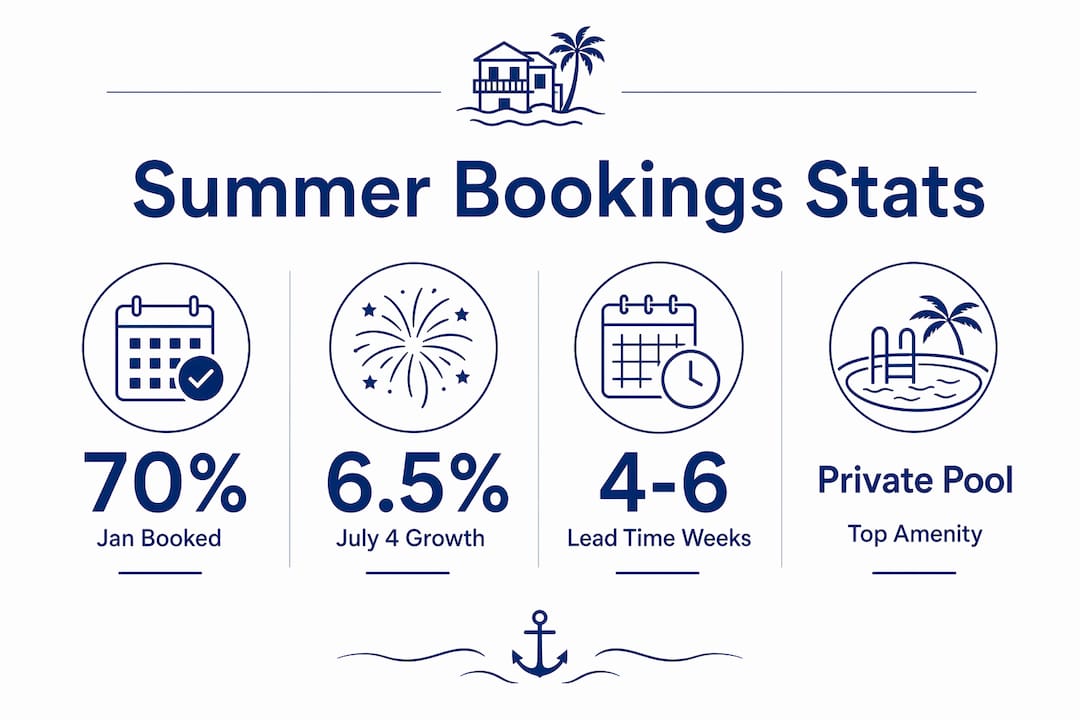
The numbers confirm the urgency. By January, 70% of summer weeks are already over 50% booked for popular destinations like Cape Cod. That means if you wait until spring to start looking, you are already choosing from the remainder. The best weeks and the best homes are gone before most people have even started browsing.

Occupancy during July 4th is pacing 6.5% ahead of last year, which signals that peak summer demand is not softening. Travelers are not just booking earlier. They are competing harder for the same limited pool of premium properties. That competitive pressure is what turns a relaxed search into a race.
What property types and features influence booking speed?
Large, multi-family beach homes with private pools, direct beach access, and outdoor living spaces are the first to disappear from availability calendars. These properties serve groups of two or three families traveling together, and coordinating that many schedules requires locking in dates far in advance. Large, multi-family beach homes with premium features tend to book earlier than condos, because the stakes of losing a specific property are higher when eight or ten people have already aligned their vacation weeks.
Condos and smaller units follow a different pattern. They attract couples and small families who have more scheduling flexibility, so they tend to book closer to the arrival date. This does not mean they are easy to find last minute, but the booking window is generally shorter than for large homes. If you are traveling with just your immediate family, you have a bit more breathing room, though not as much as you might expect during peak summer.
Premium amenities compound the speed at which a property books. A home with a private pool, a screened lanai, and direct Gulf access is not competing with the average rental. It is competing in a category where demand consistently outpaces supply. Minimum-stay restrictions of seven to thirty days reduce last-minute flexibility and cause faster sell-through for these high-demand properties. When a single booking consumes an entire week or more of calendar space, availability cliffs appear quickly and the window for securing your preferred dates narrows fast.
Pro Tip: If you are targeting a home with a private pool or direct beachfront access, treat your search like a reservation at a sought-after restaurant. The best tables go to those who call first, not those who show up hoping for a cancellation.
The advantages of summer beach stays in a private home over a hotel are well documented, and travelers increasingly recognize this. Space, privacy, a full kitchen, and the ability to set your own pace are reasons families return to rental homes year after year. That loyalty also means repeat guests often rebook before a property even lists publicly for the following season.
How does traveler behavior and planning impact early bookings?
Traveler planning windows are getting longer, not shorter. The average booking window for summer 2026 is 134.2 days, up from 131.5 days in 2025. That is a 2.7% increase, which translates to travelers locking in reservations roughly four and a half months before their arrival. For a July trip, that means booking in February or early March.
Several behavioral forces drive this shift.
Group coordination is the biggest accelerant. Multiple families aligning calendars months ahead creates clusters of early bookings for the most desirable properties. When three families need to agree on the same week, the process starts in the fall or winter preceding the summer trip.
Rate security motivates early action. Properties priced correctly early in the season fill faster, while late-listed homes discount heavily to compete. Booked ADR runs 16 to 37% above available ADR in key beach markets for summer 2026. Booking early is not just about availability. It is about paying the rate you want rather than the rate that remains.
Peace of mind is a real motivator. Travelers who secure a rental in January or February spend the following months looking forward to their trip rather than anxiously refreshing availability calendars. That psychological comfort has real value, and experienced beach vacationers understand it well.
Repeat guests rebook first. Many rental platforms and property managers offer returning guests early access or priority booking windows. If you stayed somewhere last summer and loved it, you likely had the option to rebook before it opened to the public. First-time visitors are always competing against this invisible layer of demand.
Understanding these behavioral patterns helps you see that the tips for booking beach houses are not arbitrary. They reflect how the market actually moves. Booking early is not overcautious. It is the standard practice of anyone who has tried to find a great beach home in July and come up empty.
How do location and market supply/demand dynamics affect booking pace?
Location is the single most powerful predictor of how fast a rental books. Premium beach markets like Cape Cod and Ocean City show significantly faster booking pace and higher rates than budget or oversupplied markets. This gap is widening in 2026, as travelers with the means to choose premium destinations continue to prioritize quality over cost savings.
The table below illustrates how market type and location characteristics shape booking pace.
Market type | Booking pace | Key driver |
Beachfront premium (e.g., Captiva Island, Cape Cod) | Very fast, often 4 to 6 months out | Limited inventory, high desirability, repeat guests |
Walkable coastal towns | Fast, 3 to 5 months out | Convenience, dining and activity access |
Secondary beach markets | Moderate, 6 to 10 weeks out | More supply, less brand recognition |
Oversupplied or inland markets | Slow, often last minute | Excess inventory absorbs demand |
Captiva Island sits firmly in the first category. The island’s geography limits how many properties can ever exist there, and that constraint is permanent. Florida’s vacation rental market remains strong precisely because destinations like Captiva offer something that cannot be replicated elsewhere: a specific combination of tranquility, natural beauty, and privacy that travelers return to year after year.
Supply growth in some markets has created pockets of slower booking, particularly where new construction has added inventory faster than demand has grown. But in geographically constrained premium locations, supply cannot expand to meet demand. That structural scarcity is what keeps booking windows long and competition high.
Booking timelines by property type: what the data shows
The comparison below captures how different property types and market positions translate into real booking timelines for summer 2026.
Property type | Typical booking lead time | Notes |
Large beachfront home, 5+ bedrooms | 4 to 6 months | Group coordination and minimum-stay rules accelerate bookings |
Mid-size home with pool, 3 to 4 bedrooms | 3 to 4 months | Premium amenities drive early demand |
Condo or smaller unit | 6 to 10 weeks | More flexible, but peak weeks still go fast |
Secondary market rental | 4 to 6 weeks | More availability, less urgency |
The gap between large beachfront homes and condos is not just about size. It reflects the coordination complexity that comes with group travel. When you are booking a luxury beachfront rental for multiple families, the cost of losing your preferred property is measured in months of replanning and disappointed expectations.
Recent data from 2026 beach markets reinforces the pattern. Booking-window compression and minimum-stay rules mean that single large bookings consume more calendar days, creating availability cliffs and faster sell-through of prime weeks. Once a seven-night minimum-stay block is claimed, that entire week disappears from the calendar. There is no partial availability to fall back on.
Pro Tip: Check 2026 rental trends on Captiva before you start your search. Knowing which weeks are already heavily booked helps you target realistic dates rather than chasing availability that no longer exists.
What I have learned about booking beach rentals early
The data tells one story, but years of watching travelers navigate this market tells another. The guests who feel most relaxed on Captiva are almost always the ones who booked in January or February. They arrived knowing exactly what to expect, with no anxiety about whether they got the right home. The guests who waited until April or May often settled for something that was fine but not what they had imagined.
The most common mistake I see is treating a beach rental search like a hotel search. Hotels hold rooms. They have cancellation policies designed for flexibility. Vacation rentals, especially premium beachfront homes, operate on a different logic entirely. The best properties are claimed by people who understand that waiting is a choice to accept whatever remains.
There is also a pricing reality that rarely gets discussed openly. The homes that are still available in May are often available for a reason. Either the dates are less desirable, the property has a limitation that experienced renters spotted early, or the price has been reduced to attract late bookings. Booking early does not just secure your preferred property. It gives you access to the full range of options before the market has sorted itself.
My honest advice: decide on your destination and your travel week before the year ends. Then book in January. You will spend the next six months looking forward to your trip instead of worrying about it.
— Josh
Secure your Captiva Island rental before the best weeks are gone
Captiva Island is one of the most sought-after beach destinations in Florida, and the homes here reflect that. American Realty of Captiva manages a collection of beachfront vacation rentals and group-friendly homes that book well ahead of summer. If you are planning a family trip or a multi-family getaway, the time to look is now.
Browse the full selection of available Captiva rentals to find homes with private pools, Gulf-front access, and the kind of privacy that makes a week feel like a full reset. Captiva-island also features homes with private pools for families who want that extra layer of comfort and seclusion. With over 30 years of local expertise, American Realty of Captiva helps you find the right home and secure it before someone else does.
FAQ
Why do beach rentals fill up so quickly in summer?
Summer beach rentals fill fast because prime coastal inventory is limited while demand grows each year. Beachfront and walkable properties book fastest, and group coordination needs push large-home reservations months ahead of the season.
How early should you book a summer beach house?
The average booking window for summer 2026 is 134.2 days, meaning most travelers reserve their rental roughly four to five months before arrival. For large beachfront homes, booking four to six months out is the norm.
Do minimum-stay rules affect how fast rentals book?
Minimum-stay requirements of seven to thirty days reduce last-minute options and accelerate sell-through for premium properties. When a single booking claims an entire week, that availability disappears from the calendar immediately.
Are beachfront rentals more expensive if you book late?
Properties priced correctly early in the season fill at full rates, while late-listed homes discount to compete. Booked ADR runs 16 to 37% above available ADR in key beach markets, meaning early bookers pay less than late ones in many cases.
What types of beach rentals book the fastest?
Large, multi-family homes with premium features like private pools and direct beach access book earliest. Condos and smaller units follow a shorter booking window but still sell out during peak summer weeks at popular destinations.
Recommended
As a student i found this guide kind of helpful because it explain why those summer beach rentals get snapped up so quickly, and also why you really have to plan ahead. Early reservations usually give more choices, and the prices tend to be better too. Like book publishing Australia, it felt like good preparation and right timing can make a real difference in getting successful results.